
Francesca Gambin and Roberta Ruggeri
AIPO Economic Office
At the beginning of November, the drop in wholesale prices of Italian extra virgin olive oil shook the market and posed a fundamental question to large-scale retail trade (GDO): “Now that oil is cheaper, to what extent will consumers increase their purchases?”
This question is at the heart of the economic concept of “elasticity of demand”, the “thermometer” that measures consumer sensitivity which, in the face of a drop in price, can cause a greater increase in sales volumes.
However, if we look closely, in the world of olive oil this sensitivity is not the same for everyone. Consumer response depends on the perceived value of the product, whether olive oil is considered a simple ingredient for cooking or seasoning, or an “identity product” and essential to savor.
The rigid question: the identity consumer
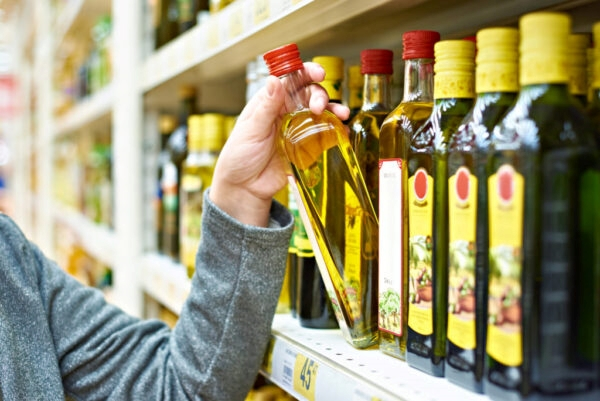
 The high-end 100% Italian extra virgin olive oil, which in the mill or on the shelf costs more than 12 euros/litre and goes up to 18-19 euros, has a “rigid question” (or inelastic). The quantity sold varies little as the price changesBecause those who buy it do so for the taste, health benefits, and traceability. For this “rigid” clientele, price matters, but it’s not the deciding factor; they rarely switch brands or increase volumes simply because of a discount.
If the price drops too quickly, for example to €10-13/litre, the “rigid” consumer might not only not increase their purchases, but might perceive the drop as a loss of value, almost a sign of lower quality or reduced differentiation.
Elastic demand: the price-sensitive consumer
 The main beneficiary of the discount is the consumer with “elastic demand”, which will likely increase purchases.
This “elastic” segment usually acquires extra virgin olive oil from €5 to €8/litre, often obtained from blends of EU and non-EU oils. Now, for the same price or a little more, you can afford a product perceived as superior, like a 100% Italian Extra Virgin.
Convenience in large-scale retail trade
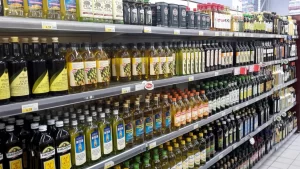
For distribution chains, Lowering the price of mid-range or basic extra virgin olive oil is a winning move, as even a small percentage reduction leads to an increase in sales volumes, thus providing “high elasticity.” Chains use this very “high elasticity” to adjust their “teaser prices,” knowing that a discount on extra virgin olive oil increases sales of everything else in the cart.
The consequences for the market (cannibalization effect)
The decline in extra virgin olive oil prices, even those from other countries, is impacting the lower end of the market, which is losing its appeal, such as virgin olive oil, olive oil, and olive-pomace oil. This is because consumers are seizing the opportunity to “upscale” and abandon cheaper substitutes, effectively cannibalizing sales of virgin olive oil, olive oil, and olive-pomace oil. This phenomenon would force large-scale retailers to keep the prices of these oils above a certain level to ensure their survival without completely losing their profitability.
In conclusion, the reduction is not just a question of price, it is an invitation to bring extra virgin olive oil back into the everyday routine of your shopping cart.
Dining and Cooking