
Standing at the edge of the Rio Grande, the air smells faintly of sage and dust clings to the skin. The blistering desert sun begins its daily mission to warm the chilly late-morning landscape. Katie Hagan Kolberg, head winemaker at Embudo Valley Vineyards, leans against the tailgate of a Toyota Tundra, a makeshift canopy stretched overhead, with six bottles lined up for tasting.
The river hums low in the background as she pours the first glass, Opiñons, a playfully named blend of Chardonnay and Viognier. It’s pronounced like piñons, the street-roasted nuts sold at roadside stands across northern New Mexico.
The wine glows gold in the light, a little cloudy from its skin-contact ferment. It smells of citrus and honey, with a whisper of pear.
“It’s kind of a beginner’s orange wine,” she says. “It’s playful, textural, not overbearing. The skin contact lasted about a week, so it’s not super tannic. And I used native yeast from the grapes and the cellar.”
When Kolberg took over as head winemaker, she didn’t have a grand plan. Just two tons of grapes and the freedom to experiment.
Katie Hagan Kolberg, head winemaker at Embudo Valley Vineyards.
Courtesy of New Mexico True
“I didn’t want to make the same thing everyone else was making,” she says. “I don’t even like Chardonnay. So, I thought, let’s co-ferment, leave the skins on, and see what happens.”
The result surprised her.
“Half Chardonnay, half Viognier, and somehow, it made me love Chardonnay.”
Her path to wine veered far from the traditional route of vineyard internships and sommelier exams. She came from distilling, where precision and chemistry guided her days.
“I started as a tasting room associate in 2018,” she says. “When the pandemic hit, it shook up everything and gave me the chance to step into a winemaking apprentice role at La Chiripada Winery.”
By that fall, she ran crush for one of New Mexico’s oldest wineries.
“The owners were in their 80s, so I jumped in,” she says. “My first crush was 2020. It went well. I took a lot of notes and kept sailing.”
Four vintages later, in 2024, she joined Embudo Valley Vineyards and now heads into her second harvest.
“Six crushes in, and I’m still learning every day.”
That curiosity shapes everything she touches. Her lineup — Staurolite, a bright white named for the state mineral; Carpe Mañana, a dry rosé nodding to Taos’s let-it-ride attitude; and unapologetic reds like Rickety Bridge, County Line, and Yes, Dear — balances cheek and depth.
“We’re doing what the grapes tell us to do,” she says.
At 6,100 feet of elevation, Embudo Valley pushes the vines to their limits: short seasons, sudden frosts, rocky caliche soils, and marauding birds that can strip a harvest overnight. Yet, those extremes yield vivid wines with structure and lift.
Courtesy of New Mexico True
“Our nights get cold, our soils are tough, and that tension gives our fruit its character,” she says.
Kolberg revives old vines and experiments with new ones. Among them, Riesling, Traminette, and the hardy Frontenac family test what varieties will take root in this improbable corner of the Southwest.
“A little stress does fabulous things for sugar,” she says. “If you give the vines what they need, they’ll thrive. We’re thriving in New Mexico.”
Four centuries before Kolberg’s first harvest, Franciscan monks smuggled grapevines from Spain and planted them along the Rio Grande to make sacramental wine. This formed the foundation of the country’s oldest documented wine region, long before any in California. By 1880, New Mexico produced nearly one million gallons per year.
Then came floods, Prohibition, and the long shadow of the West Coast, all of which damaged the industry and acreage in the state. Vines started to return in the 1970s, nurtured by families who believed in the desert’s potential.
Today, three American Viticultural Areas (AVAs) with more than 50 wineries stretch from the mesas near Taos to the Mesilla Valley, where high-altitude sun and cool nights create wines of striking freshness and depth.
Embudo Valley Organics, a sister company to Embudo Valley Vineyards, planted its first vines — Baco Noir along the river — in 1997. It bottled a homegrown wine two years later. For decades, the rows stayed modest, as the grapes quietly thrived beside vegetables and herbs. The family added Riesling and Pinot Noir in 2020, which gave the vineyard new life. Now two acres strong, it grows slowly by design.
“We could double production, but I’d rather build something that lasts,” says Kolberg. “We plant a few rows, see how they handle the seasons, and adjust.”
Courtesy of New Mexico True
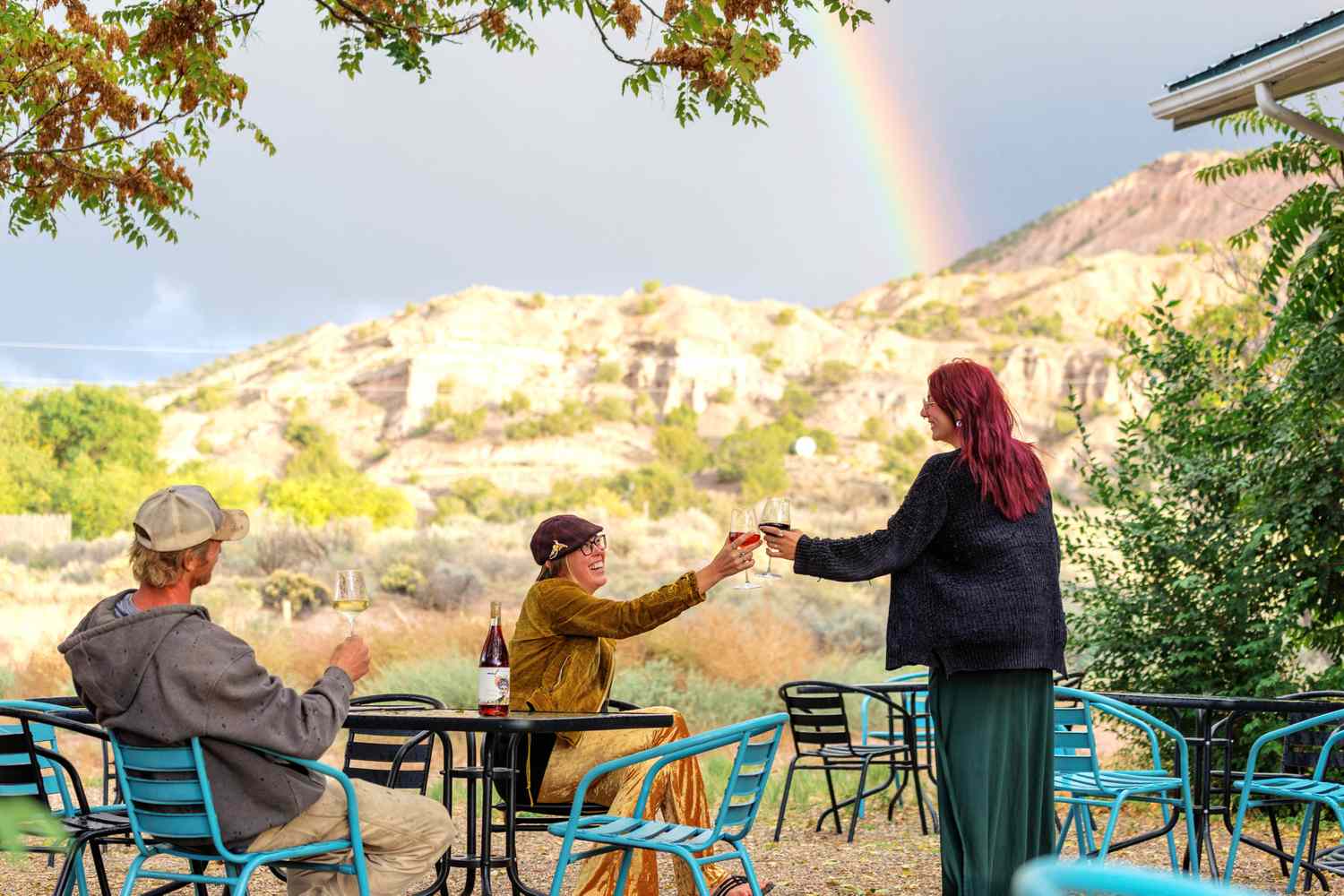
In the cellar, Kolberg layers ancient methods with modern tools. Four clay amphorae sit next to stainless tanks, ready for an orange wine experiment with a Georgian variety called Rkatsiteli. That same adventurous spirit infuses the tasting room up the road. There, you’ll find turquoise walls, velvet couches, a leopard-print rug, mountain murals, board games, and food trucks.
“We wanted it to feel welcoming, Instagrammable, and fun,” she says. “Music on Fridays, cornhole outside, a porch for wine in any season.”
Even the labels tell her story. Local artist Mira Metz designs them in collage style, where they fuse Southwest lore and surreal humor.
“We’re not a stuffy, classic wine brand,” says Kolberg. “I’m this quirky, artistic girl who loves science, too. The labels feel very me while conveying the full experience of our wines.”
Sustainability drives it all. The vines share space with pollinator rows and compost piles. The farm’s old acequia ditches still carry water from the Sangre de Cristo Mountains, just as they have for centuries. Across New Mexico, winemakers swap grapes, share equipment, and trade advice, a statewide family that’s adding to the region’s wine story together.
Bottles on the line at Gruet Winery.
Courtesy of New Mexico True / Jak+Flux
Where to Taste Across New Mexico
If you can’t make it during fall to the annual Dixon Studio Tour, one of New Mexico’s oldest and most beloved art events that showcases everything from pottery and painting to jewelry and wine, check out Kolberg’s favorite grape stops around the state.
Gruet Winery (Albuquerque and Santa Fe)
“I’m addicted to Gruet bubbles—I can’t stop,” says Kolberg. Founded by a Champagne-making family in the early 1980s, Gruet remains New Mexico’s sparkling pioneer, as it turns out méthode champenoise bruts and rosés that rival top French houses. They discovered that the state’s high elevation that produces hot days and cold nights were perfect to grow Chardonnay and Pinot Noir. Stop by the Albuquerque tasting room for a flight paired with caviar or bubbles-based cocktail. For America’s 250th anniversary, Gruet has partnered with Route 66 to turn out a bottle with a label dedicated to the iconic highway.
Vara Winery & Distillery (Albuquerque and Santa Fe)
“Vara has some new New Mexico-grown bubbles that are really good,” says Kolberg. Beyond its award-winning brut, guided by Laurent Gruet, Vara crafts Albariño, Tempranillo, Garnacha, and a variety of Spanish-style reds that highlight the potential of grapes grown in New Mexico.
Casa Rondeña Winery.
Courtesy of New Mexico True / Dirt Road Travels
Casa Rondeña Winery (Los Ranchos de Albuquerque)
“Casa Rondeña has this epic tasting room; it’s like an old castle,” says Kolberg. The sprawling estate is one of the state’s most iconic winery settings, with ivy-covered walls, tiled fountains, and vaulted tasting rooms. Don’t miss its Cabernet Franc, which Kolberg first tasted at the Santa Fe Wine & Chile Fiesta. Structured yet elegant, it’s a perfect example of how Bordeaux grapes can shine in New Mexico’s dry heat. “It was really, really good,” she says.
Jaramillo Vineyards (Belen)
After reading Cadillac Desert, Robert Jaramillo realized that alfalfa was “killing the desert,” as it used too much water for too little return. He pivoted from farming feed to cultivating grapes, which require one-fifth of the water. “They’ve got beautiful reds: Tempranillo, Barbera, and a really nice Cab Franc,” says Kolberg. Visitors at Jaramillo can sample them at the tasting room inside the historic 1909 Central Hotel on Becker Avenue in Belen, just six miles from the vineyard.
Courtesy of New Mexico True / Visit Las Cruces
Luna Rossa Winery & Pizzeria (Deming / Las Cruces)
Luna Rossa is where Embudo Valley sources many of its grapes, and where Kolberg finds inspiration. “Paolo’s blend, I want to say it’s called the NIMMI Red, is divine,” she says. “It’s lush and lovely, and he’s just one of those salt-of-the-earth people who supports all these small vineyards, from one to five acres, all around the state.” Visit its southern New Mexico tasting room for Italian-style reds and wood-fired pizzas.
Vivác Winery (Dixon)
One of New Mexico’s most awarded wineries, just up the road from Embudo, Vivác is run by brothers Chris and Jesse Padberg. Their Sangiovese, Tempranillo, and Petit Verdot show what’s possible when high altitude meets meticulous craft. It’s also one of the most scenic stops in northern New Mexico, surrounded by piñon-studded hills and acequia-fed vineyards.
La Chiripada Winery (Dixon)
Founded by brothers Pat and Mike Johnson in 1977, La Chiripada is New Mexico’s oldest winery and still one of its most beloved. The adobe-built spot in Dixon pours standout reds, whites, and rosés that include the local favorite, Rio Embudo Red. One of the brothers still paints and even designs the labels for the Artist Series wines, which you can sip as you browse the gallery filled with local art and ceramics.
Dining and Cooking