
An expert in healthy aging, Andrea Maier often brings up our distant hunter-gatherer ancestors when talking about the factors that help lead to a long life. Τhe example is particularly poignant when it comes to intermittent fasting in an age when we have constant access to food, wherever we are, whatever the time. What did people do before refrigerators and, even worse, cell phones to order at-home delivery? “Physical activity,” she said, explaining that until quite recently people had to work for their food, to hunt or forage, or even to simply go out into the garden, check on the hens and get an egg.
“Constant exposure to food is just not natural,” said Maier, a professor at the National University of Singapore and a global authority in the field of healthy longevity. Being hungry, she said, is something that is “built in” and there are “mechanisms in our cells to clean up our body.”
Nutritional paradigm
What we eat, however, is one of the most important factors that determines how long, and how well, we live, explains Maier, who is also co-director of the Center for Healthy Longevity at the National University Health System in Singapore and was in Athens last month for the first forum of the Hellenic Institute for Healthy Longevity. And for Maier, the Mediterranean diet is one of the best there is, because it has “lots of polyphenols, lots of vegetables, a little bit of fish, not too much red meat, lots of grains and legumes, and much fewer processed foods,” she said. Restricting sugar and salt is also important, she added, saying that improving our diet can help us live longer. “If you are 20 and you change your diet from just normal to optimal, you can add 12 years. If you are 50, it’s still eight years. It’s science. It’s reality and it’s knowledge we already have but we just very often neglect, because we think we only live once. That’s true, but I can tell you, you can be very happy with an optimal diet and not smoking,” she told Kathimerini. “And you feel better, you perform better and your energy levels are better.”
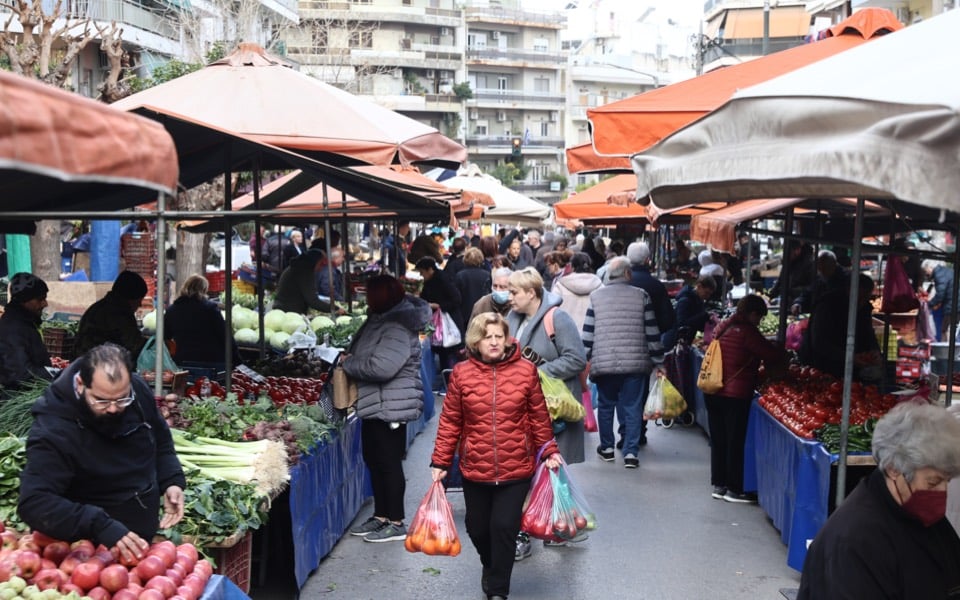 People shop for the weekly groceries at a farmers’ market in the Athens suburb of Zografou, earlier this year. Andrea Maier confirms that the Mediterranean diet is one of the best there is, because it has ‘lots of polyphenols, lots of vegetables, a little bit of fish, not too much red meat, lots of grains and legumes, and much fewer processed foods.’ [Yiannis Liakos/InTime News]
Exercise is another essential element to a good and long life, according to Maier, who notes that going to the gym is good, but exercising just once a day is not enough. “We know that it is good if you do not just have one peak, but continuous movement. You should at least get 8,000 steps.” A healthy exercise regimen should also include “peak exposure to endurance, like real sprinting, which you would do during hunting,” as well as working on balance by, say, brushing your teeth while standing on one leg, said Maier. “Do a plank every morning, do pushups,” she added.
Quality sleep
Exercise also helps us sleep better and good-quality sleep is another key to longevity, Maier noted, explaining that we should, ideally, sleep at least six hours a day. “To restore your body and your brain,” however, you need “one and a half hours of REM and one and a half hours of deep sleep,” and smart devices can help us track whether we’re getting the right kind of sleep, but we also need to learn to read the signals that our own bodies give us.
“Your body is nothing less than your car. What is your dashboard telling you? How your car is doing, when to recharge it. And if you ignore the red signals, the car stops. I think we’re taking our cars more seriously than our bodies.”
Not eating too late is also important, as is avoiding excessive alcohol consumption. Other factors that help a good night’s sleep are the quality of your mattress, the lighting, noises and temperature of the room, which Maier said, should really not be above 18 degrees Celsius.
Stress also has an impact, not just on sleep, but on health, though Maier noted that “there is good and bad stress.” “Good stress is you have a deadline, you want to get the promotion, and you love it. Don’t avoid that. It’s a little bit like hunting: Yes, you caught it! If you have stress because there is sexism, there’s ageism, there is whatever bullying, that’s very bad stress, super-bad stress, and that influences hugely the biology of ageing and you are hugely aging faster. So you have to first disentangle that stress. Is it good, or is it bad? If it’s bad, I think we should absolutely avoid it and take different steps.”
Taking care of your mental health is also important, as therapy can help you get to know more about yourself and why you react to certain stressors as you do. “You need to know how much narcissist is inside you and how depressed you are, or what kind of anxiety you have. It’s like that dashboard in your car; you need a dashboard of mental health,” said Maier.
Drive
Having a sense of purpose, which is shaped by knowing who you are, who you want to be and what kind of life you want, is a powerful motivating force in the desire to live longer, according to Maier, who said it is important to know “what are your incentives to actually be here.”
So, to sum up: A good diet, like the Mediterranean one, that sticks to a more natural way of doing things – “eat the orange, don’t drink the orange juice, which is full of fructose; regular exercise – you should actually move your body; good sleep – sometimes you just need rest; and mental wellbeing – find the purpose in your life”; and, of course, not smoking. But, added Maier, you don’t need to do all of this, “but if you would, you would live longer.”
“That is the question: It’s your choice, what do you want to do? And once you have the knowledge and you make a choice, you also have to carry the consequences.”
Greeks are pretty notorious for doing none of these things, though, I comment: They smoke, they drink, they eat late, they’re straying from their traditional diet and they don’t get much exercise.
Quality
“You are not bad in terms of life expectancy. So maybe it’s because you have that social behavior of wanting to cluster together,” Maier responded. A good, long life is also associated with not feeling lonely. “Being social and having a good quality of life is hugely important, because you have purpose,” Maier said, noting how in more traditional societies people congregate at church or at the village square. “It’s about having that network and people asking about you because you belong to a tribe, you belong to a group.”
That, she added, is the last ingredient: knowing “that somebody cares for you. Feel loved and you feel better and you live longer.”
Dining and Cooking