
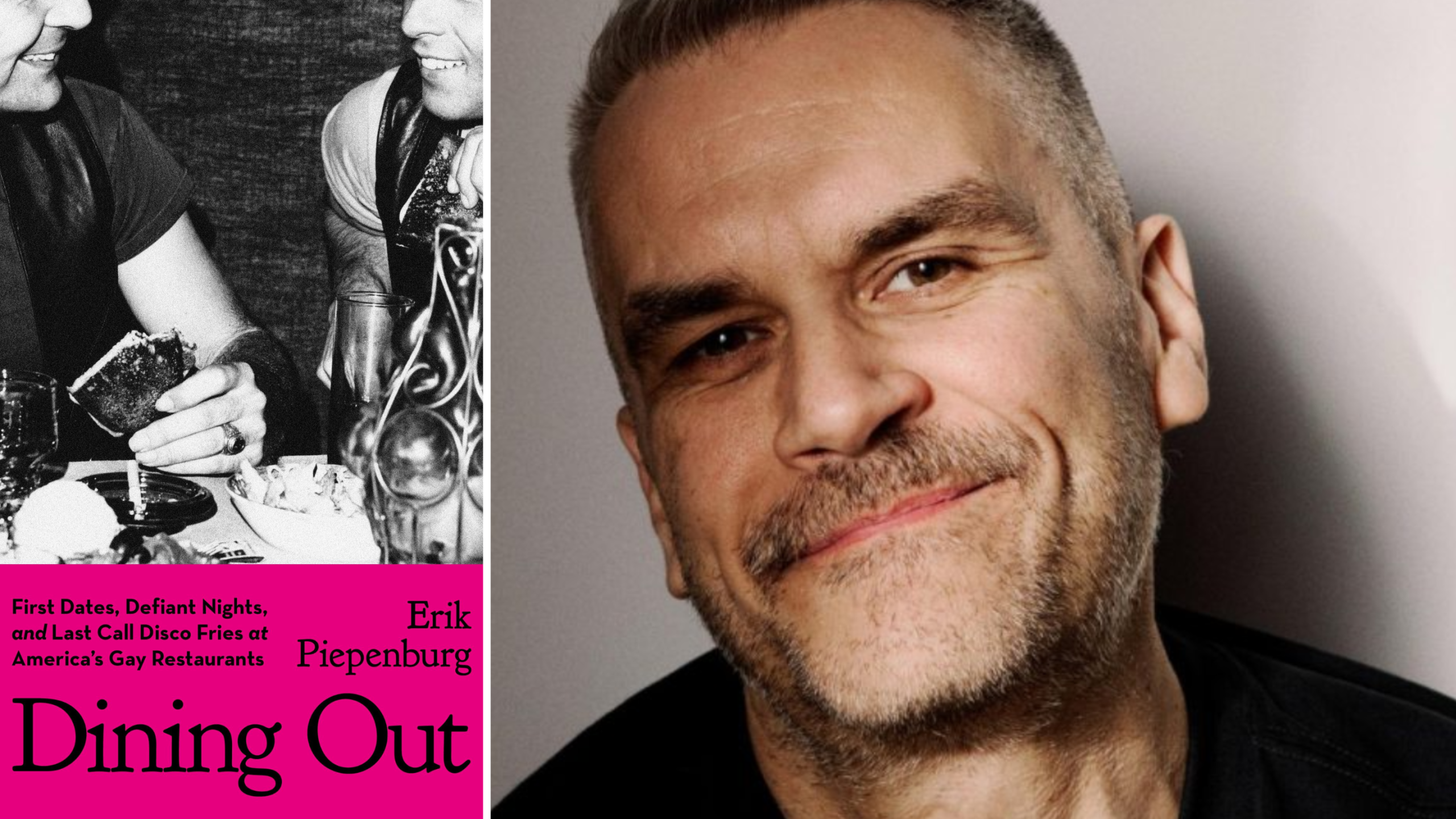
When Erik Piepenburg thinks of the late-night Chicago diners where he came of age, he remembers the chatter, the flirting and the food that always arrived hot.
In the ‘90s, Piepenburg lived in Northalsted, working the evening shift at NBC Tower and heading north afterward for a broccoli-and-cheddar omelet or sweet-and-sour cabbage soup at Melrose Diner.
“I ate there three or four times a week for five years,” said Piepenburg, who’s now a New York Times journalist. “It was kind of a second home to me.”
Melrose Diner, which stood at Melrose and Broadway for more than half a century before closing in 2017, serves as the starting point for Piepenburg’s new book Dining Out: First Dates, Defiant Nights, and Last Call Disco Fries at America’s Gay Restaurants.
The book, from Grand Central Publishing, traces how queer people have found each other, built culture, and shared comfort over meals—from Chicago’s diners and Washington’s steak houses to the drag brunches and intersectional cafes of today.
Though Piepenburg now lives in New York, his years in Chicago shaped both his reporting and his understanding of queer life. After graduating from DePaul University, he landed his first journalism job at WMAQ-TV as a night-shift web producer.
Around work, he explored Northalsted, frequenting Berlin, Roscoe’s, Sidetrack and the IHOP on Broadway.
“If you wanted to meet other gay men, you actually had to go out to bars, restaurants and by cruising the streets,” Piepenburg said. “One of those places for me was Melrose.”
The diner’s closing planted the seed for Dining Out.
“When Melrose closed, it felt like a dispossession,” Piepenburg said. “Anyone who’s lost a favorite restaurant knows that mix of sadness and nostalgia. I started wondering what happened to gay restaurants, which were everywhere in Chicago in the ’90s.”
That question led to a 2021 New York Times feature on LGBTQ+ restaurants—then to a three-year journey across the country.
The book pairs reporting with archival research and first-person accounts to show how queer people have gathered over food for more than a century. Its timeline begins in the mid-19th century, tracing a lineage of “gay-friendly” dining spaces through time.
Among the historic venues spotlighted is Annie’s Paramount Steakhouse in Washington, D.C.—opened in 1948—which became a known safe harbor for gay patrons by the 1950s and 1960s.
The Melrose Diner also features prominently because it exemplifies the way diners subtly become queer spaces. Piepenburg described it as a 24-hour diner with a sprawling menu that shifted depending on the hour:
“At 11 a.m., it might be mostly straight Cubs fans,” Piepenburg said. “Come back at 3 a.m., and it was a super-gay dining room.”
But the book makes it clear that gay restaurants are not simply “gay bars with food.” Piepenburg argues that restaurants have served a different, and equally crucial, role in queer life—one rooted in vulnerability, intimacy and slow conversation.
“At a gay restaurant, you can cry,” Piepenburg said. “You can cry over a breakup, because you had a bad day, because someone you love died. You can share sad times and happy times. You can have those conversations in a restaurant that you really can’t at a nightclub.”
If gay bars have long been the place for escape and release, Dining Out suggests that gay restaurants have quietly been where people built community, processed grief and grew up.
Piepenburg proudly calls himself “a diner gay,” a label he coined in the introduction. He traces that identity to adolescence in Cleveland and the thrill of discovering attraction and belonging in all-night diners.
“Diners are for every culinary taste, every age—and they’re usually affordable,” Piepenburg said. “You can sit there as long as you want as long as you pay your bill and don’t bother anybody. That accessibility makes them democratic spaces.”
Though Dining Out is steeped in nostalgia, Piepenburg emphasizes that it isn’t just about what’s gone.
“There is a rich history with gay restaurants,” Piepenburg said, “but also a really, really bright future. The future of gay restaurants is far more queer and social-justice based, but it still brings people together around food.”
Dining Out: First Dates, Defiant Nights, and Last Call Disco Fries at America’s Gay Restaurants is available now from Grand Central Publishing.
Related
Dining and Cooking