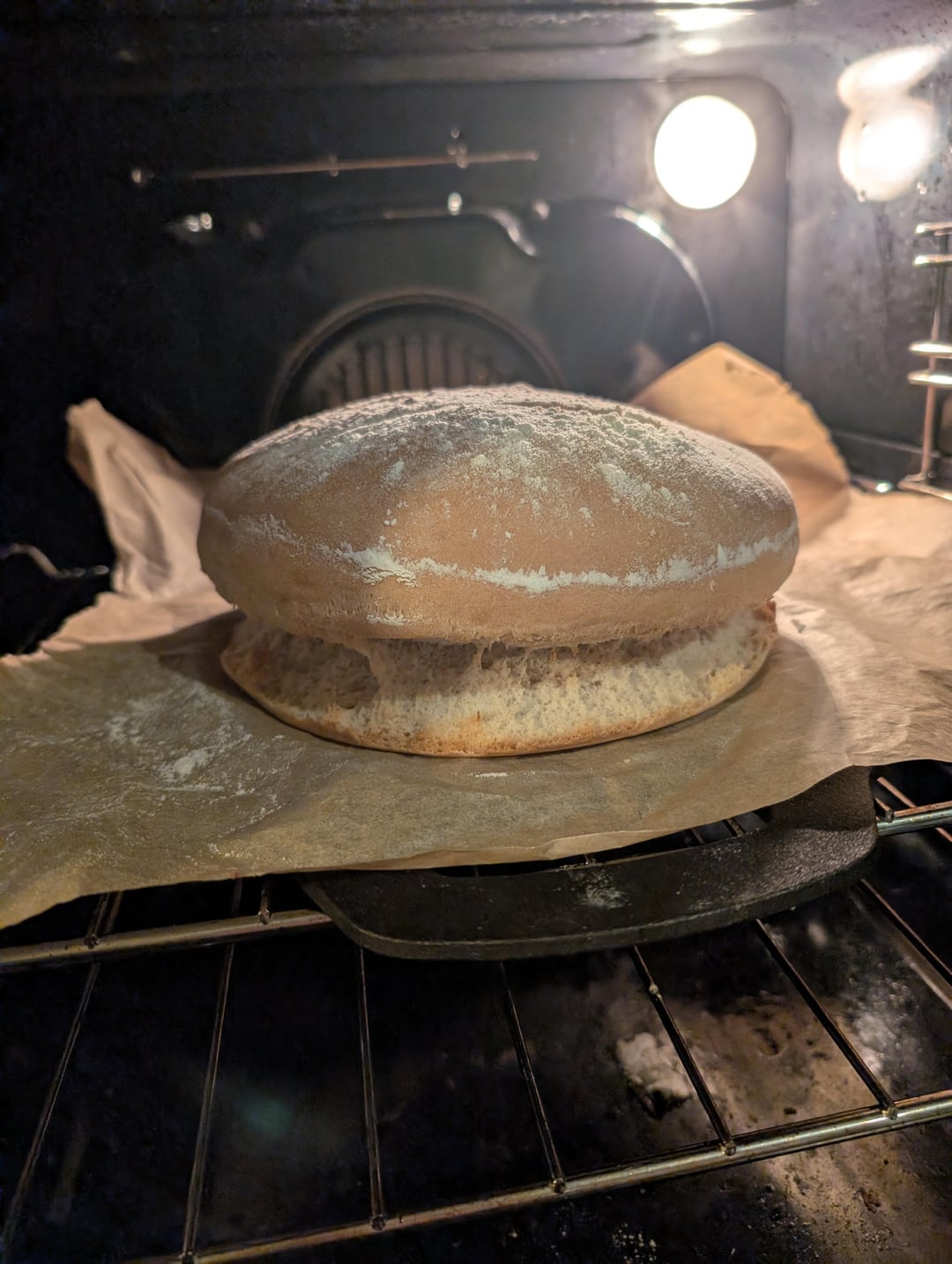
I keep making bread puddles with my stand mixer and I don’t really know what to do about it (see comments). It also turned into a mutant loaf post bake 😂 help please?
I keep making bread puddles with my stand mixer and I don’t really know what to do about it (see comments). It also turned into a mutant loaf post bake 😂 help please?
by BritishBlue32
19 Comments
BritishBlue32
Disclaimer:
I am not trying to achieve any kind of sourdough bread.
The recipe:
500g strong bread flour
1 packet dry yeast
300ml tepid water
1tsp salt
Butter 25g (not added straight away)
—
The method:
Mix dry ingredients. Add water, mix on setting 2 for 10 minutes. Sit for 15 minutes (autolyse?). Mix for 10. Add butter, mix until incorporated (usually 3-5 minutes).
Proof for 30 minutes. Today was in a warmed oven (off, cooled slightly), as my house is cold in winter.
Mix for 10 minutes.
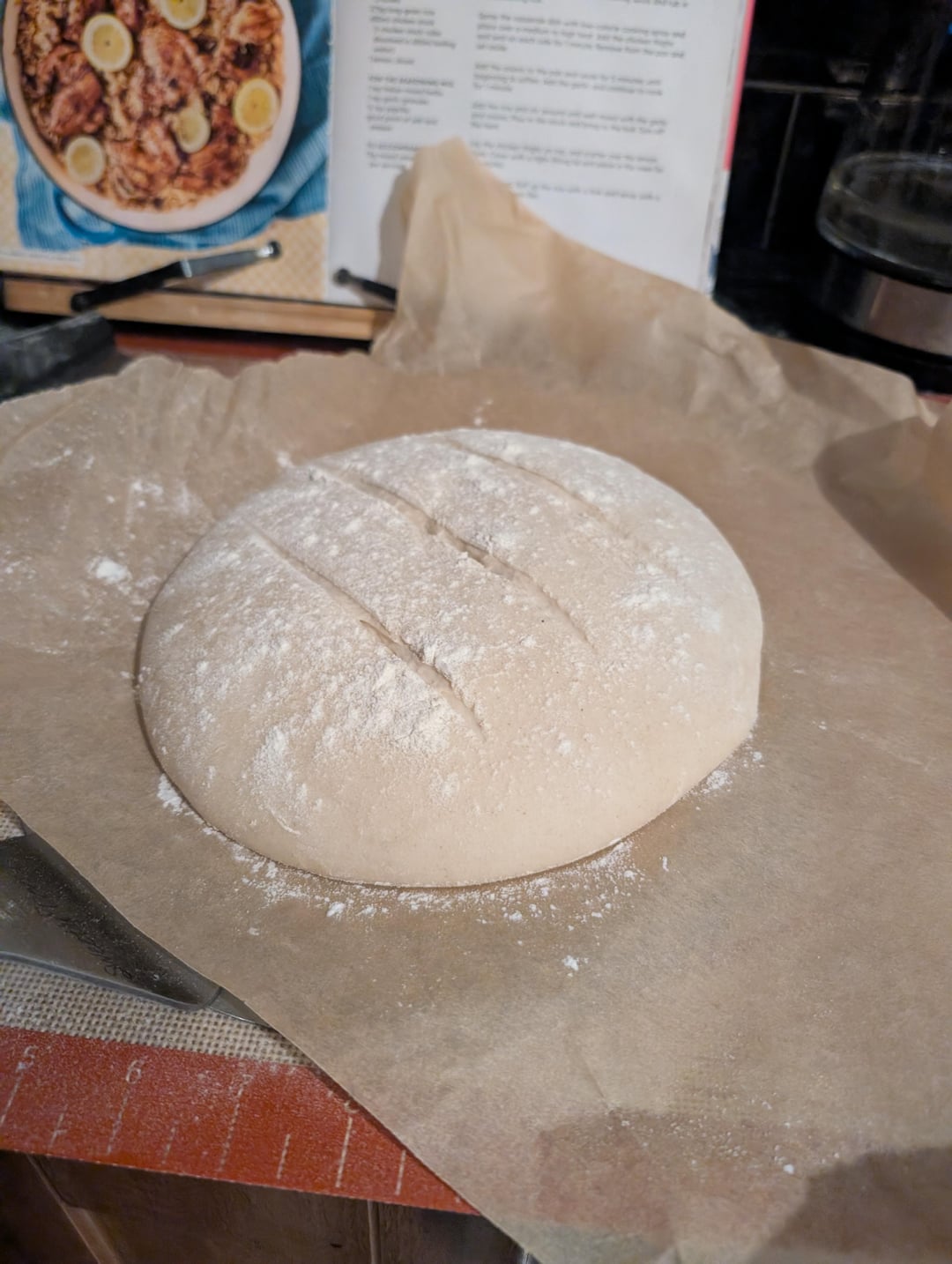
Shape and proof in oven for 30 minutes. At this point it became a pancake. I currently have nothing to cover dough in the oven with for the proof as my mixing bowls are plastic and I don’t want to stick my expensive kitchen aid bowl in the oven.
Remove from oven and heat to 180C. Bake for 30 minutes. Cue bread mutation. 😂
—
Today’s errors:
I accidentally added 400ml instead of 300ml of water and had to add flour until it turned into dough. It was big dumb. But I’m still having spreading issues even without me initially turning my dough into soup.
I also didn’t flour the baking paper, which resulted in the dough sticking to the baking paper and becoming a mutant. Oops.
—
Theories:
I never had any issues with bread when I kneaded by hand. I would rub butter in first before adding the water and just add extra flour until it stopped sticking to my hands and beat the shit out of it. Proof twice for 30 minutes each, bake for 30 at 180C.
With the stand mixer, the sticking to my hand issue is gone so I don’t add in any of the extra flour anymore. Even without the water fuck up from today, I think I’m now dealing with a higher hydration bread that I don’t know how to shape or handle properly, so I’m just going through trial and error (mostly errors at this point).
—
Questions:
I know that a lot of higher hydration bread requires extra gluten development to hold its shape. Is there anything else I should be doing to achieve this?
Does higher hydration bread require something to sit in when it’s proofing to stop it spreading like a pancake, such as a tin or a Dutch oven? I currently just have it sat on baking paper on a circular tray.
Should I just tweak my recipe to add more flour from the get go and just abandon the attempt of trying a higher hydration bread altogether?
Thank you in advance!
Edit: Reddit seems to have removed my second image with the mutant bread 🥲
HeOpensADress
So quite a few talking points here: Have you weighted how much salt you actually add in the recipe? 60% hydration is very low normally and may lead to overheating the dough whilst mixing due to higher strain. Obviously the 80% hydration today was an accident so never mind that. You baked at a really low temp 180°C is low I baked at 250°C preheat then turn down to 240°C when the bread goes in with the fan off and a tray of boiling water underneath the pizza stone/pizza steel You will benefit a lot from a banneton or a baking paper lined bread tin so the bread can do its final proof in either. I use shower caps to cover the dough at all times when it’s in a container. You didn’t mention what your shaping technique is or if you preshape too, but that will matter less with a 60% hydration dough as they can be so stiff, particularly if underproofed (you can tell if it’s proofed if it’s jiggly and begins to have bubbles on top, of course that’s for the bulk ferment, the final proof you just need it to pass the poke test for proofing) Happy to give a video resource on this
ohmymoo
Oo this is a very interesting photo I have never seen something like this before. All I can think is maybe the bottom is getting hard/crusting too quickly so it is not able to spring upwards with the rest of the dough. If you are able to afford it I would definitely get a dutch oven. Or something to cover your dough with so the moisture is trapped inside and the bottom of your bread doesn’t crust too quickly. I may be wrong though on that being the issue.
pangolin_of_fortune
Where did you get this recipe?
Strange_March6447
I don’t have an answer to all your questions however it seems like you might be mixing your dough too much too often. Especially proofing it and then mixing it again… When not using a stand mixer it’s hard/impossible to overmix dough. Try mixing for a total of 2 times if you want to mix in the bitter seperately!
ishouldquitsmoking
30 min of mixing is too much
samtresler
You have developed gluten , or it wouldn’t have cracked just released gas and been dense.
Scoring is to make pretty loaves, but it is also functional first. It let’s the bread expand without cracking. I’d suggest starting with one deeper score somewhere in the “north east to south east” line of the loaf.
Proofing depends entirely on environment, but I rarely see it take less than 45m-1h20m coming straight from instant yeast.
No need for a 10 minute mix after proofing. “Punching down” the dough is a gentle deflation, preferably without breaking the skin, followed by a final shaping and second rise.
I like to mist the top with a spray bottle to keep it soft before hitting the oven.
I don’t see the knead for a long fermentation or anything else for a simple bread.
If you want practice in shaping and getting better rises, I make KA kaiser rolls a lot. Similar recipe with an added egg makes it a little more forgiving and you can practice mini boules a lot.
ozegg
I’m surprised no one has said it, you need steam and lots of it. Your crust on top is dry before the oven spring is complete so you are having a blow out along the bottom edge.
pokermaven
At 80% hydration it’ll be slack. My guess is your proofing is killing your yeast.
GotTheThyme
All of these professional comments, but I’m just here to say, I’ll help you eat it; still looks good to me 🙂
februarytide-
Huh…. That mushroom cloud was an unexpected after photo.
hpdk
it looks delicious
redbirddanville
Skip the mixer. Do stretch n folds. Let it rise.
Horror-Wallaby-4498
It’s fine it’s just a UFO. The aliens are sending messages via bread
segphault
In addition to the issues that everyone else has raised, I think another problem here might be with your scoring on the top of the loaf. If your scoring isn’t large enough or deep enough, then the steam is going to find some other place to escape and it will tear the loaf at the weakest point. That might be what you are seeing with the ear forming at the bottom.
unknown7383762
Imo you’re not proofing it enough time each time and there’s not enough gluten or strength to the dough. When I’ve had that happen where it spreads like that it’s not been proofed enough. Might also want to tighten the ball more between proofings.
DrFeelOnlyAdequate
Oppenheimer would be proud of this loaf.
duckyourfeelings
Are you adding any steam while baking? Most people eaither cook their loaves in a dutch oven, which keeps the steam from the loaf itself in, or if they’re open baking (baking uncovered) they will put a pan with boiling water in with the loaf. It gives the loaf time to expand in the oven before the crust sets.
It looks like your crust is setting too early. The inside wants to keep expanding, bit the crust won’t let it, so it blows out, in your case all along the bottom. Other than that, it seems like you’re overworking your dough. When I use my stand mixer I usually only use the dough hook for six to eight minutes on medium-low speed then let it rise, then shape by hand.
litttlebats
Looks like you found a new signature style loaf lol I’ll take 2 please

19 Comments
Disclaimer:
I am not trying to achieve any kind of sourdough bread.
The recipe:
500g strong bread flour
1 packet dry yeast
300ml tepid water
1tsp salt
Butter 25g (not added straight away)
—
The method:
Mix dry ingredients. Add water, mix on setting 2 for 10 minutes. Sit for 15 minutes (autolyse?). Mix for 10. Add butter, mix until incorporated (usually 3-5 minutes).
Proof for 30 minutes. Today was in a warmed oven (off, cooled slightly), as my house is cold in winter.
Mix for 10 minutes.
Shape and proof in oven for 30 minutes. At this point it became a pancake. I currently have nothing to cover dough in the oven with for the proof as my mixing bowls are plastic and I don’t want to stick my expensive kitchen aid bowl in the oven.
Remove from oven and heat to 180C. Bake for 30 minutes. Cue bread mutation. 😂
—
Today’s errors:
I accidentally added 400ml instead of 300ml of water and had to add flour until it turned into dough. It was big dumb. But I’m still having spreading issues even without me initially turning my dough into soup.
I also didn’t flour the baking paper, which resulted in the dough sticking to the baking paper and becoming a mutant. Oops.
—
Theories:
I never had any issues with bread when I kneaded by hand. I would rub butter in first before adding the water and just add extra flour until it stopped sticking to my hands and beat the shit out of it. Proof twice for 30 minutes each, bake for 30 at 180C.
With the stand mixer, the sticking to my hand issue is gone so I don’t add in any of the extra flour anymore. Even without the water fuck up from today, I think I’m now dealing with a higher hydration bread that I don’t know how to shape or handle properly, so I’m just going through trial and error (mostly errors at this point).
—
Questions:
I know that a lot of higher hydration bread requires extra gluten development to hold its shape. Is there anything else I should be doing to achieve this?
Does higher hydration bread require something to sit in when it’s proofing to stop it spreading like a pancake, such as a tin or a Dutch oven? I currently just have it sat on baking paper on a circular tray.
Should I just tweak my recipe to add more flour from the get go and just abandon the attempt of trying a higher hydration bread altogether?
Thank you in advance!
Edit: Reddit seems to have removed my second image with the mutant bread 🥲
So quite a few talking points here:
Have you weighted how much salt you actually add in the recipe?
60% hydration is very low normally and may lead to overheating the dough whilst mixing due to higher strain. Obviously the 80% hydration today was an accident so never mind that.
You baked at a really low temp
180°C is low
I baked at 250°C preheat then turn down to 240°C when the bread goes in with the fan off and a tray of boiling water underneath the pizza stone/pizza steel
You will benefit a lot from a banneton or a baking paper lined bread tin so the bread can do its final proof in either. I use shower caps to cover the dough at all times when it’s in a container.
You didn’t mention what your shaping technique is or if you preshape too, but that will matter less with a 60% hydration dough as they can be so stiff, particularly if underproofed (you can tell if it’s proofed if it’s jiggly and begins to have bubbles on top, of course that’s for the bulk ferment, the final proof you just need it to pass the poke test for proofing)
Happy to give a video resource on this
Oo this is a very interesting photo I have never seen something like this before. All I can think is maybe the bottom is getting hard/crusting too quickly so it is not able to spring upwards with the rest of the dough. If you are able to afford it I would definitely get a dutch oven. Or something to cover your dough with so the moisture is trapped inside and the bottom of your bread doesn’t crust too quickly. I may be wrong though on that being the issue.
Where did you get this recipe?
I don’t have an answer to all your questions however it seems like you might be mixing your dough too much too often. Especially proofing it and then mixing it again…
When not using a stand mixer it’s hard/impossible to overmix dough. Try mixing for a total of 2 times if you want to mix in the bitter seperately!
30 min of mixing is too much
You have developed gluten , or it wouldn’t have cracked just released gas and been dense.
Scoring is to make pretty loaves, but it is also functional first. It let’s the bread expand without cracking. I’d suggest starting with one deeper score somewhere in the “north east to south east” line of the loaf.
Proofing depends entirely on environment, but I rarely see it take less than 45m-1h20m coming straight from instant yeast.
No need for a 10 minute mix after proofing. “Punching down” the dough is a gentle deflation, preferably without breaking the skin, followed by a final shaping and second rise.
I like to mist the top with a spray bottle to keep it soft before hitting the oven.
I don’t see the knead for a long fermentation or anything else for a simple bread.
If you want practice in shaping and getting better rises, I make KA kaiser rolls a lot. Similar recipe with an added egg makes it a little more forgiving and you can practice mini boules a lot.
I’m surprised no one has said it, you need steam and lots of it. Your crust on top is dry before the oven spring is complete so you are having a blow out along the bottom edge.
At 80% hydration it’ll be slack. My guess is your proofing is killing your yeast.
All of these professional comments, but I’m just here to say, I’ll help you eat it; still looks good to me 🙂
Huh…. That mushroom cloud was an unexpected after photo.
it looks delicious
Skip the mixer. Do stretch n folds. Let it rise.
It’s fine it’s just a UFO. The aliens are sending messages via bread
In addition to the issues that everyone else has raised, I think another problem here might be with your scoring on the top of the loaf. If your scoring isn’t large enough or deep enough, then the steam is going to find some other place to escape and it will tear the loaf at the weakest point. That might be what you are seeing with the ear forming at the bottom.
Imo you’re not proofing it enough time each time and there’s not enough gluten or strength to the dough. When I’ve had that happen where it spreads like that it’s not been proofed enough. Might also want to tighten the ball more between proofings.
Oppenheimer would be proud of this loaf.
Are you adding any steam while baking? Most people eaither cook their loaves in a dutch oven, which keeps the steam from the loaf itself in, or if they’re open baking (baking uncovered) they will put a pan with boiling water in with the loaf. It gives the loaf time to expand in the oven before the crust sets.
It looks like your crust is setting too early. The inside wants to keep expanding, bit the crust won’t let it, so it blows out, in your case all along the bottom.
Other than that, it seems like you’re overworking your dough. When I use my stand mixer I usually only use the dough hook for six to eight minutes on medium-low speed then let it rise, then shape by hand.
Looks like you found a new signature style loaf lol I’ll take 2 please