
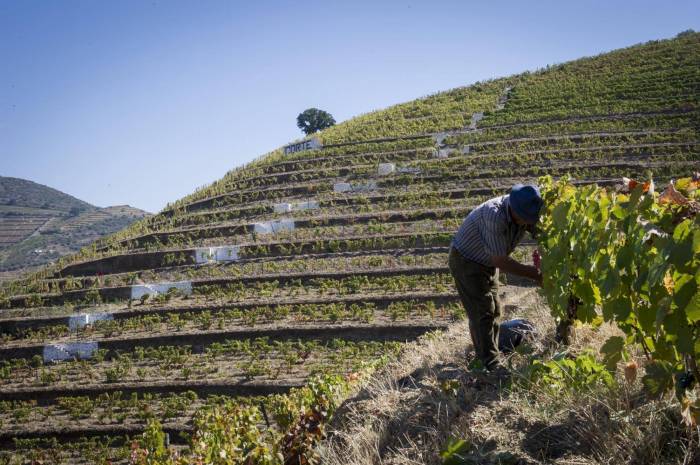
Applications for support to deliver grapes for distillation in the Douro region must be submitted by September 15, according to a regulation published today in Portugal’s official government journal. The measure, which offers a subsidy of 50 euro cents per kilogram of grapes destined for distillation, is part of a broader government plan to address the ongoing crisis in the Douro’s wine sector.
The new regulation follows approval by the Council of Ministers on August 28 and comes as the Douro is already in the midst of its grape harvest. Producers are facing a sharp drop in yields this year, with some estimates suggesting production could fall by as much as 50 percent—well above the 20 percent decrease forecasted by the national Institute of Vine and Wine.
The support program prioritizes small growers with vineyards of up to five hectares. According to Agriculture Minister José Manuel Fernandes, the Douro’s unique status as a UNESCO World Heritage site and its economic challenges prompted the government to act quickly. “We approved a resolution that has an immediate effect, providing support of 50 cents per kilo for all grape growers, with the goal of distillation,” Fernandes said.
The government’s action plan was developed after repeated complaints from producers who have struggled to sell their grapes or have been forced to accept low prices. At the same time, merchants have reported full warehouses and declining wine sales. The measure aims to guarantee a minimum income for growers while reducing surplus wine stocks in the Douro Demarcated Region (RDD). The total budget for this support is set at 15 million euros, funded by the state.
Under the published rules, priority will be given to growers whose total vineyard area does not exceed five hectares. Applications must be submitted by winemakers through the Douro and Port Wine Institute (IVDP) no later than September 15, 2025. The IVDP will determine maximum eligible quantities per grower, with an individual cap set at 30 percent of each grower’s average production over the past five years.
To qualify for support, a prior agreement must be signed between grower, winemaker, and distiller. The IVDP will oversee implementation and may introduce allocation rules if demand exceeds available funds. Approved applications and maximum eligible volumes will be communicated by September 22. Growers with up to five hectares are exempt from allocation cuts; others may see their eligible quantity reduced but are guaranteed at least 25 percent of their requested amount.
Payments will be made directly to growers—including members of cooperative wineries—by the IVDP after all legal requirements are verified. The wine produced from these grapes must be delivered to registered distillers under IVDP supervision.
Beyond this immediate crisis measure, the government’s plan includes structural reforms aimed at balancing supply and demand in the Douro region. These include restrictions on new vineyard plantings to halt expansion of areas eligible for Port wine production, incentives for converting vineyards to alternative crops while preserving cultural heritage, and targeted support for cooperative wineries.
The plan also calls for stricter controls on labeling and traceability for wines designated as Protected Designation of Origin (DOP) Porto or Douro. There will be increased monitoring of bulk wine movements within the region and enhanced enforcement against misuse of protected names.
A multi-year program is being launched to promote Douro wines internationally and strengthen their reputation in key export markets. The government also wants to leverage tourism as a channel for wine sales, including exploring ways to make it easier for visitors to transport wine home via air travel.
The action plan responds to a persistent imbalance between supply and demand in Portugal’s most important wine-producing region. In the 2024/2025 campaign, production reached 1.55 million hectoliters of DOP or Protected Geographical Indication (IGP) wine, pushing regional stocks up to 4.4 million hectoliters—about 280 percent of annual output. This oversupply has worsened financial difficulties for growers and cooperatives amid falling global demand and inflationary pressures.
The government sees an integrated approach as essential: combining immediate relief with long-term measures designed to stabilize the sector, protect local livelihoods, preserve cultural landscapes, and enhance the value of Douro wines both at home and abroad. Implementation will involve multiple agencies under agricultural leadership, with annual progress reports required.
The new rules take effect immediately following today’s publication in Diário da República. Growers interested in participating are urged to coordinate with their winemakers and submit applications before next year’s deadline.
Dining and Cooking