

Picture this: you walk into a new, buzzy, chef-driven restaurant. It’s the only one of its kind, and by all appearances, it looks like an independent spot.
But dig a little deeper and it turns out the independent restaurant is actually one of more than a dozen owned by the same company.
The business model of a restaurant “group” has, of course, been around for years.
But experts say these groups are becoming bigger players as the industry struggles post-pandemic amid declining alcohol sales and lower customer spending.
Being big, they say, offers better buying power and a barrier against risk.
WATCH | The latest restaurant trend? Groups:
The rise of restaurant groups
Most people love checking out that trendy new restaurant in the city, but some might not realize what seems like an independent spot could actually be part of a much bigger group. CBC’s Paula Duhatschek breaks down why more companies are moving toward a new model of restaurants.
Vince Sgabellone, a food industry analyst with the market research firm Circana Canada, said there’s “strength in numbers.”
“It’s very difficult for an independent restaurateur.”
Unlike at a restaurant chain, where every location is emblazoned with the same name, menu and décor, customers at a restaurant group business may never know the spot where they’re dining is part of a broader company.
But some say that past a certain scale, the trend can still involve a certain amount of homogenization, where even seemingly standalone restaurants start to look and taste a little bit the same.
A chain that’s not a chain
The extent of the growth of the restaurant group model is difficult to pin down. Restaurants Canada doesn’t track it; neither does Statistics Canada.
But Sgabellone said Circana data shows that between 2020 and 2024, smaller chains and independent restaurants (restaurant groups are tracked as part of both categories) grew at more than twice the pace of large restaurant chains in Canada.
And experts like Bruce McAdams say the trend is picking up as part of a generational vibe shift around the concept of a chain restaurant.
There’s an admittedly fine line (and potentially, some overlap) between a company running a chain of restaurants and a multi-concept restaurant group.
But broadly speaking, whereas in the 1970s and 1980s it was desirable for restaurateurs to bring their local joint to every city in the country, that’s no longer the case, said McAdams, an associate professor of hospitality at the University of Guelph.
“The whole dining marketplace has changed dramatically,” said McAdams, who worked for the Toronto-based restaurant group Oliver & Bonacini before becoming an academic.
As the country has become more diverse, Canadians have been exposed to different kinds of food. Customers are more interested in trying the next new thing, and less keen on familiarity (though McAdams noted some large chains, like The Keg and Earls, still do quite well).
For companies offering sit-down fare, this means they can get more buzz by opening different types of restaurants with different types of cuisine, rather than by trying to replicate the same restaurant over and over again.
Economies of scale
Buying power is a major benefit for restaurant groups. Compared to independent restaurant owners, groups can command better economies of scale by working in larger quantities.
For Calgary’s Concorde Entertainment Group, the company’s size means it has managed to set up its own downtown commissary kitchen that makes ingredients, like cocktail syrups, that it can dispatch to all of its locations. This can be done more affordably compared to ordering items from individual suppliers.
It also allows the company to make sure everything meets a certain standard of consistency and quality, said Jon Molyneux, the company’s vice-president of business development, sales and events.
“People may not understand how razor thin the margins are, and all our costs on everything have been increasing,” said Molyneux. “Anytime we can save a dollar here, dollar there, it really helps.”
Concorde started in 1987 with a single college bar and has since grown to include around two dozen spots, including an acclaimed steakhouse, a Japanese restaurant, a Pacific-inspired restaurant and a chain-within-a-restaurant-group of brewhouses.
The company has also expanded outside of Calgary by bringing some of its more popular restaurants to Canmore and Toronto.
At Concorde restaurants, there’s no sign announcing the business is part of a group, but it’s easy for customers to tell if they visit the website or buy a gift card.
“We’re not trying to keep it a secret,” said Molyneux.
‘Dominating’ a market
Another advantage of the business model is proximity. While businesses like Concorde do, at times, expand beyond the borders of a particular city, typically groups start by opening multiple restaurants in the same region.
“Maybe they’ve got a sushi place. Well, now they can open a steakhouse right across the street,” said Circana analyst Sgabellone.
“This allows them to really monopolize and dominate a geography.”
 Experts say the restaurant group model helps businesses hedge their bets against shifting consumer preference and economic uncertainty. (Ben Nelms/CBC)
This means companies benefit from some of the same economies of scale as chain restaurants, but don’t have to deal with the logistics of trying to keep a restaurant concept consistent across multiple cities, especially in a country as vast as Canada.
McAdams recalls the difficulty of doing just that when he worked for Red Lobster during a period when the company was rapidly expanding across the country.
“It was a gong show,” he said.
Being part of a group means restaurants can also consolidate some of their back-office work. Multiple spots can use the same human resources, marketing and payroll department.
Plus, Sgabellone said, the model offers some protection against shifting consumer preferences. If one restaurant in a group stops doing well because a cuisine has fallen out of fashion, the company has other concepts to lean on.
“If they have more restaurants, there’s more chances they’re going to be at the leading edge,” he said.
Pros and cons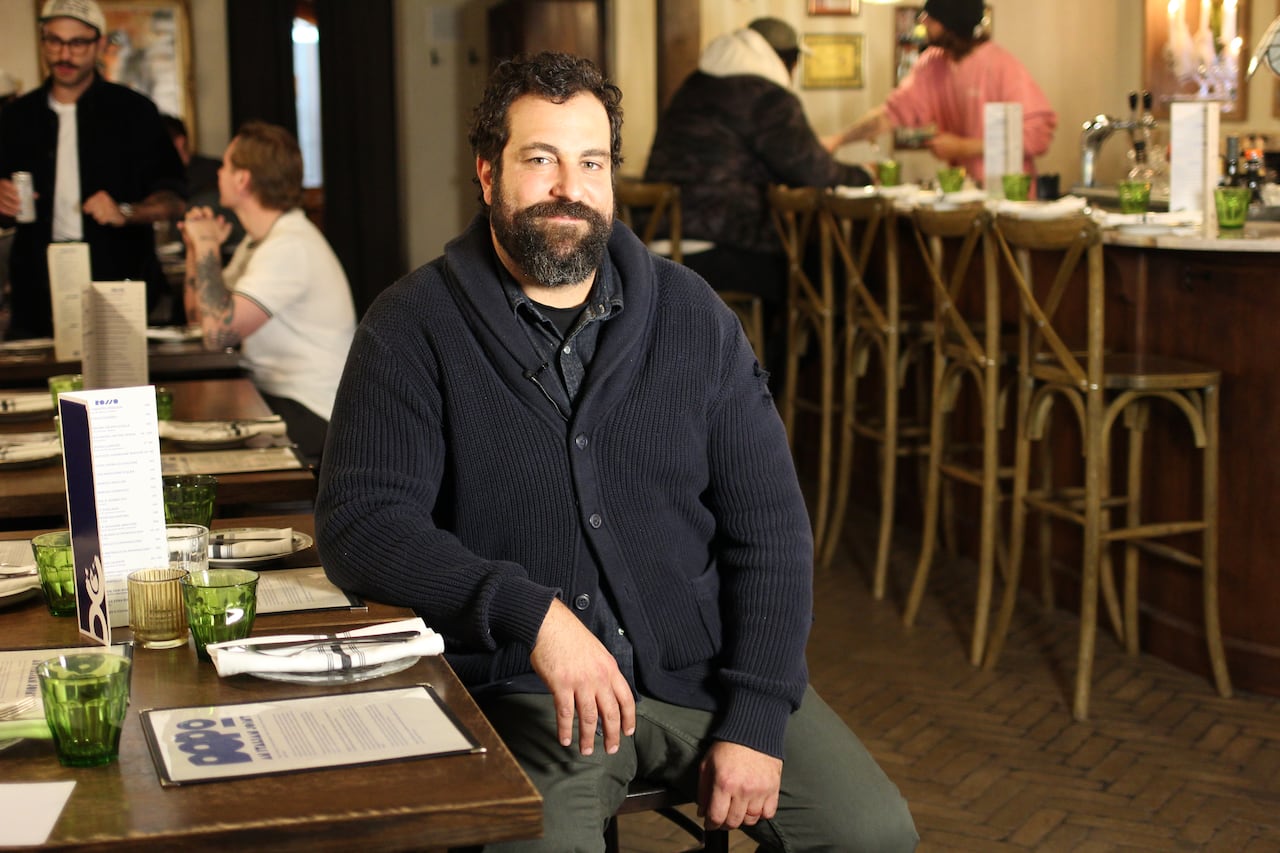 Restaurateur Tony Migliarese sits at a table at his DOPO Italian restaurant in Calgary. (Paula Duhatschek/CBC)
Calgary restaurateur Tony Migliarese sees pros and cons to the restaurant group model. He now owns five restaurants in the city (an Italian bistro, a wine bar, a noodle shop, a tavern and a pizza place), and considers his business not quite a restaurant group, but getting close.
Migliarese says he understands why the model is becoming more common.
“You’re too big to fail in a sense,” said Migliarese, best known as the owner of DOPO.
The model also works as a sort of staff retention tool, he said. If someone who works for a restaurant group wants to open a new spot, they can do so without leaving the company.
But at a certain scale, Migliarese said, it carries a risk of blandness and “everything looks the same.”
Restaurant industry analyst Robert Carter agrees. In any industry, he noted, consolidation comes with a certain risk of homogenization, perhaps especially where private equity is involved.
“There’s the fear of losing that sort of independent feel and just becoming more of a corporate sort of structure,” said Carter, managing partner with the restaurant consultancy The StratonHunter Group.
What consumers see
Restaurateurs aren’t the only ones benefiting from the group model; those eating at them can, too.
If large groups can get better deals on ingredients, that could translate to lower prices.
And for consumers squeezed by the high cost of living, spending money at a restaurant associated with a known favourite might seem less risky than taking a chance on something completely new, said Sgabellone.
In the current economic climate, businesses are also trying to mitigate risk.
According to a recent report from Restaurants Canada, food, labour and staffing costs continue to climb, putting a squeeze on restaurant owners, while consumers are choosing to spend less on discretionary items.
Experts say that means the restaurant group model is likely to keep growing. When times are tough, they say, it helps to be big.
Dining and Cooking