
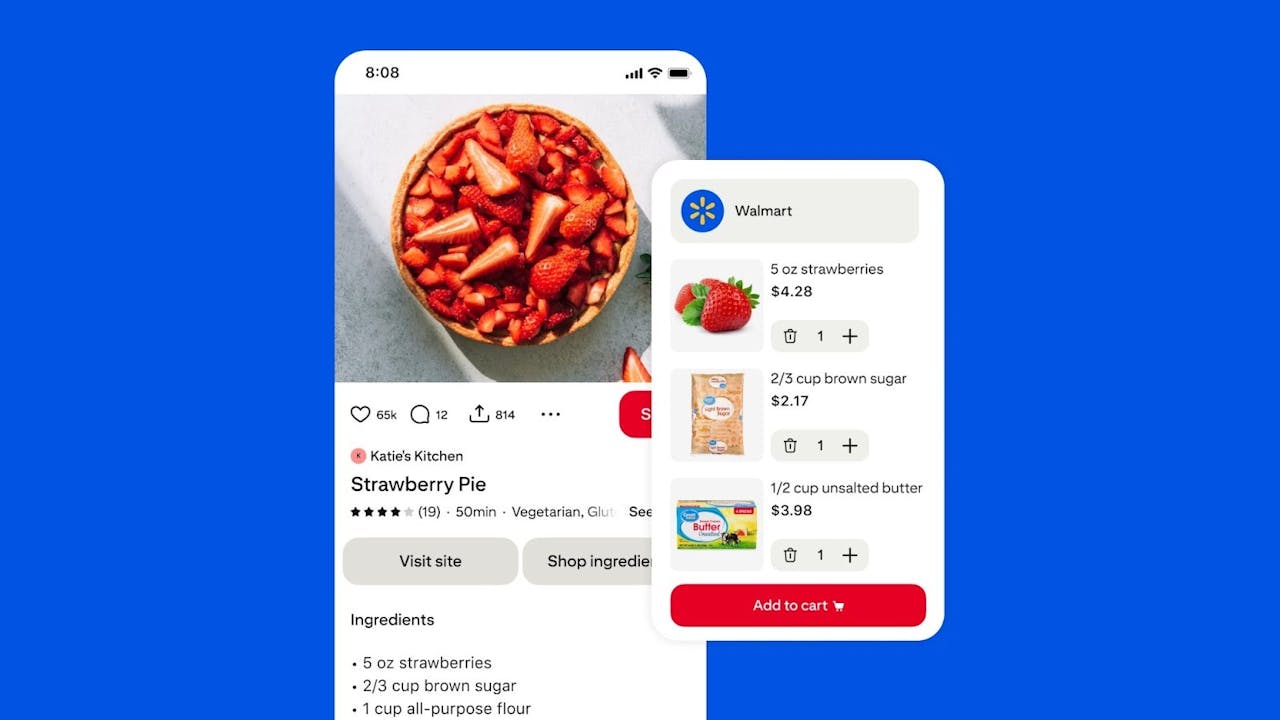
Recipe-based advertising isn’t a new trend, but it is one that has captured the interest of some of the world’s largest retailers. In her latest column, Kiri Masters unpicks why they suddenly care so much about what you’re making for dinner.
Two announcements landed within a week of each other. On Monday, Pinterest and Walmart unveiled a new ‘Shop Ingredients’ button that lets users tap a recipe Pin and add ingredients directly to their Walmart cart. Last week, Albertsons launched an AI shopping assistant with a “Shop Recipe” feature that imports recipes – from URLs or photos — and automatically populates a shopping basket. Even Williams-Sonoma, a home goods retailer, built its new AI assistant around its recipe database, using cooking guidance as the hook for customer engagement
Different companies, same bet: whoever controls the recipe moment controls the cart.
This isn’t new territory. Chicory, a contextual commerce platform, has been powering recipe-based advertising across retail media network partnerships for years. But when Pinterest and Albertsons both sprint toward the same destination in the same week, it’s worth asking why the industry’s biggest players suddenly care so much about what you’re making for dinner.
The answer isn’t that retailers love recipes. It’s that with AI-enabled shopping, they’re losing the early signals of shopping intent—and recipes are the highest-intent, lowest-friction surface they can still own.
A recipe is a shopping list
It’s difficult to reliably infer purchase intent. Is someone browsing Greek yogurt because they’re using it tonight, doing a weekly stock-up, or even picking some up for another person? Recipes solve that problem.
A recipe is structured intent. The ingredients are the shopping list. If someone is looking at a recipe that calls for Greek yogurt, as Yuni Baker-Saito, chief revenue officer at Chicory, put it to me: “You know, there’s someone that uses Greek yogurt. They might be making a list to go to the grocery store, or they might be in the grocery store looking at that recipe.“
That certainty is tantalizing for retailers whose on-site traffic growth has plateaued. Online grocery sales hit $10bn in July 2025, up 26% year-over-year, according to Pinterest’s announcement of its partnership with Walmart. But that growth isn’t evenly distributed across retailer properties. Recipes give retailers new ad space without needing more shoppers to visit their websites.
“We’re nearing the end of the honeymoon phase of retail media,” says Baker-Saito. Networks promised measurement, transparency, and performance. Now they have to deliver; or watch dollars shift to partners who can.
Is this AI-resistant?
Recipe integrations also help defend against a future where retailers own less of the shopping journey.
If AI-enabled commerce gains meaningful traction – agents that build your grocery list, comparison-shop across retailers, and check out on your behalf – the retailer becomes a fulfilment layer. They still see the transaction, but they didn’t influence the decision. The sponsored search ads they’ve been monetizing? Either invisible to an agent handling the purchase, or too late in the journey to matter.
Want to go deeper? Ask The Drum
On-site search is most exposed. If an agent handles my shopping list, I never see the sponsored products in Walmart’s search results. Off-site audience extension faces a different problem: when OpenAI has the same purchase signals as Walmart, because it processed the checkout, the retailer’s data advantage erodes. Two parties now have the transaction data that used to be exclusive.
Recipes sit upstream of both problems. Human inspiration still exists. Pinterest’s power isn’t just the plan – it’s the spark. Albertsons’ “Fridge Cleaner“ feature, which suggests recipes from what you already have, captures an aspiration moment before any transaction happens. If a person chooses the recipe, the agent is simply executing a decision that has already been made.
Some industry voices are sceptical that AI-enabled commerce will hit meaningful adoption anytime soon. Baker-Saito questioned whether it would ever reach the scale needed to truly cannibalise on-site retail media. I’m less relaxed about the timeline. The direction is clear, even if the speed isn’t. And the retailers making these moves aren’t waiting to find out who’s right.
Recipes won’t block AI shopping entirely. But they’re a hedge – a way to capture intent before agents take over execution.
What this means for advertisers
The obvious question brands will be asking is ‘when can I sponsor the ingredients?’
Chicory already enables this on third-party recipe apps. Brands can sponsor specific ingredients at the recipe level across Chicory’s RMN partnerships. The value proposition is simple – someone staring at a list of ingredients either needs them now or this week. For once, the ad matches what the shopper actually wants.
For Pinterest and Walmart, the consumer-facing plumbing is now live. Substitution moments are built into the experience – shoppers can swap products for alternatives and see real-time pricing. That’s performance advertising infrastructure waiting to be switched on. I asked whether sponsored ingredients are on the roadmap, but the company declined to comment.
It would certainly be a compelling value prop for both retailers and brands. The heady growth of retail media is slowing, and retailers are seeing headwinds from AI. When asked about future disruptive forces, RMN leaders at US retailers rated ”zero-click/genAI search disrupting discovery” first (36%), and ”agentic AI changing ad buyer decision-making” second (28%) in their list of top concerns, in a survey conducted by eMarketer and Bain.
Sponsored ingredients in recipe lists could provide brands with salience at the basket-building stage, and offer retailers a new monetization surface that’s resilient to AI-enabled shopping.
Networks have spent years building ever-more-sophisticated targeting based on purchase history and browsing behaviour. Ingredient sponsorship works differently – it’s less about who you’re reaching and more about when.
Baker-Saito put it directly: “Where are you serving ads? That context, that moment, that mental availability, if that consumer is so important. But I think that gets all lost in data.“
Recipes collapse the funnel. What used to be brand → consideration → search → purchase now happens in a single swipe.
The land grab is on
Pinterest, Walmart, Albertsons, Williams-Sonoma – all converging on the same moment that Chicory has been quietly monetising for years.
For advertisers: ingredient-level sponsorship is coming to major platforms. The infrastructure exists. The consumer behaviour is proven. Start thinking now about how your brands show up at the recipe level, not just the search bar.
For retailers: recipes aren’t a cute feature or a meal-planning nice-to-have. They’re a moat against a future where you don’t own the shopping journey any more.
The retailer who controls dinner controls the cart.
Dining and Cooking