
But it will take about five years for his newly planted vines to bear their first fruit. For Bernier, too, the rebuilding process will be long and arduous.
Guiraudon would surely not be the only one to throw in the towel. In this harsh climate, it was hard to imagine people queuing up to repossess the land. Could the Corbières prevent more plots from giving way to abandoned, overgrown lands? Could the region break this vicious cycle where rural flight fuels the flames, which further fuels the flight, which further fuels the flames?
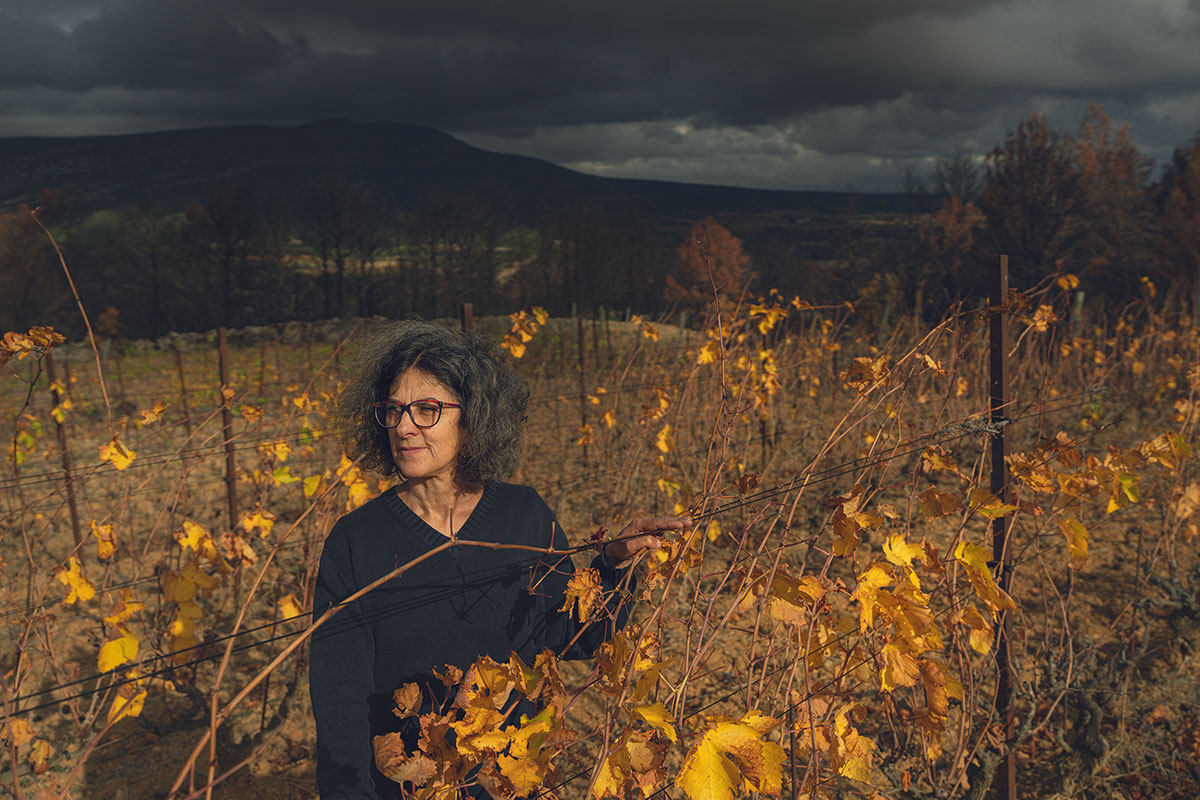
AT THE END of October, I drove out to Château Beauregard Mirouze, an expansive biodynamic wine estate adjacent to a medieval abbey. The estate owners, Nicolas and Karine Mirouze, have been trying to address some of these questions.
Earlier this year, the Mirouzes, whose vineyard had been impacted by wildfires in 2021, set out to establish a farmers’ community hub on the estate that would bring local agricultural, civic, and environmental groups together to plan a viable future for the Corbières region. After the August fire (which bypassed their area), this nascent initiative transformed into a critical base for responding to the urgent needs of victims, helping organize everything from psychological support to dozens of joint rebuilding efforts, including the one on Bernier’s farm.
But this emergency response role was only temporary, Karine Mirouze told me as we sat under a large chestnut tree beside the hub space, a converted front room of the estate’s old family home. Over winter, she intends to gradually reorient the hub’s work back to its original mission.
One of the keys to reimagining the region’s future can be found in its past, she said. “When you look at the landscapes that have burned, they tell a different story to the one we know,” Mirouze said, referring to the countless terraces, stone walls, and other manmade features that the incinerated hillsides had revealed, hinting that the region had a more diversified agricultural system not so long ago.
Livestock farming was once an integral component of these landscapes. Until the end of the Second World War, the hills were “dotted with small herds,” Guillaume Portal, a livestock breeder in the nearby commune of Thézan-des-Corbières, told me. His own farm had been protected from the August fire by the pastureland around it.
“When you look at the landscapes that have burned, they tell a different story to the one we know.”
By reoccupying such lands, not only could grazing animals clear dry brush and help rehabilitate the soil, but shepherds and goatherds could also act as human deterrents to potential fire starters and help with early detection, Portal said.
The Mirouzes’ farm offers an illustration of the potential for symbiotic relationships between these past and present pillars of rural life. In addition to keeping a few of their own sheep and donkeys, they have an agreement with a neighboring shepherd: Throughout the winter, his flock roams freely among their vines; in return, they provide his sheep with a share of the hay they grow for their livestock.
Portal and the Mirouzes are among a growing chorus of voices who believe that a return to pastoralism is critical to saving this region. In fact, a month before the August fire, the Mirouzes had launched a petition, signed by more than 30 agricultural organizations and submitted to local authorities, in which they called for the establishment of a regulatory framework to promote livestock farming on abandoned lands.
Pronto from the European Forest Institute agrees that pastoral agriculture is an “extremely viable” solution.
“The common denominator everywhere where you have these extreme fires is the fuel buildup,” he reiterated. “There’s basically three ways you can deal with that: You can graze it, you can blaze it using prescribed fires, or you can mechanically treat it. The most ecologically safe way is grazing.” Pronto highlighted a project in Catalonia, Spain, called Fire Flocks, which involves local shepherds grazing their herds in strategic fire-risk areas defined by the Catalan Fire Department.
Dining and Cooking