
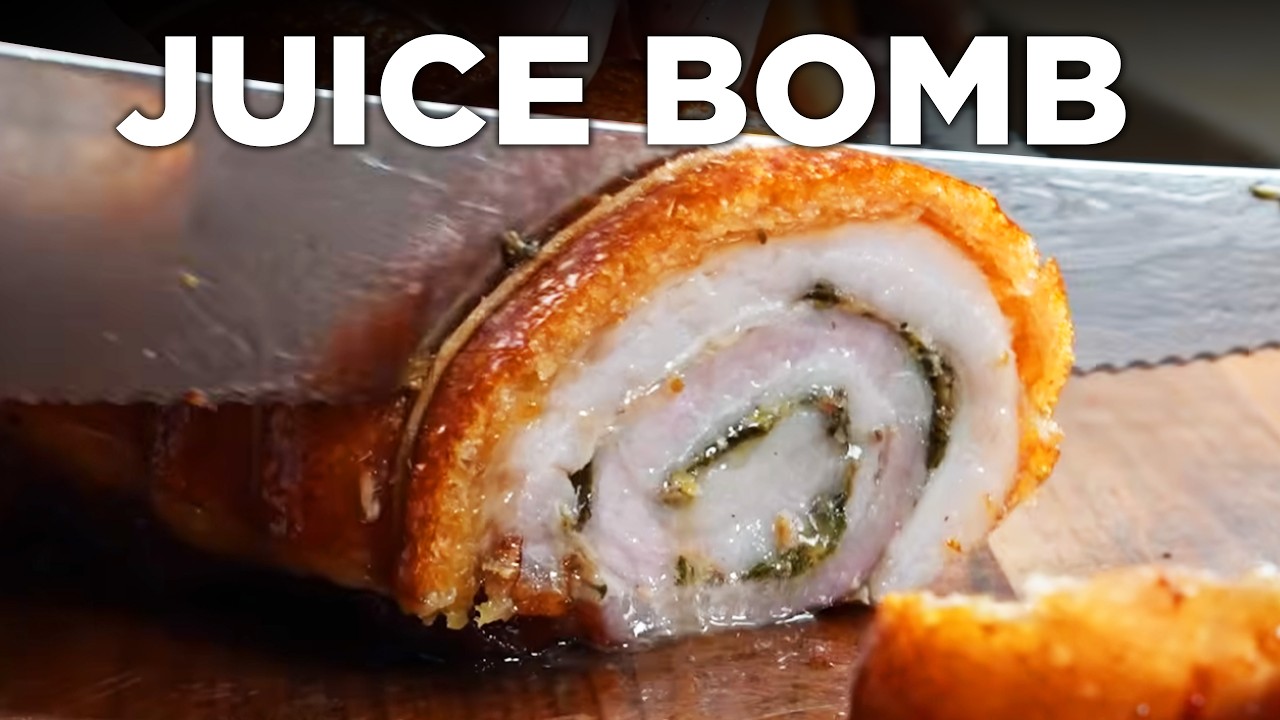
The 1st time I ever tasted Porchetta in Rome, it kinda took my breath away. A whole pig lying on the counter, deboned, rolled up, sewn together, and roasted until the skin is crispy and the meat is juicy and tender. This is one of Rome’s most core and iconic foods, and while we won’t be getting a whole hog, we can still make a porchetta at home — much easier than you think — and it is the perfect centerpiece for your holiday dinner. This is Porchetta.
Today I’ll show you how to recreate this jaw-dropping Roman tradition in your own kitchen with simple techniques that deliver shattering crispy skin and unbelievably juicy meat. Whether it’s for Thanksgiving, Christmas, or any big gathering, this porchetta earns the spotlight.
#cookingchannel #holidaymeals #recipe
📘 Purchase my Holiday Plan of Attack
https://www.notanothercookingshow.tv/purchase-plan-of-attack
✨ Watch all of my Holiday Special Recipes
If you make this, tag me on Instagram @notanothercookingshow — I love seeing your holiday spreads.
Take care of yourself… and go feed yourself.
PATREON:
https://goo.gl/5Nr1oB
RECIPE
https://www.notanothercookingshow.tv/recipes
(Website Design by: https://www.kristasdesignstudio.com/)
HATE LESS COOK MORE HOODIE
https://teespring.com/stores/notanothercookingshow
________________________________________________________________
INSTAGRAM:
https://www.instagram.com/thefoodfreakk
FACEBOOK:
https://www.facebook.com/notanothercookingshow
TWITTER:
Tweets by thefoodfreak
The first time I ever tasted porquetta in Rome, oh my god, incredible. It kind of took my breath away. A whole pig just laying on the counter, deboned, rolled up and sewn together, roasted until the skin is crispy and the meat is juicy and tender. I take one bite and suddenly I believe in heaven. This is one of Rome’s most core and iconic foods. And while we won’t be getting a whole pig, we can still make porquetta at home much easier than you think. And it happens to be the perfect centerpiece for your holiday dinner. This is porquetta. And of course, this recipe, like all of my recipes, is going to be in my holiday plan of attack. My go-to resource for all of you to make sure you enjoy the holidays as much as I do when it comes to food. Family, that’s another that I can’t help with that. And now, of course, since we’re not using a whole hog, this recipe is going to start with pork belly. And today’s Friday, I started this a couple days ago. So, this is prep day. The beauty of this recipe is we can prep this maybe 4 or 5 days before we actually need to cook this. And the longer you wait, the skin of the pork belly just gets drier, which means it just gets better once it’s cooked. First thing we got to do, toast a couple of herbs. Here, I’ve got some whole peppercorns and some whole fennel. Got a hot pan here. Just going to add in the pepper and then roughly an equal amount, maybe a little less of the fennel. Tablespoon, tablespoon and a half. Right away, if the pan’s hot enough, you’re going to start to smell an aromatic smell, all the flavors waking up. And we’re just going to get them into a mortar and pestle. And we’re just going to grind them up. Start by kind of cracking them. I kind of like to push from the side down towards the center. And then once they get cracked, you can just start to roll it around, grinding all the spices up as evenly as you can. You end up with about a tablespoon and a half of black pepper and fennel. Now, to those core flavors, we’re going to add some other wonderful flavors. First, we’ve got about 10 to 12 cloves of garlic. We’re going to get that in. And when it comes to salt, we’re going to base that as a percentage of weight to the amount of weight in pork belly that we have. The pork belly today that we’re going to be using is 5 lb. 1.6% of that, it’s going to be 38 g. So, remember the salt you add, you’re going to have to know the weight of the pork belly and then just do 1.6% of that. Ask the internet what that is in grams, but that’s what you’re going to want to do. Get that in there. Now, we’re going to add our pepper and fennel. Now, I’ve got some fresh rosemary. Maybe two to three stalks of rosemary to that. One bunch of sage, just the leaves. One bunch of parsley here. I’ve got some oregano leaves. So, I’m just going to pull a few stems of those. And we’ve got some fresh thyme. We’re just going to pull the leaves off of as well. To that, some lemon zest. Now, I’ve got these two small lemons, so I’m going to use two. Got a bigger one. I would just use one. And to get the maximum zest out of it, you kind of just start at the top, run it down, and you’re able to get most of the zest off the surface. And then finally, usually you add some chili flake in there, but I’m just going to go ahead and add about 3/4 of a tablespoon of Calabrian chili. Pulse it. Push down the sides. We just want to get it nice and fine so it evenly distributes into the pork. A should smell nice, bright, fresh, herbaceious. That’s what you’re looking for, an herb crumb. Now on to the pork belly. This is an example of a shape of pork belly not ideally suited to make porquetta. I’m friends with my butcher. I can special order things, make sure they set aside a specific piece. And they did that for me the first time. At some point you’re at the whim of what the producer and the animal offers you. And so I’ve got this. And now we’re going to make this work. But I do have others properly prepped which I’m going to show you the difference. Right. So now, first you’re going to look for anything from about a 6 to 8 lb pork belly with the skin on. And you want to ask the butcher, I need it rectangular, as square and rectangular as possible, rather than long and narrow like this. And you’re going to see why that’s important. So the first thing we want to do is use one of these things. This has little needles that stick out of it, and it acts to sort of poke holes in the skin. And those little micro holes, those are going to create an escape hatch for the fat to sort of pour out of and sort of base that skin and get it nice and tender. So, I’m just going to bash it. Now that that’s out of the way, I’m going to cut this in half so it’s easier to work with. So, if you got an 8 lb pork belly, you cut that into two 4 lb pieces. Ideally, you want a pork belly that looks more like this. Roughly the same width as length. So now here we are with one side. Now even though we poked it, there’s one thing we can do that’s kind of nice and it’s going to create a pattern and help the fat render. It’s just we’re going to do slices across, right? And we’re not going to do the other way. Otherwise, the string kind of gets stuck when we tie it. So now there’s two ways to do this. You can either roll it long and thin like this or short and thick like this. I’m going to show you both ways. Then of course a traditional porquetta is served a whole hog. The next level is a big pork belly and a pork loin and you stuff the pork loin in the pork belly. Those two things result in two big a pieces of meat I feel is respectable to serve on Christmas. The sole pork belly porquetta is the most approachable, the cheapest, the easiest to deal with roll up, tie up, and the most practical for at home for the Christmas dinner table. First way we’re going to show you, we’re going to do the thick but short porquetta. So, what that means is I’m going to lay it flat and then I’m going to start to butterfly open the long end. So, I’m going to get down with my knife, find like a little bit above the halfway point, and begin slicing and slowly peeling away until we open it like a book while still keeping it attached to the bottom of the pork. So, there you see how it’s going to work, right? We’re going to roll this up just like that. Before we do that, we got to stuff it. So, I’m going to go down with a little bit of the stuffing and I want to rub in a light layer across the entire thing. You don’t want too much, but there is all that salt in there that you want to make sure you kind of rub into the pork to season it. So now I’m just going to take where that flap is, very tightly roll it up. Just going to clean up the board. I I want to keep that skin really kind of clean and isolated. As you can see, this works. It’s just for a much smaller situation. Final step is to tie it. So, I’m going to go down into the middle. And very simply, I’m just going to do a basic knot, but I’m going to loop it around twice. So, it’s a triple knot. And I’m going to go down the side just to kind of get the knot away from the presentation top and I’m going to tighten it. Then, we’re going to tie another triple knot and then secure it. Then go to either side of it. And the more you do these closer to each other, the more even you’re going to get the porquetta at the end. I’m going to cut off the excess string. And there you’ve got beautiful little pork belly for I don’t know, four people, five people. We’re going to set that off to the side and then work on the other style. We’re going to go the long way. One other thing you got to ask the butcher for is a leaner piece of uh pork belly. And you could score it again, but we’re going to try this one without scoring it. So again, going to open it up like a book, being very careful you don’t cut through any of the sides of the pork. And as you can see, this is a much fattier side. So, I’m just going to trim off some of that fat. And then again, season that inside. And then just like we did before, going to roll it up. And when you do it this way, you’re not going to totally encase it in the skin. Some of the meat’s going to be at the bottom, but you’re going to get a much longer, thinner pork belly or porquetta. And then, same deal. Go towards the center first. Tight knot. Another triple knot. Continue tying up. Making sure that that skin is nice and tight. There’s no crimps in it. There’s no wrinkles. You see this one has more of like a shell around it. Doesn’t completely encase it. Still a nice porquetta. Just thin and long. Now, in their own right, these are perfectly fine porquettas. Can’t you see how like the the shape of the pork belly that we got lends itself to not the ideal shape and size of a borquetto? However, this is more my speed. Same sort of width you get when you roll it the long way. However, it’s just not as big of a piece of meat. Might not satisfy as many people. Same thing here. It’s a little thinner and longer, but this is still long and thicker. And as you can see, these were prepped 3 days ago. This skin is really beautiful and dry. It’s starting to get firm and nice. This is the secret. We need this skin to be as dry as possible. But this is the difference between getting the right piece of meat and getting maybe a less ideal piece of meat. And I’m going to get these into the fridge so they can dry out. These have been in the fridge for 3 days. And you could go ahead and cook them like this. I’m going to go for even more drying out of the skin. So, I’m going to let these go another couple days, which is nice. So, you don’t have to prep this Christmas Eve. You could literally prep this when is Christmas this year. Christmas is a Thursday. You can prep this on Sunday. Let it dry out in a fridge or your second fridge. Easy peasy. Your main course is basically taken care of. Now, today is Friday and these pork bellies, these porquettas, I prepped Monday. And as you can see, that skin has darkened. It’s browned a bit. That’s a sign of the skin being effectively dried out. And that’s exactly what you’re looking for. if it’s still a little white, which you can kind of see under the strings and you can kind of see underneath a little bit like that’s still dried out. But how dark this skin is before you cook it is really going to determine how well that skin crisps up. And now there’s two ways we can approach this and we’re going to show and try both. Now, outside of preparing it and the seasoning and all that, there’s two real tricks we really use to cook this properly, right? The first one was to dry that skin out. And we gave it the better part of a week. And you could probably let this go a day longer. The next thing we need to do is at some point during this cook, introduce this to high heat. And we’re going to do that two ways. First, the high heat in the beginning. The second one, the high heat at the end. We’re going to see which one yields the best result. So, I’m going to set this in the fridge and we’re going to get this guy into the oven. No oil, no nothing. We’ve got a 425°ree oven preheated and we’re going to roast it at that high temperature for about 30 45 minutes. Now, I know I said 425, but after further consideration, I think 450 is the right temp. And with convection, if your oven has it, that high heat is going to help render the fat under the skin. And once that fat starts rendering, it almost starts to fry that leathery skin into a puff. I got to add some water to the bottom of the pan just cuz the juice from the pork belly started dripping and burning. Just use a clean sheet tray when you start this cook so it doesn’t burn. Now, that skin that doesn’t puff up may stay crunchy, but just not as tender, more like glass. And all we’re really doing now is waiting for the skin to darken and puff to our desired taste. This route gives you control. You cook that skin to the puffy and crispiness that you want now, but once you lower the temperature, it’s not going to get much crispier or puffier. But rendering the fat is essential. If you’ve ever had pork skin that is kind of sticky in your mouth and your teeth, it’s because the skin is crispy, but the fat’s not fully rendered underneath it. Crisp skin will have that fat fully rendered till there’s almost a space between the meat and the skin. I’m going to take it out, but I could have left it in longer. And I’d recommend just doing this stage of the pork carefully. This is going to determine how amazing that skin’s going to be. Stick a thermometer into the center of the pork belly so we can monitor when it’s done. And then we can also get that second pork belly on. This is going to start slow and then we’re going to finish it on high heat to see the difference. And then we’re going to lower the heat down to 325. I’m just going to monitor this until it hits around 100. Anywhere really between like 170 and 200. You kind of don’t want this to be like falling apart, shreddable. You want it kind of like on the edge where it melts in your mouth, but there’s nothing really tough about it. I’ll probably shoot for around 185, 190. Now, what’s nice about starting a pork belly low and slow is it gives extra time and heat to further dry that skin out before crisping it up. We’re just going to double check the temp in the pork belly. Make sure I’m not in any fat pockets. Looks like we’re about 155. And I like to pull mine around 185, 190. Right now, I’m going to check the temp of the pork belly that’s been going low and slow and it’s at around 130. I think that’s the right amount of time to fully crisp up that skin. So, I’m going to turn the heat back up to 450. And I’m going to let that bigger pork belly stay in there while it heats up just to give it some a little extra crisp. And once I hit 185, I’m going to pull it out of the oven, remove the thermometer, and then place it into the other pork belly so I can monitor its temp when it’s in the oven. It’s about 190 in the center. Took out the thermometer, placed it into the other one that’s at about 140. We’re just going to try and crisp up that skin. One thing I will say though is I probably would have let this sit in the blasting heat in the beginning a little bit longer just because some parts down here are crisp but they’re like a little bit not like a cracker. So I really want you to allow in that first step that crackling to really make its way all the way down here. So we’re let this cool while the other porquetta finishes. Now, that second one’s been in that high heat now for a minute. And as you can see, we’re getting a lot of that bubbling and puffing in the skin, and it’s extraordinarily crispy. To me, this skin is looking better than the first one. It’s around 175, and we can let that go for another 10° before we pull it. And there’s our second porquetta. And if I may say so myself, incredibly gorgeous looking skin. slight puffing around the edges, so you get that puffy crisp, but it also is really just like glass. Now, this one is the one where the skin does not wrap all the way around, the skinnier, longer one, but because the skin doesn’t wrap around, it sort of ensures a maximum crispy. Whereas on this one, there’s a little still very crisp, but has some soft spots to it. Now, before tasting either of them, here are my thoughts about the techniques. I really like the first technique because I can then control the skin, whether I’m using the smaller one or the bigger one. I can then dial the skin into exact crispiness I want. Make sure it kind of creeps all the way down. Make sure we got some of this nice popping and bubbling that we got on this one that we didn’t so much get on this one, but we still got it blistering happening. And then you slow the heat down and just cook it to the temperature you want. And this is good to go. Also, if you’ve got guests coming, when you blast this at a higher heat, there’s lots of smoke. And this one is done last. So, if you don’t want your guests inhaling smoke from your oven, the hot and fast in the beginning and then slow is probably the way you want to go. What I like about this is it’s time in the oven to slowly render the fat and to allow that skin to get maximum dried. And then once you hit it, you get that blistering that’s really nice on the outside. Going to let that cool and then we’re going to make some sandwiches. It’s not what I’m going to serve on holiday, but I got to make porquetta sandwiches. I’m sorry. Now, you’re going to need a serrated knife. Trying to cut through this with a normal knife is just going to kind of harm it. Oh my god. Now, let’s analyze. Notice the rendered skin, puffed and crisp. And underneath there’s no real fat. Meat is tender. Let’s see how it tastes. Look at my fingers. Incredible. Not fall apart, but tender. We’ve got one. Let’s see the other. Now, let’s give the big one a taste. I think they’re both great. It’s salty, herby, fatty, tender. I will say the skin on the second one is better. If you tear off a little bit of the skin that isn’t fully rendered, a little tough and a little sticky. See, now this one, it’s a little bit more puffy. And here’s what we’re going to do. It just don’t get much better than that. If I’m cooking this again, surprisingly, I didn’t think I would choose this. I’m going with the long and the skinny one where the skin does not completely encase it. And I’m actually going to cook it the reverse way. I find the meat overall was more succulent. It was juicier. It was more tender. And of course, that skin is much better. I hope you enjoyed this. Again, if you like this recipe, it’s going to be in my holiday plan of attack. It’s got this and all of my recipes, about over 60 of them for Christmas and Thanksgiving. Everything from sides, desserts, manes, appetizers, you name it, it’s got it. And I’ve gotten so many reviews from people who said it has actually worked within their family and it’s now part of their tradition. Links going to be down in the description. That’s all that I have today. I’ll see you next time. Until then, take care of yourself and go feed yourself.
48 Comments
One of the few people I've seen who zest correctly! This looks amazing I have to make it.
So one thing to try out next time around for that really blistered skin is a brushing of vinegar (any will do) over the meat for the final high heat blast at the end. If you really wanna go the extra mile, then we turn to the Asian style of ladling some hot oil over the meat.
For several years now I'm been making a porchetta/cuban lechon hybrid for christmas. Basically it's a porchetta but instead of using an italian seasoning in the center I use one with a cuban flavor profile (garlic/sour orange mojo). I call it a porchon and the fam goes wild for it. The only trick is it can be hard to find fresh pork belly with the skin on, which is essential.
Il y a aussi la version avec aussi du Cognac ou de l'Armagnac, ou du rhum, ou autre alcool fort ou du vin surtout du vin fort (Sauternes ; Porto…) appliqué sur la viande et de la bière rajoutée sur la peau tout à la fin de la cuisson.
You are a fucking genius. I am certainly not boasting, but my friends and family think I’m a pretty good home cook. But anytime I see one of your videos, whatever it is you’re cooking, I just do it your way. It’s always perfect. Also you are skilled at making videos that are entertaining and easy to follow. Awesome man, just awesome. I’m buying that book.
It's just another form of chicharrones
Sorry, but do you not remove the hairs?
Outstanding!!~~
That herb mixture is referred to as a "gremolata" in culinary terms. Also, it helps a lot to salt your skin heavily during the drying phase then wipe it off before cooking to aid in drawing moisture from the skin. Those are gorgeous! Im going to make this for my next family get together!
So is what we are putting in the middle of the porchetta, is that a gremilota?
What about the recipe of pouring hot oil over the skin at the end to puff up?
Try that with an orange glaze for a meal one time, see how it goes over…
Thought it may pair well with the rosemary and herbs…
Woooooow❤
Good content as always man, thanks
the nipples on that first cut threw me…
I understand what you’re doing, you have not wash or taken hair off the skin and that a lot of hairs in the skin. I like Vincenzo Plate the real Italian was doing much better pure clean, juicy and crispier on his porchetta. I’m sorry to tell you this because you left a lot hairs on the skins that I won’t eat it. But it look nice but next time remove the hairs off the skin. Ty!
fabulous video…..legend
I'm drooling here.😊
That hair puts me off 🤢🤢
Great vid! The low heat in the beginning is another opportunity to dry out that skin before hitting it with the high heat.
Looks awesome man. Do you prefer fennel pollen? I found that it has a little better floral and slightly less bitter flavor. I imagine the toasting helps with that for the seeds though.
Please let me know if I understood your recommendation at the end… You preferred the longer, thinner porchetta with the skin not wrapped all the way around, but you would cook it the way you cooked the shorter, fatter porchetta, meaning the high-heat first method? Just confused because that long thin one looked hella crunchy!
Try Filipino Lechon Belly
the tray you use for cooking..what are they called?
The comparison is super useful, thanks
I would use a blow torch and torch the skin 1st to remove hair then clean it with a towel then poke holes and proceeds
99% of Filipinos think that they invented this food item. They call it Bellychon, 😂😂😂. The masses pretended that this food item is traditional. But it was only introduced in recent years. Now everyone is pretending it was something they had in their childhood.
My 0nly question is, could you have rub some 🧂 on the skin while in the fridge, then wiping it off before you put it in the oven, after its been in the fridge for a crisper texture? Of the skin! Just a thought of having a nice beautiful crisper crunch to the skin! Just asking if it would work, for crisper crunchy taste😊!
Thanks for sharing 👍
I am a professional chef in Italy, and I have been making porchetta for many years. Mine is a recipe that is inspired both by the porchetta of my region, the Marche, and by the influences of Umbria and Lazio, in short, a recipe from central Italy; for every kg of meat, I put 19/20 grams of salt, and 2.5 of black pepper. 1 large clove of garlic for every kg, + 1, finely chopped with the peel, will give a particular aroma to the porchetta… then I add coriander, and nutmeg ( just a little…). Finally, I prepare the finely chopped aromatic herbs: wild fennel and rosemary, and in smaller quantities also thyme and sage. I massage the meat well with the spices, and then I also add the aromatic herbs. I cook it at a low temperature for at least 4/5 hours, or in any case until the "heart" temperature reaches 74/75 degrees celsius. And in the last minutes before the end of cooking, I raise the temperature almost to the maximum and add coarse salt over the crust, so that it rises slightly while remaining nice and crunchy. I hope my advice has been helpful
Yes!
I'm from the UK and you saying those Lemons were small genuinely shocked me. They would be massive Lemons here 😅
18:00 which way was the reverse way again?
u need to shave the skin of pork cuz i can see the hair
Awesome recipe! I like to use fennel pollen – it's a it expensive and not always easy to source, but it has a really beautiful aroma that goes super well with pork.
180F is crazy high! Maybe the belly can take it, but I made a porchetta with a loin inside and even at 170F the loin was dry. The safe temp for pork is 'only' 140F, so I'd suggesting pulling way earlier than 180.
I'm hungry now
sexy
Best part was moping the cutting board with the bread. A proper cook's sandwich!
Is it weird that I know it's a Combustion Inc Thermometer?
I noticed the pork hair hair on the skin. We normally shave or torch those in asian cooking. Is this not done in italian cooking?
16:44 omg ❤
1:50 Ouch ! Your cutting board doesn't like the sharp feet on that pestle !
Stephen, I'm guessing you're a fan of Chris's predictive thermometer ?
If you pooch the cook a little and the top is nice and crispy but the sides (especially) towards the bottom are still a bit soft, here's a hack. If you have a hardware store style heat gun you can use it to 'wave' over the soft pork and literally watch it bubble and crisp up before your eyes. It only takes a minute or two. In fact BE CAREFUL or you will burn the crackle if you get the nozzle too close and or you don't wave it to disperse the flow of superheated air.
Is it an excuse to not cook it right the first time ? No of course not, but it may just save your bacon for serving …. err …make that save your pork !
Leaving a slab of pork like that in my fridge for five days it would sure go off.
I always put a touch of salt and baking soda on the skin while it is drying. The baking soda will give you incredibly crispy skin, and the salt helps to dry it out. I just remove a tablespoon or two of the weighted out salt from the beginning step so that it isn't too salty at the end.
What do you do with the hair?