
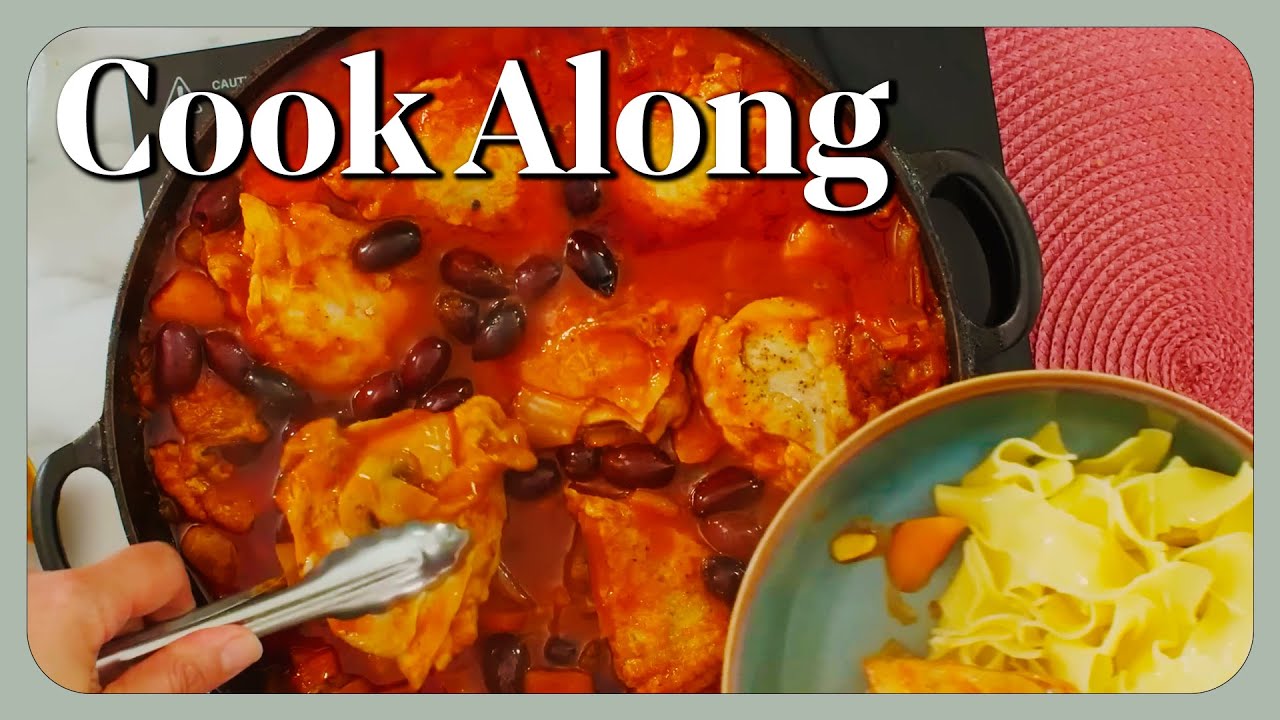
A weeknight dinner classic from the new cookbook Anna Cooks! Chicken cacciatore translates to “hunter’s chicken,” referring to the origins of the dish—a hunter bringing home their take (chicken?) in addition to mushrooms and herbs gathered in the forest while out hunting.
——–
*• Recipe Information •*
Serves 4
Prep time: 20 minutes
Cook time: 1 hour
Note: The stew can be prepared ahead and stored in an airtight container in the fridge for up to 2 days or in the freezer for up to 3 months. Reheat, covered, over medium heat, stirring only occasionally to keep the chicken pieces intact.
Cooking for a crowd? To bolster the stew to make it heartier or feed a few more, cook 1 lb (450 g) Italian sausage meat in the pan and remove before searing the chicken, then add it back to the pan when you add the chicken to braise.
——–
*• Ingredients •*
Extra-virgin olive oil, for the pan
6 to 8 bone-in, skin-on chicken thighs (about 2.2 lb/1 kg)
1 large onion, diced
2 medium carrots, diced
½ lb (225 g) cremini mushrooms, sliced
4 cloves garlic, minced
3 bay leaves
1 cup (250 mL) dry white wine
2 cups (500 mL) crushed tomatoes
Salt and black pepper, to taste
¼ cup (32 g) roughly chopped fresh Italian parsley
1 red bell pepper, seeded and diced
1 Tbsp (4 g) chopped fresh oregano or 1 tsp dried oregano
½ tsp red chili flakes (optional)
1 cup (130 g) pitted kalamata olives (optional)
——–
*• Directions •*
1. Drizzle the olive oil in a large sauté pan or medium Dutch oven over high heat. Add the chicken thighs, skin side down, in a single layer in the pan and sear for about 3 minutes on each side. Remove the chicken to a plate and reduce the heat to medium.
2. Add the onions, carrots and peppers and sauté for about 5 minutes, until the onions become a little translucent. Add the mushrooms and increase the heat to medium-high, sautéing until any excess moisture has evaporated, another 5 minutes. Stir in the garlic, bay leaves, oregano and chili flakes and stir 1 minute more.
3. Add the white wine and bring this to a simmer, still on medium-high heat, followed by the crushed tomatoes. Once the liquid begins to bubble, reduce the heat to medium to medium-low to maintain a gentle simmer and add the chicken back to the pot, nestling it in skin side up. Cover the pan and simmer for about 40 minutes, stirring gently once or twice while cooking, until the chicken is fully cooked.
4. Before serving, remove the bay leaves and season to taste. Stir in the olives. Stir in the parsley immediately before serving.
5. Serve with wide noodles with butter or olive oil, or boiled potatoes.
——–
Excerpted from Anna Cooks by Anna Olson. Copyright © 2025 Anna Olson. Photographs by Janis Nicolay. Published by Appetite by Random House®, a division of Penguin Random House Canada Limited. Reproduced by arrangement with the Publisher. All rights reserved.
I’m so glad you could join me for this easy weekn night meal all made in one pan. It’s a bit of a classic. It’s chicken cacator. What really defines a kachaturi? So, done in the style of the hunter is a meat cooked in a tomato sauce with lots of mushrooms which you would find in the woods assuming you’re a hunter hunting though. Are you really hunting chicken? Maybe from your neighbor’s backyard. The first thing I want to do is get my vegetables ready before I start searing my chicken. So, this all happens in one pan stove top. I’ve already diced up my onions. Just coarsely chop them. I’ve peeled my carrots. The recipe calls for two large carrots. Mine are on the small size, so I’m doing three. And what I like to do when I’m cutting vegetables for a stew or a braze like this is do what’s called the pyan or country cut, also called the rolling cut. Cuz you can see the way I’m rotating the carrot. And you know how some carrots can be slender at one end and really thick on the other. When you use this method, it evens out the shapes so that they cook evenly and every bite is the same. Essentially, your carrot should fit easily on your fork. I also like using this cut when I’m doing roasted vegetables because if you simply slice coins of your vegetables, especially if you’re doing a mix of say carrots and parsnips and other vegetables, they can just look flat on the plate and these really take on browning if you’re doing a roasted root vegetable. Okay, we’ve got carrots. Let me just put that in a bowl. Additionally, you need a whole pepper. And an easy way to cut your pepper is to use the natural four sides, the way a pepper grows. And I cut through. And you can notice I’m leaving that white spongy membrane intact here. And instead of cutting the pepper in half and seeds going everywhere, they stay attached. But I won’t waste this little bit of pepper there. If you want, you can further take away the membrane. I do that if I’m doing a finer cut, but you’re worth it. I’m gonna take a moment. It’s just a good habit. The spongginess, it just it it tastes like nothing. The texture isn’t great. And matching the size of the carrots, I’ll give my peppers a bit of a rough chop, or a bit of a dice, I should say. All right, I just need to grab a bowl for these because before I cook the vegetables, I have to start by searing the chicken. First, I want to preheat my pan. on high heat. I’m using a cast enamel pan. A heavy skillet really does the best job. And you want to make sure it has a lid, too. When you braze, it’s called a combination cook method. So, first you introduce dry heat by searing your chicken. Then you introduce uh a moist cooking environment. In this case, it’s going to be combination of white wine and tomato sauce. And that two-step of cooking layers in flavor and keeps the meat nice and juicy. Chicken thighs are best for a recipe like this. They stay nice and moist. I’ve got skin on bone in chicken thighs. You can use boneless, skinless, but I just wanted to show you the step of searing, which adds flavor to the skin and the chicken itself when you cook it. You actually want a little bit sticking to the bottom of the pan. Nice gug of olive oil. Give that just a second to heat up and that oil should create a barrier. But, you know, now and again, if you’re taking your chicken cold from the fridge, it can have a tendency to stick the to the bottom of the pan. But, it’s not a problem. there. My oil is really running around, so I know it’s nice and hot. If you’re using a smaller, deeper pan, you might have to sear your chicken in batches. I start skin side down [Music] and I’ll just add a light sprinkle of salt and pepper. So, I season a little bit as I go, but ultimately it’s at the end you want to do your final seasoning. So, I’m just looking to get a bit of brown color on the skin. And I will flip it over and continue to cook. It’s a bit of a myth that searing your meat keeps in the juices. It doesn’t. It’s all about layering the flavor. So that caramelization of browning the skin and browning the meat adds a level of flavor to your finished dish. You could, if you wanted to, just nestle your chicken thighs into the liquid once you’ve got everything cooked further along, and I’ll show you that point. But this really is a worthwhile step. I think my pan was nice and hot. These aren’t sticking. [Music] [Music] So, while my chicken thighs are sizzling away, let’s talk about dry heat cooking. What is dry heat cooking? An example is pan frying, grilling, even roasting, where your ambient temperature around the food can be really, really hot. Think of a pizza oven. Um, or when you preheat your oven to 400° and so you can just really put a lot of heat on the outside of your meat or whatever you’re cooking compared to a wet cooking method. So that would be boiling, poaching, steaming, anything that involves liquid. Well, liquid turns to steam at 212 Fahrenheit, 100 C. So, your temperature of your cooking ingredients that’s cooking the meat can’t get higher than that. Which is why this combination, we’ve got the high heat to build in flavor and we’ll be adding liquid to then slowly simmer and use the liquid itself to flavor your main ingredients. All right, let’s give this chicken a flip. Oh, look at that nice browning. Oh, outside piece. I need to dip that over to get a little color. Don’t worry if you get a few pieces stuck to the bottom of the pan because once I add the next ingredient, the layer of vegetables, the moisture from the vegetables plus the acidity from the liquid I add will loosen that and ensure that that flavor goes into the whole dish. All right. Now to take the chicken out. And you do have to treat it like it’s still raw chicken because it is still raw chicken even though it’s cooked on the outside. [Music] So, I’ll just set this aside with my chicken tongs and I’ll turn down my heat because now we want to soften up those vegetables. So, the onion I talked about, those beautifully cut carrots, and the pepper. And so, you want to cook this for just about 5 minutes. What I love about a dish like this is while you have the initial active cooking time where you’re stirring the vegetables, searing the chicken, once you get the liquid in the pot and the lid on, well, that’s the passive cooking time. I mean, you can go take care of whatever you have to do in that time as your dinner cooks away. While the vegetables soften up, let’s talk about the partner of chicken kachaturi and that’s chicken shasser. So, while kachaturi is Italian, shasser is French and it means the exact same thing in the style of the hunter, but there are distinct differences between the two. So, first let’s talk about what kachaturi and shaser share in common. I’m using chicken in this case, onion, carrot. It’s cooked with white wine and tomato sauce. Now, let’s talk about what’s different between kachaturi and chassur because it reflects the regionality of the dishes. So, kachaturi has the red bell pepper. It uses oregano. It will have olives often stirred into it at the very end. Whereas Shasser doesn’t have the pepper, doubles up on the mushrooms, and instead of oregano, features teragon, sometimes a splash of brandy, and can even have some beefto or chicken stock added to it. All right, I’ve had my vegetables on medium heat and they’ve softened up. So now I’m going to turn up the heat a little bit more because it’s time to add my mushrooms. So it’s not a catchur or a chasser without the mushrooms. And at this point, like I season the chicken lightly, I’m going to season the vegetables just slightly. The reason I turn up the heat is because the mushrooms are going to let out liquid and I don’t want them to turn soggy or flabby. So, a higher heat really works because the moisture comes out of the mushrooms, protects the other vegetables so they don’t brown too much, and we can let that water evaporate. You see a little browning in the bottom of your pan. So long as it’s not turning black because once I add the white wine, that will delaze the pan. It will pull off that beautiful caramelization. All right, I think my mushrooms are nicely softened. Turn down the heat a little bit. And now for some more flavor builders. Four cloves of garlic. Yes, this is a garlicky dish. Of course, you know what your family likes and what you like, so you can control it. I had mentioned oregano. You can use fresh if you wish, but dried oregano, I find, is actually more consistent and lends just such a familiar flavor. I like using dried oregano. Even though I’m a big fan of fresh herbs for everything else. And it’s up to you if you want to add a pinch of chili flakes. I’m going for a little bit of heat, maybe a little bit more. And I just stir this for a moment just to soften up the garlic, but I don’t want to scorch it. All right. Now, for the liquids, a combination of dry white wine. And if you don’t want to use wine, you could simply replace this with a chicken stock or a vegetable stock if you’d rather or even water. Sometimes we’re too afraid of using water in our cooking. There’s nothing wrong with that. We’re building in so much other flavor. And I let this start to simmer. And you can see I’m able to pull up all those sticky bits from the bottom of the pan. And that will continue to happen. You can see how it changes the color of the liquid there. And as soon as it’s bubbling evenly, I’ll add my tomato. Here we go. For the tomato, I’m using a tinned crushed tomato. You could use a tomato pada, which is also a cooked tomato product, but it’s more strained, so it’s got a finer texture to it. I like the the thickness that crushed tomato lends. [Music] And as soon as this mixture returns to a simmer, it’s time to bring back the chicken. Okay, I’ll nestle the chicken back into the pan. When you’re brazing, you don’t have to fully submerge your meat in the liquid. So, leaving a little of the nicely brown skin exposed is absolutely fine. In go extra juices. All right. And now, to keep all the flavor and the liquid in, you give it a cover. You reduce the heat to a gentle simmer. But because these are just little individual chicken thighs, this only takes about 40 minutes. Now, if you’d rather not cook this stove top for that time, you can put this pan in a preheated 350 oven and it takes the exact same time. So, the choice is yours. And in 40 minutes, oh, you’ll know because the kitchen will smell delicious. Oh, it sure smells incredible in here. I can smell the peppers and the mushrooms. And the nice thing about using chicken thighs is you don’t have to worry about overcooking. They can handle that extra heat and moisture without drying out, unlike chicken breasts which can do that. So now Oh, I love how the juices from the chicken cook into the sauce and the flavor from the sauce cooks into the chicken. And I should mention as I’m putting my lid on the stove, my stove works just fine, but because we have a camera mounted overhead so you can see this deliciousness, that’s why I wanted to cook this right in front of you facing you instead of with my back to you during the whole recipe. So now I will leave it up to you if you want to pull off some of the excess fat that is from the chicken skin and the residual olive oil if you want or if you prefer that to sort of coat through. You can stir it through easily. My last additions for the catchuri some pitted black olives. If you prefer green, you can use green. I love when I know you can take a recipe of mine and customize it and really make yourself happy with how you’ve tailored it to your own tastes. And I do I think I’ll save the parsley for when I plate this. And this dish is just made to serve with some cooked noodles. Any sort of pasta that can really hold the sauce and every bite as you’re scooping it. So, let me take out a few pieces of the chicken. And before I spoon out the sauce, I do want to give it just a little taste just to see if it needs any adjustment in the seasoning. No, it is great. Wow. Make sure I get a nice mix of vegetables. that sprinkling of parsley. And so really about 10 15 minutes of active cooking, 40 minutes of passive cooking, letting the catchuri do its thing and you have a delicious aromatic one pot meal that is just so comforting. And like anything cooked with this two-step brazing method, dry followed by wet, you know, it even tastes better the next day. I hope you’ll give my chicken kachaturi recipe a try and stay right here on the channel because I’ve got lots of baking and cooking. So many recipes to share with you. It’s been nice to see you. I’ll see you again soon. [Music] Oh yeah, that’s hot. M. It’s amazing how much flavor you can work in in 40 minutes of cooking. [Music]
15 Comments
Wow Yummy 😋🤤
Love this and all your recipes You’re videos are wonderful ❤
😅😅😅
Yummy ❤❤❤
Looks fantastic. Thanks😊
❤
Funny I just made this earlier this week. Fall classic.
Pet peeve…using the same utensils that were touching raw meat or chicken and again on the cooked/cooking meat or chicken is a recipe for serious food bourne illness from cross contamination. Sorry, just had to say that…
It looks great. What kind of pasta was that?
Your recipes are always great! Thank you!
Just made your butter chicken and weekday
chocolate cake, fabulous and so excited to try more recipes from your latest cookbook
Thanks Anna, I’ll definitely try this.
Also I made the ( depression) chocolate cake ( because I had run out of eggs!) last week and my ( married) children absolutely LOVED it! 💗
Hi Anna. I am continuously trying out most of your recipes, old and new, and loving it. My married children and grandchildren get a constant flow delivered to them! Last week they made a surprise party for my husband and myself for our 50 year wedding anniversary. Amongst other things, they made a poem about us, it was a joint effort. And guess what? You Anna , featured in it!!!!!
It went like this: “ ….and now Anna Olson fills her screens, with cakes of marble – layered dreams….”
I just had to tell you!!!
Fabulous Anna thank you so much be bless with family
I love the way you prepared this chicken recipe. This i have to try.Thank you Anna and keep on bringing more recipes.