
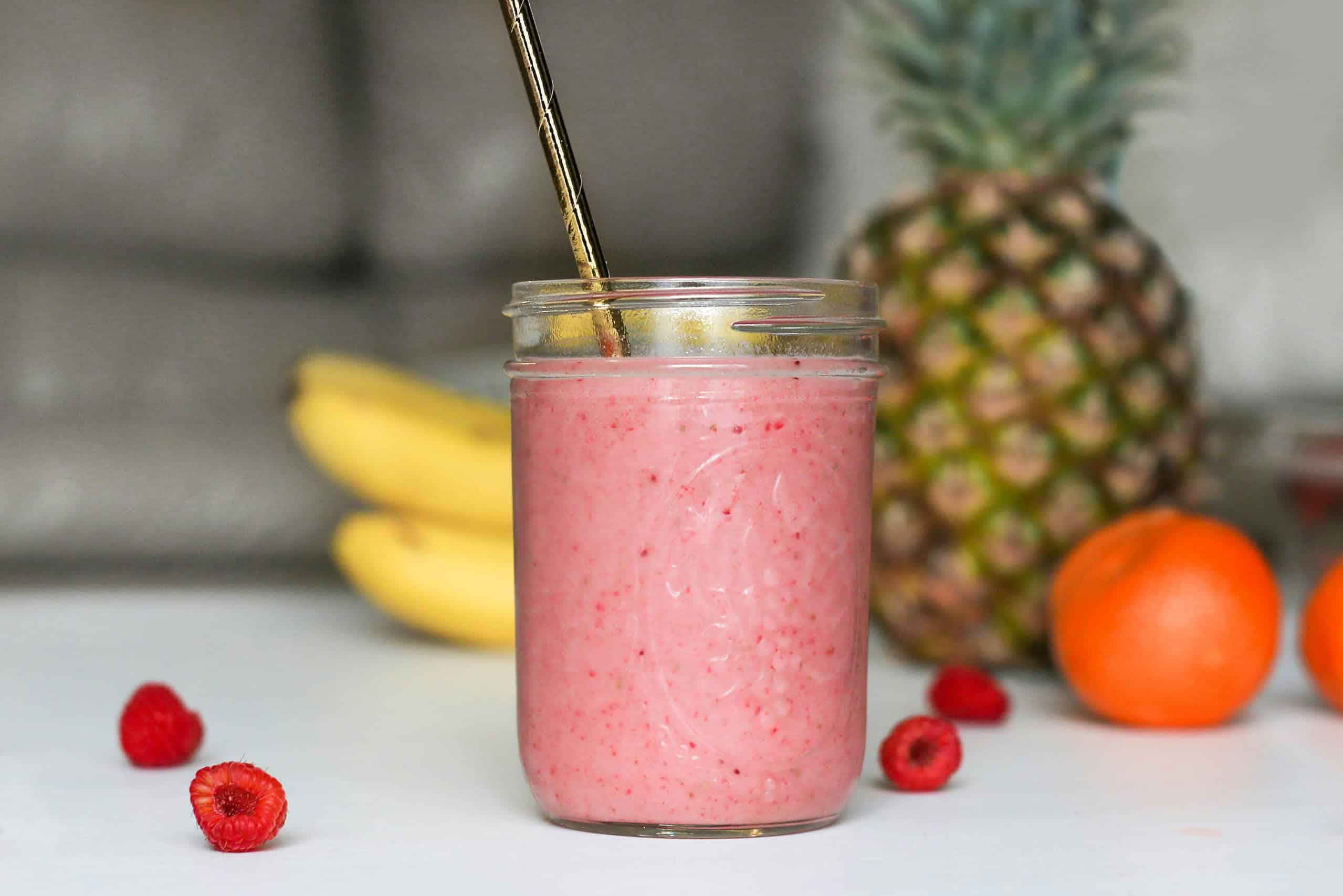
Few things go together as well as bananas and smoothies. They provide the perfect texture and sweetness. But a study published in the journal Food & Function suggests we might need to rethink our morning routine.
The research focused on the “food matrix” — essentially, how ingredients interact with one another on a microscopic level. It turns out that an enzyme found in abundance in bananas acts as a destroyer of flavanols, a specific class of bioactive compounds linked to heart and brain health.
It’s not that bananas aren’t healthy (they are). It’s that they don’t play nice with other fruits, particularly berries.
More Than the Sum of Its Parts
It’s easy to assume that when you blend ingredients, the result is just the sum of the parts. You blend A and B, you eat A plus B. But chemistry is rarely that simple.
In this case, the key is a group of flavanols called Flavan-3-ols. These are found in things like berries, cocoa, apples, and tea. They have substantial health benefits, particularly for cardiovascular health. The Academy of Nutrition and Dietetics recently recommended consuming 400 to 600 milligrams of these daily for cardiometabolic protection.
The problem arises when these meet polyphenol oxidase (PPO).
Bananas are packed with PPO. This enzyme is the reason an apple turns brown when you slice it and leave it out. That browning is an enzymatic reaction where PPO oxidizes polyphenols. In nature, this is a plant’s defense mechanism. In your smoothie, it’s a nutrient massacre.
Gone in 60 Seconds
Researchers at the University of California, Davis, and the University of Reading wanted to see exactly how much damage this enzyme could do. They designed a study using eight healthy men. The participants were given three different interventions on different days:
The control group received a capsule containing flavanols (from cocoa extract), taken with water.
The banana-less group received a mixed berry smoothie (naturally low in PPO) spiked with the same cocoa extract.
The banana group received a banana-based smoothie (naturally high in PPO) spiked with the cocoa extract.
The researchers then drew blood from the participants over the next six hours to see how many of those beneficial flavanols actually made it into their systems.
When the men took the capsule, their bodies absorbed a healthy dose of flavanols. When they drank the berry smoothie, the results were almost identical to the capsule. The berries didn’t cause any change.
But when the banana came in, the levels of flavanols in their blood plummeted. The peak concentration was 84% lower than the control.
“We were really surprised to see how quickly adding a single banana decreased the level of flavanols in the smoothie and the levels of flavanol absorbed in the body,” Ottaviani said. “This highlights how food preparation and combinations can affect the absorption of dietary compounds in foods.”
The researchers analyzed the banana smoothie immediately after preparation. They found that the flavanol levels dropped rapidly — within minutes of blending. The moment the banana’s cells were crushed by the blender blades, the PPO enzyme was released and began hunting down the flavanols.
How To Fix Your Smoothie
It isn’t just about bananas. The researchers tested 18 different fruits and vegetables to see which ones possessed this flavanol-destroying power. The saboteurs included high-PPO foods like beets and pears. Meanwhile, berries, citrus fruits, tropicals and greens caused no flavanoid problems.
“This is certainly an area that deserves more attention in the field of polyphenols and bioactive compounds in general,” said Ottaviani.
But before you cast the humble banana aside, let’s give a bit of nuance.
Flavanols aren’t the only healthy ingredient in fruit. Bananas are excellent sources of potassium, fiber, and energy. They are convenient, cheap, and delicious. The study does not say bananas are bad for you. It says they are bad companions for flavanols.
The solution is to stop pairing bananas with flavanol-rich foods. If you want a berry or cocoa smoothie, skip the banana. Thicken it with yogurt, avocado (which has very low PPO activity), or frozen mango instead. If you want a banana smoothie, just go for it. Add protein powder, peanut butter, or milk. These ingredients don’t rely on flavanols for their nutritional value.
Bon Appétit!
The study was published in Food & Nutrition.
Dining and Cooking