
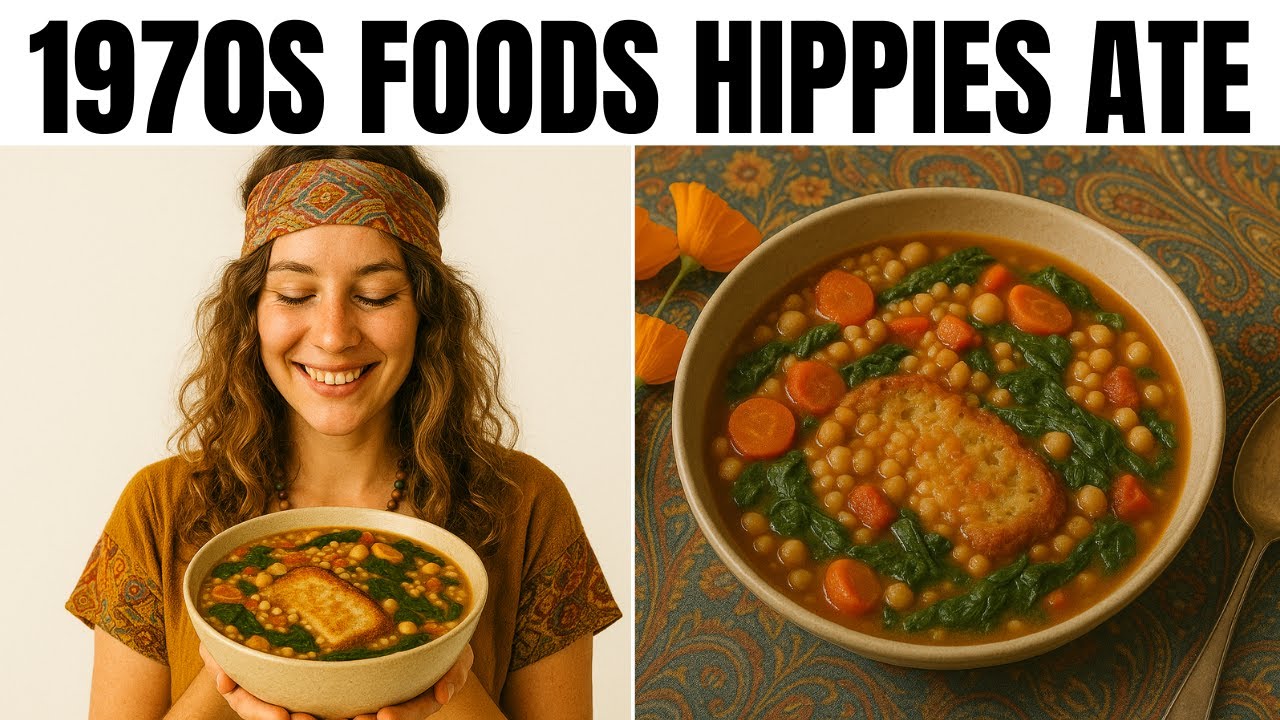
This #historical #foodhistory drops you straight into the #hippies kitchens of off-grid cabins, shared farmhouses, and counterculture communes during the peak of the #1970s . These are 25 foods hippies actually cooked in 1970s #communes — meals built around #selfsufficiency , #cheapingredients, and a belief that food should nourish the body and the soul. From lentil stews simmering all day to homemade granola baked in communal ovens, these dishes powered a generation chasing #freelove , #peace , and freedom from the system.
This is the untold story of #communefood, where #vegetarian cooking, bulk grains, wild foraging, and DIY everything replaced grocery stores and fast food. These meals weren’t trendy — they were survival. Cooked for dozens at a time, eaten cross-legged on the floor, and shared by candlelight, they reflect a moment when Americans tried to reinvent how they lived, ate, and connected.
They weren’t just meals — they were #movements. Stone-ground whole wheat bread kneaded by hand, brown rice and beans stretched to feed everyone, carob desserts made without sugar, yogurt cultured on kitchen counters, and soups flavored with whatever grew nearby. Every pot told a story of #counterculture, #backtoland ideals, and rejecting consumer culture bite by bite.
For those who remember (or wish they were there):
👉 The smell of lentils and garlic simmering all afternoon
👉 Granola crunching under homemade honey drizzle
👉 Big pots of food passed hand-to-hand in total silence
👉 Meals made cheap, shared freely, and eaten together
These 25 recipes aren’t just food — they’re #history you can taste. Hit play. Step inside the commune. Remember what food was meant to be.
💬 COMMENT BELOW:
Which of these commune meals surprised you most? Would you eat it today or stick to your modern kitchen?
🔔 SUBSCRIBE to @theamericaweremember for more #foodhistory, #nostalgia, and the forgotten meals that shaped America.
👉 https://www.youtube.com/@theamericaweremember?sub_confirmation=1
📧 For sponsorships, collaborations, or copyright matters:
theamericaweremember@gmail.com
👉 If this video brought back a memory — share it. Let’s keep these #forgottenfoods alive.
#hippiefood #1970scommunes #counterculturefood #communalcooking #backtolandmovement #vintagerecipes #alternativehistory #plantbasedhistory #americanhistory #nostalgicfood #slowliving #homesteadcooking #forgottenrecipes #vintagelife #foodtimeline
________________
There was a kitchen in Northern California where nobody owned anything. Not the pots. Not
the land. Not even the food growing outside. But every single night, forty people
sat down together and ate like family.
No money changed hands. No one went hungry.
And the food? It tasted like freedom. This was 1973. And across America, thousands of
young people were walking away from everything their parents built. They left the cities. They
left their jobs. They left behind meatloaf and TV dinners and white bread in plastic bags.
And they started cooking food the world had almost forgotten.
Some of it was strange. Some of it saved lives. And some of it… well, you can still find
it at Whole Foods today, selling for $12 a jar. But back then? It wasn’t a trend. It was survival.
It was rebellion. It was a whole generation trying to prove you could live a different way.
Let me show you what they ate. And why it mattered more than you think.
________________
1. BROWN RICE AND VEGETABLES
Brown rice wasn’t trendy in 1973. It was cheap. And it was everywhere.
You could buy a fifty-pound burlap sack for almost nothing. One sack could feed a commune
for a month. So that’s exactly what they did. Every morning, someone would scoop rice into
a giant pot. Add water from the well. Let it simmer on the wood stove for an hour.
Then they’d chop whatever vegetables were ready in the garden. Carrots. Onions.
Zucchini. Kale if they were lucky. No recipe. No measurements. Just
rice. Just vegetables. Just enough. It didn’t taste like much. But it filled you up.
And when you’re living on two dollars a week, that’s all that matters.
The hippies called it “the foundation.” Because you could build a
whole life on it. Simple. Honest. Real. And every single night, someone said grace
over that pot of brown rice. Not because they were religious. But because they were grateful.
You can’t fake gratitude when you’re eating food you grew with your own hands.
________________
2. GRANOLA
Before granola came in a box, it came from a kitchen that smelled like heaven.
Oats. Honey. Sunflower seeds. A little oil. Sometimes raisins if someone hitchhiked
to town and brought them back.
They’d mix it all in a giant metal
bowl. Spread it across baking sheets. Slide it into the oven. And wait.
The whole commune could smell it. That warm, sweet, toasted smell that made your stomach
wake up even if you weren’t hungry. When it cooled, they’d break it into
chunks. Store it in glass jars. Eat it with raw milk from the goats. Or just grab
a handful on the way to work in the fields.
It was fuel. It was fast. And it lasted forever.
Some communes made it every Sunday. Baked twenty pounds at a time. And by Saturday,
every jar was empty again.
Nobody called it “breakfast cereal.”
They called it survival food. And fifty years later, you’re paying eight
dollars for a tiny bag of the same thing. But it’ll never taste like it did back
then. When it was made by hand. By people who needed it to live.
________________
3. WHOLE WHEAT BREAD
There was always someone baking bread. At dawn, you’d walk into the kitchen and
there’d be dough rising in big ceramic bowls. Covered with damp towels. Sitting
by the wood stove where it was warm. Whole wheat flour. Water. Salt. Yeast. That’s it.
No sugar. No softeners. No preservatives. Just four ingredients and time.
They’d knead it by hand. Fold it. Punch it down. Let it rise again. Then shape
it into loaves and slide it into the oven. And when it came out? The crust cracked when
you tore it. The inside was dense and chewy. It tasted like the earth.
You couldn’t make a soft sandwich with it. It was too heavy. Too real.
But slice it thick, slather it with honey or homemade butter, and it kept you going all day.
Every commune had one person who was known for their bread. It was a gift. A
skill. Something you contributed. And when that person left the
commune? Everyone felt it.
Because bread isn’t just food. It’s the
thing that makes a house feel like home. ________________
4. LENTIL SOUP
Lentils were magic.
You could buy a whole pound for thirty cents. And that pound could feed twenty people.
They didn’t need to soak overnight like beans. You just rinsed them. Tossed them in a pot with water,
onions, carrots, maybe some garlic if you had it. Let it simmer for an hour.
And suddenly you had soup.
Thick. Earthy. Filling.
Some communes ate lentil soup three times a week. And nobody complained. Because
when you’re hungry, lentils feel like a blessing. They’d serve it with a hunk of
that whole wheat bread. Maybe some nutritional yeast sprinkled on top.
And people would sit around the table, dipping their bread, talking about
the garden or the goats or whether they should build a new cabin before winter.
Lentil soup wasn’t fancy. But it was honest. It said: We don’t have much. But we
have enough. And we’re sharing it. And that? That was the whole point.
________________
5. SPROUTS
This is where it got weird. Hippies grew food in jars. On the
kitchen counter. In the dark.
Alfalfa seeds. Mung beans.
Sometimes lentils or chickpeas. They’d rinse them twice a day. Drain the water.
Cover the jar with cheesecloth. And wait. Three days later, you had sprouts.
Little green tails bursting out of the seeds. Crunchy. Fresh. Alive.
They’d pile them on sandwiches. Toss them in salads. Eat them straight from the jar.
It sounds crazy now. But back then, it was revolutionary.
Because sprouts were fresh vegetables in the middle of winter. No garden required. No
money required. Just seeds and water and time. Some people thought it was hippie nonsense. But
the science was real. Sprouts were packed with vitamins. Enzymes. Life force, they called it.
And when you’re living off-grid in Vermont in February, and the garden’s
buried under three feet of snow?
Sprouts were the difference
between health and sickness. So yeah. They grew food in jars.
And it kept them alive.
________________
6. YOGURT Before yogurt came in little plastic cups, it
came from a crock in the corner of the kitchen. Raw milk from the goats. A spoonful of culture
from the last batch. A warm spot by the stove. You’d mix it. Cover it. Let it sit overnight.
And in the morning, it was thick. Tangy. Alive. They’d eat it with honey. With granola.
Sometimes just plain with a spoon. It wasn’t smooth like store-bought yogurt. It was
chunky. Separated sometimes. But it tasted real. And every batch was a little different.
Because it was alive. The bacteria were working. Changing. Growing.
Some communes made five gallons at a time. Big crocks that never got washed, just
rinsed. Because the culture lived in the clay. And when someone started a
new commune across the state? They’d bring a jar of that culture with them.
Like sourdough starter. Like a piece of home. Because yogurt wasn’t just
food. It was continuity.
It connected you to the batch before.
And the one before that. All the way back to the first person who figured it out.
You were part of something bigger than yourself.
________________
7. TOFU STIR-FRY In 1973, tofu was alien food.
Most Americans had never seen it. Didn’t know what it was. Thought it looked like a wet sponge.
But the hippies? They were obsessed. Because tofu was cheap protein. No animals had to
die for it. And if you pressed it, marinated it, fried it in a hot pan with tamari and garlic?
It actually tasted good. They’d make huge stir-fries in a wok
over the wood stove. Tofu. Cabbage. Carrots. Whatever vegetables were around.
The whole kitchen would fill with smoke and steam and the smell of soy sauce and ginger.
And people would line up with their bowls. Pile it over brown rice. Eat standing
up because there weren’t enough chairs.
It wasn’t fancy. But it was
hot. And it was theirs. Some of the older folks in town
thought the hippies were crazy. Eating “oriental food” every night.
But the hippies didn’t care. They were learning to cook a
whole new way. From cultures their parents never understood.
And every bite felt like freedom. ________________
8. VEGETABLE STEW
Nobody planned vegetable stew. It just happened.
Someone would go out to the garden in the afternoon. Come back with an
armful of whatever was ready.
Three zucchinis. A handful of green
beans. Some tomatoes. A few potatoes. Toss it all in a pot. Add
water. Salt. Maybe some herbs. Let it simmer for two hours.
And that was dinner.
No two stews were ever the same.
Because the garden changed every week. In summer, it was light.
Tomatoes and basil and squash.
In fall, it got heavier. Potatoes and
carrots and the last of the onions. By winter, it was just roots. Turnips.
Beets. Things that kept in the cellar. But it was always warm. Always
filling. Always enough.
They’d serve it in mismatched bowls. Sit
on the floor. Pass around a loaf of bread. And someone would always say the same thing:
“This is the best stew we’ve ever made.” Even though it was the same as last week’s.
Because it wasn’t about the food.
It was about the people you were eating it with.
________________ 9. MISO SOUP
Miso paste came in a wooden barrel. Dark. Salty. Fermented.
It smelled like the ocean and old basements and something you couldn’t quite name.
Most people didn’t know what to do with it at first. But then someone
who’d been to Japan showed them. Boil water. Add a spoonful of
miso. Stir. Don’t let it boil again or you’ll kill the good bacteria.
Add some seaweed. Some cubed tofu. Maybe some green onions if you had them.
And suddenly you had soup.
It tasted like nothing they’d ever
eaten. Savory. Deep. Complex. Some people hated it. Said it
was too weird. Too foreign.
But others drank it every morning.
Said it woke up their body. Helped their digestion. Made them feel clear.
The Japanese had been eating it for a thousand years. And now, in a commune
in Oregon, Americans were learning why. Because miso wasn’t just food.
It was culture in a bowl. Tradition. Ancient wisdom.
And the hippies were hungry for all of it. ________________
10. TAHINI
Tahini was sesame seeds, ground into paste.
They’d buy the seeds in bulk. Toast them in a dry pan until they smelled nutty. Then
grind them in a hand-crank mill until they turned into thick, oily butter.
It took forever. Your arm got tired. But it was worth it.
Because tahini was magic. You could spread it on bread.
Mix it into salad dressing. Stir it into soup. Drizzle it over vegetables.
It tasted rich. Earthy. Like something ancient. Middle Eastern families had been
making it for centuries. But in America in 1973, it was brand new.
The hippies learned about it from cookbooks. From travelers. From people
who’d lived overseas and came back changed. And once they tasted it, they couldn’t stop.
Some communes went through a jar a week. Made it in big batches. Stored it in the root cellar.
It wasn’t just food. It was a connection to the rest of the world.
To people who’d been eating this way forever.
And it reminded them: We’re
not inventing anything new. We’re just remembering what we forgot.
________________
But this next one… this one changed everything.
________________ 11. CAROB BROWNIES
Chocolate was the enemy.
It had caffeine. It was processed.
It came from big corporations. So the hippies found a replacement: carob.
It came from the carob tree. Ground into powder. It was sweet. Brown. And if you
squinted, it almost tasted like chocolate. Almost.
They’d make brownies with carob powder, whole wheat flour,
honey, and oil. Bake them in a cast-iron pan. And when they came out, they were… fine.
Not great. Not terrible. Just fine. They were dense. A little dry. And they
definitely didn’t taste like chocolate. But people ate them anyway. Because it was
dessert. And dessert meant celebration. Kids who grew up in communes still remember
carob brownies. Not because they were good. But because they were love.
Someone took the time to bake. To make something sweet. To share it.
And when you’re living with thirty people in the middle of nowhere, that matters.
Carob brownies weren’t about taste. They were about trying. About making do.
About finding joy in strange places. And honestly? That’s more
delicious than chocolate ever was.
________________
12. HONEY-SWEETENED TREATS White sugar was poison.
That’s what they believed.
Refined. Processed. Bleached. Made by
corporations who didn’t care about your health. So they sweetened everything with honey.
Cookies. Cakes. Tea. Oatmeal. Even tomato sauce sometimes.
They’d buy it in five-gallon buckets from local beekeepers.
Thick. Golden. Still warm from the hive. And they’d use it for everything.
The food tasted different. Heavier. More complex. Because honey isn’t just
sweet. It’s floral. Earthy. Alive. Some people loved it. Said it was better than
sugar. More natural. Closer to the earth. Others missed the lightness of
white sugar. The clean sweetness.
But nobody said it out loud. Because
rejecting sugar was part of the philosophy. You didn’t just change what you
ate. You changed why you ate it.
Every spoonful of honey was a choice. A statement.
A refusal to participate in the system. And when you drizzled it over your
morning oatmeal, you were saying:
I’m done with their way. I’m doing it mine.
________________ 13. SOURDOUGH BREAD
Sourdough starter was alive.
A jar of flour and water, left to ferment.
Wild yeast from the air. Bacteria. Bubbles. It smelled sour. Tangy. A little bit like beer.
And it was precious. Communes passed around starter like family
heirlooms. Someone’s starter came from San Francisco. Another’s came from a woman in
Vermont who’d kept hers alive for thirty years. You fed it every week. Flour and water.
Stirred it. Kept it in a warm spot. And when you wanted bread, you’d
scoop some out. Mix it with more flour. Knead it. Let it rise slow.
The bread was different every time. Because the starter was alive. It changed with the
weather. With the temperature. With your hands. Some loaves rose high and
airy. Others stayed dense.
But they all had that tang. That sour
bite that made your mouth wake up. Sourdough wasn’t just bread.
It was a relationship.
You took care of the starter. And
the starter took care of you. And when someone left the commune,
they’d take a jar of starter with them.
A piece of home. A living
thing. A way to stay connected. ________________
14. BULGUR WHEAT PILAF
Bulgur wheat came from the Middle
East. Cracked. Parboiled. Dried. It cooked in fifteen minutes. And it
tasted like nutty, chewy grain heaven. The hippies learned about it from a vegetarian
cookbook. Or maybe from someone who’d traveled to Lebanon.
And suddenly, communes everywhere were making bulgur pilaf.
You’d toast it in a pan with a little oil. Add water. Throw in some onions, garlic, maybe some
raisins and almonds if you were feeling fancy. Cover it. Let it steam.
And fifteen minutes later, you had a meal.
It was faster than rice. More interesting
than pasta. And it felt exotic. Like you were eating food from another world.
Some people served it with yogurt on top. Others mixed in vegetables. A few communes
made it sweet, with cinnamon and honey. But however you made it, it was good.
And it reminded everyone: The world is bigger than America.
There are people out there who’ve been eating this way forever.
And maybe, just maybe, they know something we forgot.
________________ 15. NUTRITIONAL YEAST ON POPCORN
This is the one everyone remembers. Nutritional yeast. Little yellow
flakes that looked like fish food.
It tasted… cheesy. Kind of. But not
really. It was hard to describe. The hippies called it “hippie parmesan.”
And they put it on everything.
But especially popcorn.
They’d pop kernels in a big pot on the stove. Pour it into a wooden bowl. Drizzle
it with a little oil or melted butter. Then shower it with nutritional yeast.
And it was… incredible.
Savory. Salty. Cheesy but not cheesy. Addictive.
Kids loved it. Adults loved it. Even people who hated health food loved it.
And it was good for you. Packed with B vitamins. Protein. All the stuff vegetarians needed.
Some communes ate it every single night. Big bowls passed around while people played guitar
or read poetry or argued about politics. It wasn’t just a snack. It was a ritual.
A way to gather. To share. To be together. And fifty years later, people still make it.
Still sprinkle those little yellow flakes on their popcorn.
Still taste 1973. ________________
And people still talk about the next one today.
________________
16. SUNFLOWER SEED BUTTER Peanut butter was too mainstream.
Too corporate. Too Jif.
So the hippies made their own. From sunflowers.
They’d buy seeds in bulk. Toast them. Grind them in a hand-crank mill or a blender until
they turned into thick, gritty butter.
It didn’t taste like peanut butter. It was
earthier. A little bitter. A little sweet. But spread it on whole wheat bread
with honey, and it was perfect.
Some communes grew their own sunflowers.
Huge plants with heads as big as dinner plates. They’d cut them down in fall. Hang
them to dry. Then shell the seeds by hand. It took hours. Your fingers got sore.
But when you finally tasted that butter, made from seeds you planted yourself?
It tasted like victory.
Because you didn’t need a factory.
You didn’t need a corporation. You could make your own food.
From scratch. From the earth.
And that was the whole point.
Not convenience. Not ease. Freedom.
________________
17. KOMBUCHA TEA
Kombucha was strange. Even for hippies.
It was a jar of sweet tea with a weird, jelly-like blob floating on top.
They called it “the mother.” Or “the SCOBY.” It looked like an alien pancake.
But it was alive. Fermenting. Bubbling. And after two weeks, the tea turned
tangy. Fizzy. A little bit vinegary. Some people loved it. Said it
gave them energy. Helped their digestion. Made them feel clean inside.
Others thought it tasted like dirty socks. But everyone was fascinated by it.
Because it was ancient. People in Russia had been drinking it for centuries. And now, in
a commune in New Mexico, Americans were growing their own SCOBYs in Mason jars.
When someone left the commune, they’d peel off a layer of the SCOBY. Give
it to you in a jar with some starter tea. And you’d take it wherever you went.
Like sourdough. Like yogurt.
A living thing. A connection.
A way of saying: You’re part of this now. Keep it alive.
________________
18. RAW MILK AND CHEESE
Most communes had goats. Not because goats were easy. They weren’t. They
were stubborn, loud, and they ate everything. But goats gave milk. And milk was life.
Every morning, someone would go out to the barn. Sit on a stool. Milk the
goats by hand into a metal pail. Warm. Fresh. Foamy.
They’d strain it through cheesecloth. Pour it into jars. And by
breakfast, people were drinking it straight. Raw. Unpasteurized. Illegal in most states today.
But back then, it was normal. It was what milk was supposed to taste like.
Rich. Creamy. Still warm from the animal. Some of it they’d turn into cheese. Simple stuff.
Soft curds mixed with herbs. Or pressed into hard wheels and aged in the cellar.
It wasn’t fancy. But it was theirs. And when you milked the goat yourself, carried
the pail yourself, made the cheese yourself? You understood food in a
way most people never do.
It wasn’t something you bought.
It was something you created. With your hands. With care.
With love.
________________
19. WILD FORAGED MUSHROOMS The forest was a grocery store.
If you knew what to look for.
Chanterelles. Morels. Chicken of the woods.
The hippies learned from field guides. From old-timers who’d been foraging
for decades. From each other.
They’d go out after rain. Walk through the
woods with baskets. Eyes on the ground. And when they found mushrooms,
it felt like treasure.
You had to be careful. Some mushrooms could
kill you. So they’d study. Cross-reference. Check and double-check.
But when you were sure, you’d bring them home. Sauté them in butter
and garlic. Serve them over rice or pasta. And they tasted like the earth.
Like rain. Like the forest floor.
Some communes also foraged dandelion
greens. Chickweed. Nettles. Weeds. Free food growing everywhere.
You just had to know how to see it. And once you learned, you realized:
You’re never really hungry.
The world is full of food.
You just have to pay attention. ________________
20. TEMPEH
Tempeh was even weirder than tofu.
It was a block of soybeans. Fermented. Held together by white mold.
It looked like something you’d find growing under the porch.
But slice it thin, fry it until it’s crispy, and it tasted… good. Nutty. Earthy. Hearty.
The hippies learned about it from Indonesian cookbooks. Or from someone who’d been to Java.
And they started making it themselves. You’d soak soybeans. Cook them. Mix them with
a special culture. Wrap them in banana leaves or plastic bags. Keep them in a warm spot.
And two days later, the mold would take over. White fuzz binding everything together.
Some people thought it was disgusting.
But others saw it as proof:
Fermentation is magic. You take something raw. Add time and bacteria.
And it becomes something new. Something better. Tempeh wasn’t just food.
It was transformation.
And that’s what they were
all trying to do anyway. Transform themselves. Transform the world.
One fermented soybean at a time. ________________
21. APPLE CIDER VINEGAR TONIC
Every morning, someone drank fire.
A shot glass of apple cider vinegar. Raw. Unfiltered. With “the
mother” floating at the bottom.
They’d knock it back. Wince. Chase it with water.
And swear it made them healthier. Some people added honey. Or mixed it into
tea. But the hardcore ones drank it straight. They said it cleaned your blood. Boosted
your immune system. Gave you energy. And maybe it did. Or maybe it
was just the placebo effect.
But when you’re living without health
insurance, without doctors, without medicine? You believe in anything that might keep you well.
Apple cider vinegar was cheap. Natural. Ancient. And it felt like taking
control of your own health.
You didn’t need a prescription.
You didn’t need a pharmacy. Just a bottle of vinegar and faith.
And every morning, you’d drink it. Make that face. And feel like a warrior.
Ready for another day. ________________
22. HERB TEAS
There was always a pot of tea on the stove.
Mint. Chamomile. Nettle. Rose hips. Herbs from the garden. Dried and stored in jars.
You’d grab a handful. Toss it in a pot of boiling water. Let it steep.
And suddenly, the whole kitchen smelled like summer.
People drank it all day. Morning. Afternoon. Late at night around the fire.
It wasn’t about caffeine. It was about ritual. About slowing down.
Some herbs were medicine. Chamomile for sleep. Peppermint for digestion. Nettle for energy.
The hippies learned from old herbalism books. From Native American traditions.
From European folk medicine.
And they treated tea like pharmacy.
Got a cold? Drink elderflower. Can’t sleep? Drink chamomile.
Feeling anxious? Drink lemon balm. It didn’t always work. But it felt
like taking care of yourself.
And when someone made you a cup of tea,
sat with you, asked how you were feeling? That was the real medicine.
Not the herbs.
The care.
________________
23. TAMARI-ROASTED SUNFLOWER SEEDS
These were addictive. You’d take raw sunflower seeds. Toss them in a
pan with tamari—the fancy, wheat-free soy sauce. Roast them over low heat. Stir constantly.
Until they were dark. Salty. Crunchy. And then you couldn’t stop eating them.
People would make huge batches. Store them in jars. Snack on them all day.
They were salty. Savory. Satisfying. And they were proof that you didn’t need
chips. Or pretzels. Or processed snacks. You could make your own. From real ingredients.
Some communes sold them at farmers markets. In little paper bags. For fifty cents.
And people bought them. Because they were that good.
But the best ones were the ones you made yourself.
Late at night. Standing at the stove. Stirring. Tasting.
Burning your tongue because you couldn’t wait. And knowing that tomorrow,
the jar would be empty again.
________________
24. FRUIT LEATHER In late summer, the trees were heavy with fruit.
Apples. Pears. Plums. More than anyone could eat.
More than they could store.
So they made fruit leather.
You’d cook the fruit down into a thick puree. Sweeten it with honey.
Spread it thin on a baking sheet. Then set it in the sun.
Or in a very low oven. For hours.
Until it dried into a chewy, sweet sheet.
They’d cut it into strips. Roll it up. Store it in jars.
And in the middle of winter, when the trees were bare and the ground was
frozen, you’d unroll a piece of fruit leather. And taste summer.
It was like magic.
The kids loved it. The adults did too.
Because it wasn’t just candy. It was memory. It was proof that summer would come back.
That the earth would give again.
That nothing was really lost.
Just transformed. ________________
25. COMMUNAL CURRY NIGHT
Once a month, someone would announce it:
“Curry night.” And everyone got excited.
Because curry night wasn’t just dinner. It was an event.
Someone would make a huge pot of curry. Yellow. Red. Green. It didn’t matter.
Coconut milk. Vegetables. Tofu. Maybe some lentils. Spices bought in bulk from the co-op.
Cumin. Coriander. Turmeric. Ginger. Garlic. Chili.
The kitchen would fill with steam and spice and heat.
And people would start showing up. With rice. With bread. With whatever they had to contribute.
Someone brought homemade chutney. Someone else brought roasted vegetables.
Someone brought a salad.
And they’d spread it all out on a long
table. Light candles. Sit down together. All forty people. Or sixty. Or however
many were living there that month. And they’d eat.
Pass the bowls. Laugh. Tell stories. Argue. Sing. Curry night wasn’t about the food.
It was about the table.
About proving that you could live this
way. Together. Sharing everything. And for one night, it felt like it was working.
Like they’d built something real. Something that might actually last.
________________
The communes didn’t last.
Most of them fell apart by 1980. People got older. Had kids. Needed money. Needed space.
The dream was too hard. Too cold in winter. Too much work. Too many arguments
about who didn’t do the dishes.
But the food?
The food survived. Walk into any Whole Foods
today, and you’ll see it.
Granola. Yogurt. Tofu. Tempeh.
Kombucha. Nutritional yeast. All the weird hippie food that
nobody understood in 1973.
It’s everywhere now.
Because the hippies were right about some things. Food could be simple. It could be healthy.
It could connect you to the earth. You didn’t need corporations.
You didn’t need factories.
You just needed seeds. And soil. And time.
And maybe that’s the real legacy. Not the communes. Not the
politics. Not the rebellion.
But the food.
The quiet revolution of people learning to feed themselves.
And teaching the rest of us that there was another way.
So next time you sprinkle nutritional yeast on your popcorn, or drink your
morning kombucha, or eat your organic granola? Remember.
Someone grew that first batch in a commune kitchen in 1973.
With their hands. With hope.
Trying to change the world.
One meal at a time.
43 Comments
Which of these commune meals surprised you most? Would you eat it today or stick to your modern kitchen?
Português please!
None of these are weird. Im an old hippie. 😊 never lived on a commune, but ate or drank all of these except drew the line at kombucha 😝
I saw all of this in Taos
I watched this video twice because it was so good!!! I'm 60. Never got to live in a Communion, but always wished I could. Cousins older than me were hippies, taught me a lot. I am a hippy! Proud of it! Still eat like this today! Thank you for this video!
❤❤❤❤
What do you know?
I’m a modern day hippie and I eat a lot of these foods! Even raw goat’s milk right out of the goat!
Raised my kids on all these! 🌿 I have since strayed, maybe its time to get back to the garden! 🌿💚🌿
Goats will not eat everything. In fact the goats a picky. They will nibble on anything..
1970'S HIPPIE FOODS :
@01:04 : BROWN RICE AND VEGETABLES
@02:12 : GRANOLA
@03:24 : WHOLE WHEAT BREAD
@04:34 : LENTIL SOUP
@05:33 : SPROUTS
@06:45 : YOGURT
@08:00 : TOFU STIR FRY
@09:08 : VEGETABLE STEW
@10:15 : MISO SOUP
@11:24 : TAHINI
@12:38 : CAROB BROWNIES
@13:55 : HONEY SWEETENED TREATS
@15:04 : SOURDOUGH BREAD
@16:20 : BULGAR WHEAT PILAF
@17:28 : NUTRITIONAL YEAST ON POPCORN
@18:48 : SUNFLOWER SEED BUTTER
@19:54 : KOMBUCHA TEA
@21:03 : RAW MILK AND CHEESE
@22:16 : WILD FORAGED MUSHROOMS
@23:20 : TEMPEH
@24:31 : APPLE CIDER VINEGAR TONIC
@25:32 : HERB TEAS
@26:42 : TAMARI – ROASTED SUNFLOWER SEEDS
@27:42 : FRUIT LEATHER
@28:40 : COMMUNAL CURRY NIGHT
If you think these are hippy foods your a poser this is just regular ass food
My childhood.
I was raised in hippie communes. These days of increasing food prices I'm finding my way back to the food of my childhood.
Guess they didn't eat meat
You are right about hippies introducing these foods in the US and as they grew up their foods have become more mainstream and convenient. The recipes are really too time consuming to prepare regularly, but it is always a treat to find a boutique cafe or bakery where you enjoy the prepared dish. My one objection to the era was a whole wheat pizza with alfalfa sprouts in California circa 1977. Hippies, back away from The Pizza!
I remember a bus called the green turtle. You could travel with them for gas money. They'd go as fast or slow as the driver felt like driving. If they got hungry They'd stop and cook. It took a while to get anywhere but at the time you were traveling with hippies.
Most of us old hippies still eat this way. No goats here, I make my cheese from soy milk or cashews. Growing food makes you feel like we were never driven out of the Garden.
0:16 I'm actually an old hippie. I was there. It actually tasted like poverty and body odor.
If I'd have been born a few years before I was, I believe I would have lived in some kind of commune. I wasn't fortunate enough to have that experience, but I did get involved in the Co ops here in Minneapolis and learned about almost all of those foods. Being creative with natural foods is an obsession. I spend all of my free time making sourdough bread (with flour I've milled), kefir, and fermented foods, nut butters and bean soups. I love foraging and growing what I eat. I'm really just an old hippie.
I still have a copy of the cookbook from the commune called The Farm. All kinds of inexpensive, simple, vegan foods in big batches.
I love being educated.
I’ll get back to you after I see the “rest of the story “.
In the late 1960's, many of us artsy types lived on brown rice and onions. I was lucky enough to live on Lake Michigan, which was full of small, easy to catch perch or I might have starved to death. Still, those were far better times than now.
Born in the 60s and I adored the hippies as a kid❤❤ my mom not so much. They were always in the parks in our area❤❤😊but what was funny my mom and many other women in the area would bring them boxes of veggies from thier gardens to help feed them❤❤. I guess no matter what or who th he mother thing is always there❤❤😊. They lived the fresh veggies and were always wereso thankful for it❤. I loved the jewelry they made out of grasses and flowers❤❤❤I was a little girl and thought they were awesome ❤❤
They have sprouted grain bread in the local Walmart where I live. I used to eat Lentil soup for lunch every weekend when I was a Child.
I used to eat Carob brownies during My Childhood.
Loving that all of this food is on my shelves! Life breeds life!
Lived in a comune in Guatemala and Mexico. Twelve if us, odd people would come and go but it seemed 12 was a constant. Corn, beans, squash, fruit.. Wheat flour was non existent, dozen varieties of beans.
Ok,so where did they buy the carob and all the other things they couldn't grow?
They had to buy necessities somewhere.
Communes didnt last very long after 1970.
Hippies were already on the way out.
True hippy time was in the mid 60s. From 1965 to 1969.
1967 was the height of it all. The summer of love…
The last big time was woodstock.
After that by 1972,we'd lost Janis,Jimi, Jim, and music groups were disbanding.
By 1972 and 73,Glam rock was all the rage,and the hippies faded away.
Unless you went to a Dead show..
maybe Jesus was present 🙂
This is probably why they are called Granola heads.
Hippies suck
VEGAN n Retire… n on a budget I ate my lentill soup miso tofu yogurt n sprouted bread granola ❤ This are the Best Healthy food … Keep on mind , I love Hippies Life Style 😊 No Bulls ….t only given n nature lover .🌺🌷🌸☮️☯️🕉️💥😊🌞😍
I was born in 1973.
Now if they were just a little smart they could have some protein if they could have slaughtered some of the baby goats 🐐 then they profit from the two of our own major food groups Milk Meat 🍖 and goat 🐐 skins .
I'm doing and here been doing the same for as long as I can remember
I absolutely agree with this list. Tempeh was the first nutty, umami meal that went in sandwiches and sprouts or fried in chunks with veggies and served over rice, like a flavorful chewy, meat like chicken substitute. And like yogurt, the cultures kept going on to make the next batch. Tamari was omnipresent. Honey also, white sugar was non existent. There were a LOT of herbal teas, but I don’t feel kombucha so much. We also had a ton of dehydrated fruit and vegetables, seeds and a HUGE ONE, smoothies so no overripe fruit ever went to waste. Smoothies were one really, special sweet treat.
Whoever wrote the part about carob, should be censored for lying. I never heard anyone complaining about carob. The carob brownies we made were moist and fudgy. You don't need to live in a tent or hovel to make delicious carob brownies. Whoever made your brownies must not have known how to cook. Very insulting anti 1970s trash talk.
Neat
I happen to know that hippies sometimes added other things to those carob brownies.😅😅😅
I wonder how many commune members later became entrepreneurs, CEOs even; it's no mystery why Silicon Valley is so close to San Francisco. Sad, how the ingredients of the foods now cost $$$ at Sprouts and Whole Foods.😕
I hate the AI narration, but i love the content. C'est vrais! Please get more human!
What a bunch of hogwash! Hippies didn't invent any of these foods. They borrowed some foods from other cultures but most came from American pioneers. Granola, for example, was invented in 1863. Another example is Sunflower butter. Hippies didn't make it, it was developed in the early 2000s by the USDA and a sunflower seed producer in N. Dakota and is called Sunbutter. Prior attempts couldn't produce a palatable product. Many of the foods you listed weren't available in local stores outside of Portland or San Francisco (tofu, tahini, tempeh, kombucha, nutritional yeast, etc). I say that from experience because I lived in the PNW as an adult during that time.
None of the hippies in N. Cali or Oregon worked and unless they had daddy buy them a farm they weren't growing vegetables either. There was one commune SE of Portland that bought property and tried to farm but just like every other experiment with socialism, it failed in short order.
Then they tried to live in and grow their favorite green plant in the National Forests but were kicked out and jailed all the time. They ended up on the streets begging for food. I'm sure most of them cleaned up their acts eventually, but at the time, they were just slovenly, smelly, drug addicted animals with no redeeming human qualities. What a waste of time trying to convince people they had something going on in their drug addled heads.