
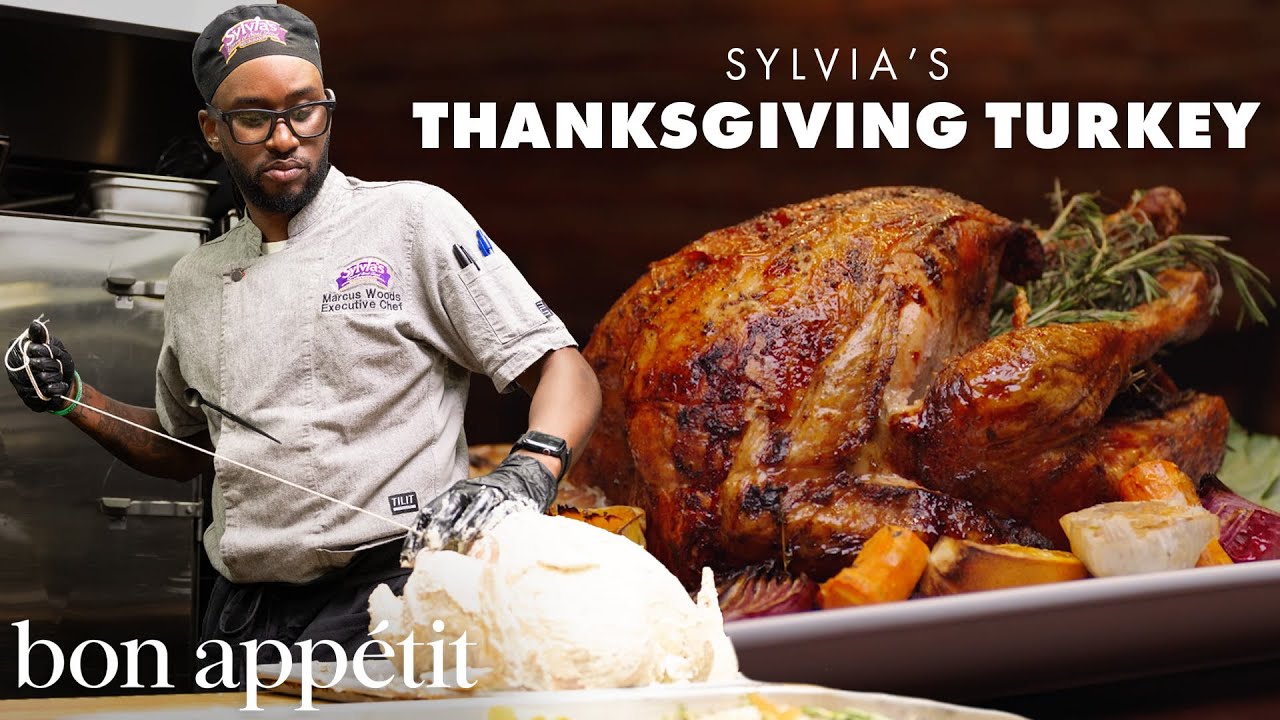
Today on Bon Appétit, learn how to make Southern-style roast turkey with Executive Chef Marcus Woods of Sylvia’s Restaurant, NYC’s legendary soul food institution. Marcus shares his grandmother Sylvia’s timeless approach to holiday cooking–from dry brining the turkey for deep flavor to preparing a rich Southern gravy using homemade turkey stock and fried chicken oil.
00:00 Intro
00:35 Prepping the Turkey
07:53 Roasting the Turkey
10:33 Making Gravy
13:05 Carving the Turkey
14:29 Plating
Want Bon Appétit shirts, hats and more? https://shop.bonappetit.com/?utm_source=youtube&utm_brand=ba&utm_campaign=aud-dev&utm_medium=video&utm_content=merch-shop-promo
Still haven’t subscribed to Bon Appétit on YouTube? ►► http://bit.ly/1TLeyPn
Want more Bon Appétit in your life? Subscribe to the magazine! https://bit.ly/313UWRu
ABOUT BON APPÉTIT
Bon Appétit is a highly opinionated food brand that wants everyone to love cooking and eating as much as we do. We believe in seasonal produce, properly salted pasta water, and developing recipes that anyone can make at home.
I’m Marcus Woods, executive chef here at the iconic Sylvia’s restaurant in Harlem, New York City. And today I’ll be showing you how to make the best roast turkey with some southern gravy. I’m third generation. Sylvia was my grandmother and the main thing that she told me was that you have to cook with love. Cook like you’re cooking for your children. The perfect turkey should be nice and golden brown on the outside, juicy on the inside, seasoned very well. I know a lot of people get intimidated by cooking a turkey, but I’m going to try and make it as simple as I can for you. Allow me to show you. Make sure you get a bird that is humanely raised. You want product that lived a good life. Looking at this turkey here, I could tell that this is going to be a great bird. Skin is very clean. It’s not all bruised and bruised, which is another clear sign that I had space to live and grow. So, this bird right here is a 12 to 14 lb bird. It’s a little bit on the uh older side, but it’s able to build up some nice fat content, which is going to help in the cooking process. The turkey that I have now is fully thawled. Get your turkey early. Get it in the fridge, let it thaw out the right way, and it will be a better product for that. And a common mistake people make at home is they get that frozen turkey, they’re like, “It’s not thawing out fast enough.” They’re like, “Oh, I’m going to just run it under some water.” You know, that that’ll work, but you’re not going to get a complete thaw. So, that means your turkey is going to cook uneven. Today, I will be doing a dry brine for our turkey. I choose a dry brine because that’s the way we’ve done it at Sylvies for all these years. A brine is generally a blend of seasonings that you’re going to use to impart a flavor on whatever protein you’re cooking. When you brine a turkey and you actually give it the time to brine, you’re not just going to get that flavor on the outside. You’ll get that flavor imparted all the way to the interior of the bird. So that everybody who’s getting that wing to that person that’s getting the inner slice of the breast will get the same flavor. This is my dry brown right here. This is Sylvia’s soulful house seasoning. We use this for pretty much everything in the restaurant. If you have some garlic in there, some black pepper, some smoked paprika, onion powder, those things right there are going to add a lot of flavor to your turkey. When it comes to cooking, salt, sodium is usually the last thing I add. I try my best to impart as much depth of flavor in what I’m cooking before I add salt. That way, the sodium actually becomes a flavor enhancer instead of your core of your flavor. The biggest thing is to make sure you get flavor everywhere. One of my grandmother’s funniest lessons she taught me when it came to seasoning. Season things like you’re putting lotion on a baby. When I was a kid, I thought that was a little strange, but the older I got, I get it. If you have a child at home, when you’re putting lotion on them, you don’t want to leave any open spaces cuz you don’t want them to be dry. You want every piece to get the proper attention that it deserves. If you see this bird is dried, I had to pat it dry after it thought out. If you put a wet turkey in the oven, the issue is you’re going to be steaming your turkey instead of roasting it. We’re going to let this brine in our walk-in box on a speed rack. It’s going to have the fans blowing on it. That’s going to help it air dry overnight. For the home cook, your refrigerator is a perfect place. Put it on a low shelf uncovered 24 hours. Take it out in the morning. Even let it sit out for about 30 minutes or an hour before you even throw it in the oven. That’s going to help that skin dry out even more. The dry skin is super crucial because when you roast it off in the oven, that skin is going to become super crispy and golden brown. And that’s a lot of flavor. That mayard reaction that you’re getting from that skin browning off in the oven, that’s flavor. That’s depth of flavor. And that’s something you can’t achieve without taking that time and letting it dry. Now, I need to take this time and start working on the aromatics. I’m going to be creating a bed of vegetables and aromatics to sit in the bottom of the roasting pan. This is a a traditional old school roasting pan. This pan is probably older than me, but it’s been used by my grandmother. It’s been used by pretty much everybody that’s worked in this restaurant in 64 years. So, this is a piece of history right here. You don’t want something too deep cuz then you’re going to pull up a whole bunch of moisture. But, you do want high sides. You want something that you could build up some juices cuz those juices that build up in the bottom of the pan, that’s what you’re going to be basting on top of your turkey. I’m going to start with my bell peppers. Just giving a rough chop. My grandmother’s philosophy was you can’t beat her at giving. She used to always say that. And she meant that because she was a true giver. And anybody who’s ever been around a true giver knows that they’re a special person cuz they’re going to give you their all. They’re going to give you their best. And that’s what we do here at Sylvia is we’re going to give you our best. The whole process of cooking a Thanksgiving dinner is a labor of love. But when you come to terms with the fact that it is a labor of love, you will give it love. And if you give it love, you will give it attention. If you give it attention, it will come out good. I like to add a little red onion for a little added sweetness. Celery is part of what we call the holy trinity. Onions, celery, carrots, your citrus acid makes things taste better. In balance, though, you don’t want it to become overpowering. You want it to just impart a little bit more floral notes to what you’re cooking. That looks pretty even. We’re going to put the rosemary and the thyme in the cavity of the turkey, but I’m also going to add a little bit more on top of this. It’s only going to make it taste better. Inside every turkey comes a goodie bag. I call it a goodie bag because it’s a lot of flavor in there. These are called the giblets. This stuff right here is what I would call the essence of turkey. It’s a mixture of turkey necks, turkey livers, turkey tails, and turkey hearts. a lot of flavor in there. Do not throw this in the garbage. Utilize this. Utilize every piece of the bird. That’s how we give animals the respect. This is going to go into a stock pot and we’re going to let it simmer overnight till all the meat falls apart. And that stock that now you’ve come to now in the morning that has completely broken down all of your protein, all your vegetables, onions, celery, carrots. That’s what we’re going to also use to make our gravy. And once everything starts to fall off of the bone, you could take those turkey necks out, pull all the meat off, and you can use that for whatever you like. I choose to put it in the stuffing. You can add it to your gravy. You can add it to whatever you like. So, after 24 hours in the air chiller, the skin is now tight. It’s nice and dry. That’s exactly what I was trying to achieve. I pulled out a lot of moisture from the bird. That’s another good sign, but still a lot of work to do. Now, I have a compound butter. A compound butter simply is a butter mixture that you blend with other seasonings. Rosemary, some thyme, some garlic, and the same seasonings that I use for the turkey. So, this is just going to add more and more nice good buttery flavor. So, now we’re going to do like grandma said, we’re going to lotion the baby. Make sure we don’t miss any crevices, okay? You’re going to be very generous with this. I’m going to make sure that I get this lather on the outside, but not just the outside. You want to go even on the inside of the bird. You want to get under the skin. You want to make sure that you’re getting every every nook and crann. That’s going to make sure that flavor gets into the meat and that’s going to make sure that the meat stays nice and moist. You want to be careful not to break the skin. You break the skin, you’re not going to be able to achieve that crispy skin. Your final step, you get this bird tied up. Butcher’s twine. This is what we use in the kitchen for trust and protein. Trusting is simply tying, keeping everything close together. That helps make sure everything cooks evenly. When you’re doing any trussing, you want to give yourself a lot more slack. After you get to this point, you’re going to make sure it’s nice and tight. Bring it up around the body. You’re going to tighten it up. You’re going to make sure those wings come nice and flush to the side of the bird. And make sure these legs are going to protect that cavity. It’s going to keep it nice and tight so it cooks evenly cuz I don’t want those wings to cook it faster than anything else. Turkish trust. It’s almost ready to go in the oven. Just can’t forget adding some final aromatics to the cavity. That’s going to help impart more flavor throughout the cooking process. Rosemary, thyme, a little bouquet garnier. This is just going to impart more flavor to the center of the bird, which is going to end up on the outside regardless. A lot of people like to stuff their stuffing inside of the bird. I’m not a huge fan of that because your turkey has to be cooked 100% through. You have to get this bird up to 165° in order for it to be safe to eat. While your stuffing doesn’t need to be cooked to 165 degrees. It just needs to be cooked to the proper dness. So, I recommend putting your stuffing on the side. Let your stuffing be its own dish. All right. So, I have my roasting pan here ready to go. And your turkey is going to go on a roasting tray right over this. The reason that I’m elevating the turkey on top of all these vegetables instead of putting it directly on is because I don’t want the turkey to stew. We want a roasted turkey. Allow all of this stuff to go ahead and marinate with all those turkey juices. And you’re going to use this to finish off your stock and make your gravy. [Music] So, here’s the game plan. You got 3 hours of cook time ahead of you. Make sure your oven is preheated to 350°. You’re going to do the first 2 hours covered in the oven. Don’t bother it. Just let it cook. After those first 2 hours, you’re going to uncover it. Going to crank the oven up to 375°. Then, you’re going to let your turkey go ahead and roast and develop that nice crispy uh skin. And you’re going to base that consistently throughout that process with those juices that develop at the bottom of the pan. and check your temperature. Once your temperature gets to about 160°, you can pull your turkey out of the oven and that’s the time to rest. You’re going to let it rest and that carryover temperature is going to bring you up to your desired temperature, which is 165°. Nothing more, nothing less. All right, so we’re going to go ahead and get this turkey covered up. Seal it nice and tight. For this first part of the cooking process, you don’t want too much to escape. You want to keep everything locked up in there. All right, bringing it to the oven. So, we got it in the oven now. Let the oven do its work. Let that heat circulate around. Do not open it. Please. I beg of you, do not open the oven. I know you want to. I know you want to poke and prod and check. Do not check. It’s only going to slow down your cooking process. All right. So, turkeyy’s been cooking for 2 hours now. I’ve already uncovered it. Those juices that build up in the bottom of the pan. Tilt it and pour it into a pan. So, it makes it easier to baste it. When you see that golden color, you’re achieving that that color that you want. Baste it maybe every 15 to 30 minutes just to to make sure you’re not opening the oven up too many times. This last hour is going to be very touch and feel. You have to know your oven. And you really have to keep eyes on it at this point cuz now it’s uncovered. You’re really achieving color cuz you already got pretty much 75% of the way as far as the temperature goes. So now it’s all about the color that you want. Once you start seeing that crisp uh skin start to develop on the top, you start seeing the skin start to bubble a little bit. That’s when you start wanting to base cuz you’ll you’ve already kind of achieved the crispy texture. So you can base at that point. You’re not going to lose too much. You don’t want to base too early cuz your skin will never get crispy if you start basing too early. You don’t need to spend money on a turkey baster. Oldfashioned ladle like grandma would have did it. So, you want to rotate the bird halfway through your basing process just to make sure we don’t overcook. Let’s check if this turkeyy’s done. I’ve already basted it twice. Our turkeyy’s out of the oven now. It has the perfect color that I’m looking for, but now I’m trying to make sure that that internal temperature is where I also wanted it to be. You want to find the thickest part of that breast and go in as far as you can, not through the bone. And I’m getting 160. That’s exactly what we were looking for. You see our little friend right there? It works. A lot of people don’t trust it, but trust me, it works. This thing is tried and tested. It’s telling me that it’s time to let this bird come out and rest. We’re going to let this bird rest for about 15 to 20 minutes. You don’t want to cut into it too early and all your juices are going to run out. So, let it rest. And while it’s resting, you still have work to do. Let’s start working on this gravy. My gravy is very traditional. Starts with the rue. A rue is just a fancy term for a thickening agent. It’s what you’re using to thicken your sauce, your gravy, or your soup, or your stock. The R is the base of a southern gravy in my in my eyes. That’s what I was taught by my grandmother. Equipar flour, equal parts fat. We’re going to start with our fried chicken oil. This is our secret ingredient here at Sylvies. We use the oil that we fry our chicken in to make our R. That flavor that you develop from frying chicken. It becomes such a nutty, aromatic kind of smell that’s incorporated into the r. That’s incorporated into the gravy. Very down home southern flavors. Allpurpose flour. You’re going to start nice and hot, but you’re going to want to bring that temperature down nice and low. So you could have time to actually let your R brown over time and not burn. This usually takes about 10 to 15 minutes depending on how dark you want your R. The color you’re going to need is like a dark brown and the consistency of like wet sand. So I know a lot of you guys at home don’t have access to large capacity deep fryers. If you are frying chicken for Thanksgiving, use that oil that you fried. If you fried something maybe a couple of days before, save that frying oil. You can use it for an application like this. You can even use bacon fat. Absolutely. Duck fat. Duck fat is beautiful. Use any type of fat you have at home and to try to incorporate it into this dish. So, it’s been about 15 minutes now and now the R is getting that color that I want to achieve. Most importantly, I’m also getting that smell, that nuttiness from the flour, browning in that oil, and I’m also getting, of course, that hint of that fried chicken essence. If you’re making a a gumbo at home, you’re going to want to stir this for about 30 to 40 minutes just to get that dark r. But if you’re making a soup, a gravy, you don’t need that dark, dark r. You just need a light brown r. This is the base of our gravy right here. You see that wet sand? My r’s finished now. I’m going to set that to the side. Now it’s time to incorporate the turkey stock. When it comes to a gravy, usually it’s going to be about 10% r to about 90% stock. But this is one of those also touch and feel things. is you have to kind of watch it cuz you could think that your r looks proper being a 50/50 oil to flour, but you won’t know until you start incorporating everything together. So, you want to add it slowly. Yeah, you’re just going to keep spooning in until you achieve your desired consistency. Then, you’re going to flavor it. Looks good. You always want to check coats the back of a spoon. Yeah, this gravy is good to go now. This is ready for the table. You want to keep it nice and warm, not too hot, but don’t allow it to cool down or it will start to like separate. So, our turkey is probably rested now. We can get ready to serve. Okay, so my my turkeyy’s rested now. It’s been about 30 to 40 minutes, which is ideal. Now, it’s time to get carved into it. You can look by the skin, the color of it. You can actually lift it and tell that that water weight is completely gone now. That means that the turkey is done. So, you see the wings perfectly done and crispy. The skin, everything is done to perfection. This does not have to be intimidating. Carving a turkey is fairly simple. We’re going to start with the drums. I like to take the drums off first. That’s going to allow us to make it more of a manageable piece to deal with and then separate the breasts, debone them. So, I’ll get the breasts on a flat surface so I could slice the breast and make it look nice and pretty. I have a heavy duty knife, what you would call in the kitchen a workhorse knife. Sturdy handle, nothing that’s going to bend on you. So, I have the two breasts off. Everything’s looking nice and crispy and nice and juicy. Next thing I would actually be taking off the wings. Those wings you want to get by the joint. You don’t want to cut through those oysters. You don’t want to cut through anything that you don’t want to be on the table. But I am going to separate the wings from the wingette. So everybody gets a a fair piece. My personal favorite is this because this is what I saw in the holidays growing up. Everybody wanted that turkey drum. And at home, I like to carve it at the table because that um nostalgic feeling of somebody pulling out a knife, carving a turkey, serving you piece by piece on your plate. That’s just a beautiful feeling. [Music] So, I have everything I need right now to make my plate perfect. So, I have myself some collard greens seasoned with some smoked turkey, some macaroni and cheese, and some mashed potatoes. We have our gravy lthered on top. When I see a plate like this in front of me, it reminds me of my grandmother. All of these things are going to taste like a touch of the South. That’s the most important thing. It should taste like love. It’s going to feed your soul cuz that’s what grandma would have did. It’s about feeding your soul and feeding your spirit and making you feel whole, beautiful. That crispy skin, that gravy, all that seasoning, that garlic, that rosemary. I’m getting a little bit of everything. All that hard work and that attention that you put into this dish, you’re tasting it at the end. Got to go back in. This feels like my grandmother cooked it for me. And that’s what you get when recipes are passed down over time. You get historical data every time you taste this food. You get to taste history. You get to be a part of history when you follow old recipes. Good things do take time. This is a labor of love. So, like my grandmother will always say, give time, time. And at the end of the day, you’ll get a beautiful product that all of your family and all of your guests will get to enjoy. [Music]
45 Comments
🎉🎉
Yep this is the recipe I'll be using tomorrow! Already got the turkey drying in the fridge, cannot wait.
This should have a million views. Thank you so much ❤
Great job! Ms. Sylvia would be so proud!
This was great, Chef did an amazing job explaining and sharing his passion.
Thanks for sharing! Definitely going to air dry my turkey as you showed…..
Wow, this guy is rad.
Big fan of Marcus.
Turkey always looks dry for some reason
Excellent video
Thank you ❤
❤❤❤
Such a natural, we need a show!
I love that they kept it in the family!!!
Made it today. Turned out to be the best and juiciest thanksgiving turkey I have ever made. Thank you !!!
He needs his own show
🍗 ᴳᵒᵇᵇˡᵉ, ᵍᵒᵇᵇˡᵉ, ᵍᵒᵇᵇˡᵉ 🍗
🦃 ᴴᵃᵖᵖʸ ᵀʰᵃⁿᵏˢᵍᶦᵛᶦⁿᵍᵎᵎ 🦃
This guy is awesome and really knows his stuff.
Just made this turkey and it was the most juiciest turkey I've ever had in my life.
More of Marcus!
That is one pretty color turkey thank u I learned a lot
Wow I watched the whole thing grandma taught u well be Blessed
I used Chef Woods’ method for our Thanksgiving turkey, and it was absolutely amazing! Thank you, Chef!
Thank you my turkey turned out perfect!!!!!
Get me to Sylvia’s!!!
I can't get the giblets in Italy!!!
Nice video..I met your grandma several times.She was a wonder person!. we share similar family roots in South Carolina…the Florence area . spoke about folks we both knew back in the day..😊❤ 🙏
The brother was Crystal clear with his instructions and has an amazing personality. Time to head to Sylvia’s.
❤😢😮😊 the amount of love and pride in this is priceless
Now THIS is what the Food Network should be showing.
I will try this but on the chicken first.🐔
UNFORTUNATELY THE FOOD AT 'SYLVIA'S' DOES ( NOT ) TASTE LIKE THIS ..! ? THE FOOD AT SYLVIA TASTE LIKE CAFETERIA FOOD. NOT ( BAD ) BUT NOTHING 'GREAT' ..I WENT ONCE YEAR'S AGO…I WOULD NOT GO BACK..😮 SORRY.
I’m saving this vid and using this recipe
I'm an experienced soul food cook and this was informative for me
Saving!
Solid
Looks like he removed the twine after uncovering it.
Soul food 😂😂😂
It's expensive…
This is now my go-to recipe and technique for turkey. Used it for Thanksgiving last week and everyone loved it. Great job, Marcus!
This man's narration makes his cooking both aspirational AND approachable.
That sht looks dry 😂😂😂
This guy is very cool 😎
Wow, I can tell this guy is so full of love and respect, for his grandma, for his profession, for the audience, and even for the ingredients. Kudos 👏🏻👏🏻👏🏻
Grandmothers and mothers are the best chefs