
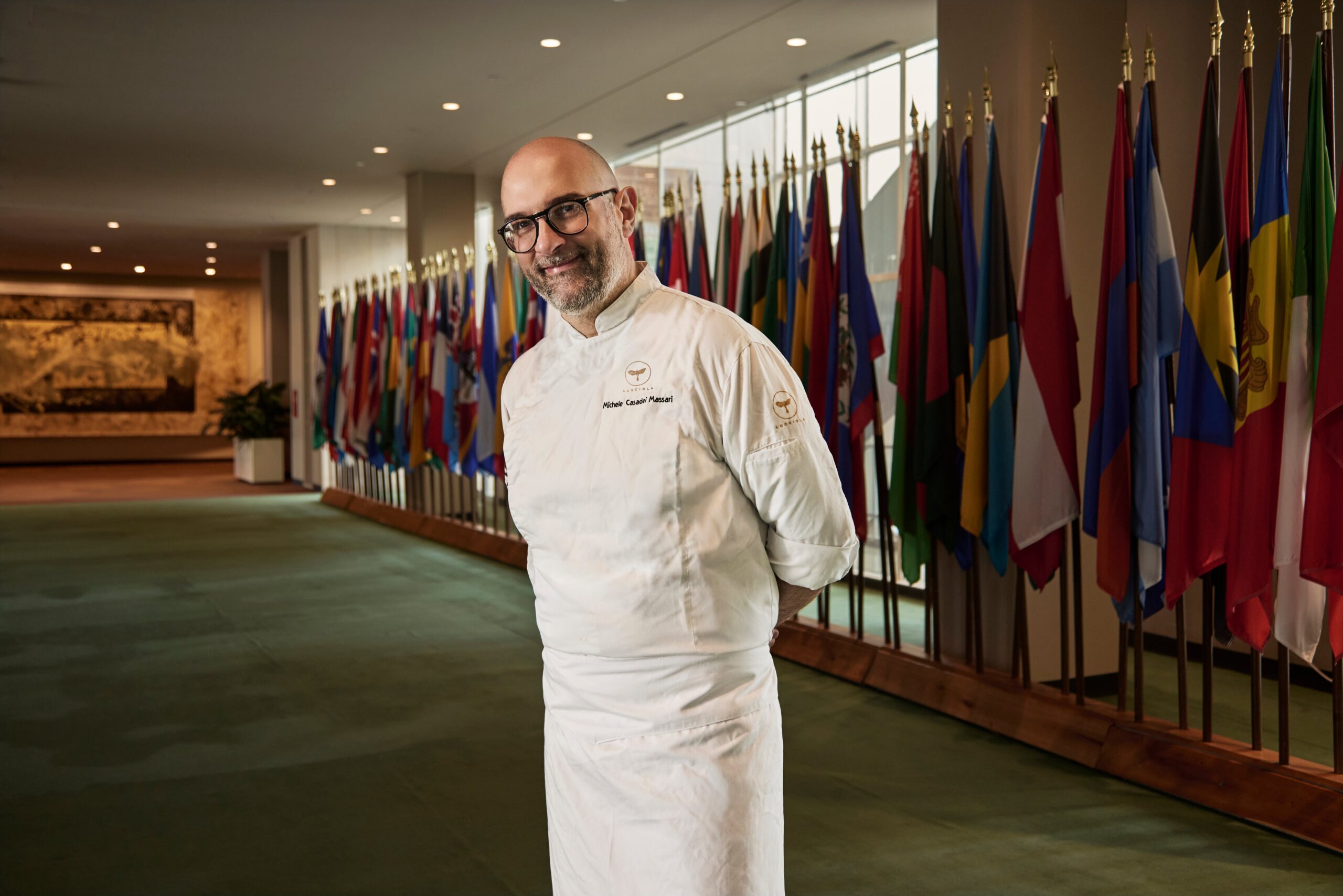
The Science of Hospitality
When he was younger, Massari studied medicine at the Università di Bologna while working in restaurants and technology. Over time, he felt the pull toward culinary work, especially after taking a course on the science of eating, and he developed a passion for learning about other cultures through travel. The gala became a culmination of those early experiences, a place where he folded those lessons into his cooking.
“Medicine and cooking, for me, were two ways of responding to the same need: to make people feel better, to communicate, and to express myself,” he explained. “That is why I talk so much about temperature, factors, and the science behind dishes. That part of my education stayed inside me.”
Temperature, for him, became a strategy to accommodate the unpredictability of a large-scale event like the gala and a key factor in the meal. Massari intentionally set the starting courses at room temperature to highlight how “many of the greatest foods in history were never refrigerated,” he said.
In this way, Massari honored the many cultures around the world that eat this way, using a simple technique to bring people together through something many would find familiar.
Not “Just a Big Dinner”
Despite the historic venue and distinguished guest list, including fellow Italian chef Massimo Bottura of three-Michelin-starred Osteria Francescana, who was honored as Global Advocate of the Year, Massari maintained a remarkable perspective.
“The way I approach cooking has to be meaningful,” he said. “I do not believe there is a cuisine that comes first or after, or a menu that works for one crowd but not for another. Whether it is six guests or a thousand, my question is always the same: Do I have the right idea and the right connection to the people I’m cooking for, for these guests, and for this evening?”
This philosophy has earned Massari trust far beyond his intimate restaurant. As corporate executive chef for Ferrari North America, culinary director for the Parmigiano Reggiano Consortium, and the chef behind gastronomic experiences at major events ranging from the Venice Film Festival with Italian film company I Wonder Pictures to the World Economic Forum, he has proven that his approach scales beautifully, not by changing his values but by amplifying them. This extended to the UN gala.
“It’s not just another dinner,” he said. “This is another great occasion to cook things I believe in and to offer my full vision of hosting and hospitality.”
When the dinner concluded, Massari hoped guests would leave discussing recipes, debating techniques, and remembering family traditions.
“I hope they walk away feeling how fun it is to share what we love most,” he said. “I imagine people saying, ‘Those flavors were so simple, so homey. This is the first gala dinner I’ve been to where the food really tasted like something.'”
In a world fractured by division, Massari offered the oldest form of diplomacy: a shared table, familiar flavors, and the quiet insistence that what we hold in common matters far more than our differences.
“Food has the power to make everybody equal,” Massari said. “Who can seriously say that Indian, North African, South African, or any other cuisine is less or more than another? Nobody.”
Dining and Cooking