
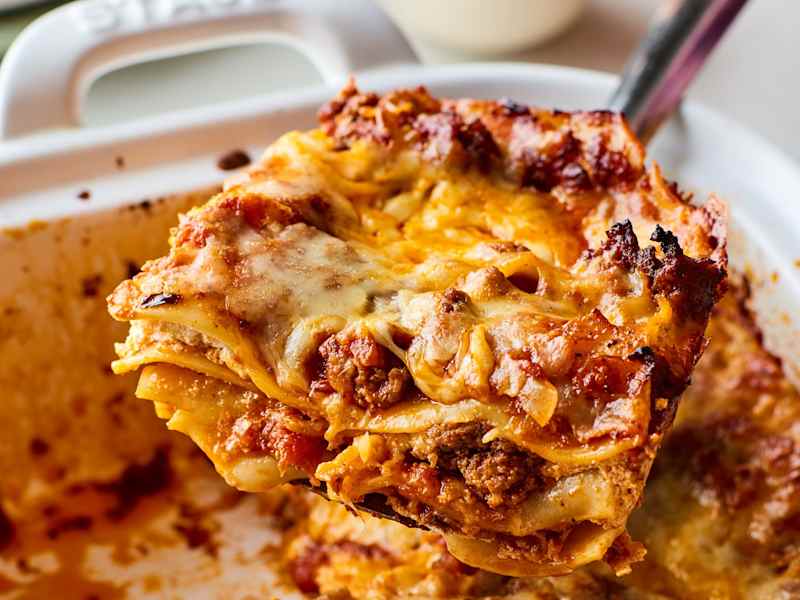
Lasagna is slightly different in Italy — the style of pasta sheets, the fillings, and the portion sizes are all a little different than what you see in America. But what can we learn from Italian chefs and families? What are the keys to a perfect lasagna? I asked an Italian-born chef, Francesco Lucatorto, who carries with him a ton of professional experience, but perhaps most importantly, a lot of time spent cooking with Italian nonnas.
Francesco is the chef and owner of Ceci’s Gastronomia in Silverlake, Los Angeles. He grew up in Genoa, Italy, where he learned to cook with his grandmother, who resided in the Emiglia-Romagna region of Italy. There, he spent summers preparing and cooking fresh pasta, pastries, salads, and snacks. This style of home cooking served as the basis for Ceci’s, with many of the restaurant’s recipes coming directly from Italian nonnas.
The lasagna at Ceci’s is phenomenal and comes served traditionally with meat Bolognese or with pesto (a style of lasagna native to his home region of Liguria). I asked Francesco to talk about lasagna at length, and he was full of keen insights he learned from nonnas over the years.
Credit: Nathan Hutsenpiller
The Building Blocks of Lasagna
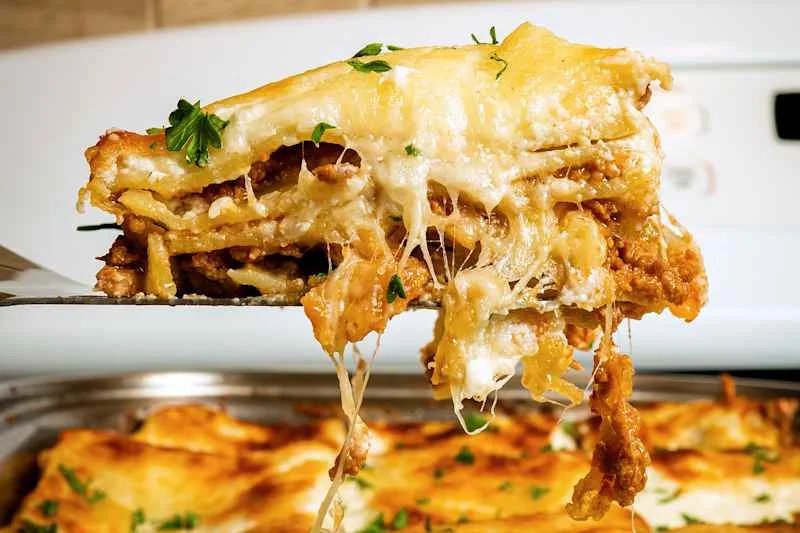
“No ricotta. Never,” Francesco blurts out immediately when asked for lasagna tips, “This is the thing I want to point out first. It’s the most common question I get at Ceci’s.” Ricotta simply doesn’t fit Francesco’s platonic ideal of lasagna, which he describes as having three essential building blocks — pasta, Bolognese, and béchamel sauce. While ricotta is a hard no, the Bolognese is a bit more fluid; in Francesco’s native region of Liguria, pesto often replaces meat sauce. Further south, you see things like prosciutto or maybe even mushrooms. Francesco’s biggest piece of lasagna advice, however, is that the pasta sheets must be as thin as possible.
“The key to me is to create the most number of layers you can,” he says, “At least six or seven layers. The pasta has to be the thinnest you can.” Francesco explains that thick, overcooked lasagna sheets become too chunky and soggy. When the sauce rehydrates the pasta sheets, they in turn become bigger in size. This is what Francesco describes as a “chunky” lasagna, which is decidedly not what they serve at Ceci’s or around Italy for that matter.
Francesco’s biggest tip for would-be lasagna makers at home is to ditch the store-bought pasta sheets altogether. “We only use fresh pasta in Italy. We don’t even have curly pasta sheets. We have straight sheets,” Francesco says. He refers to the curly edges of pasta sheets here in America, which are ridged like mafaldine. He laments that these types of pasta are too thick for lasagna.
Why Thin Pasta Sheets are Key to Better Lasagna
Thinner layers of fresh pasta allow for all kinds of wonderful textures that you don’t get with dried, store-bought lasagna sheets. The thin lasagna sheets provide rich, eggy flavor and a toothsome bite. Perhaps of most importance to Italian-born chefs and nonnas, however, is that the edges of the lasagna become crunchy and crispy.
“In Italy, as a kid, everyone wanted the corner. That crispy edge,” remembers Francesco, “So, we try to have a four corner lasagna [at Ceci’s] with crispy spikes.” To achieve this, Francesco bakes his lasagna in individual, foiled sheet pans sized 13×8 inches. It offers more crispy edges, and provides that classic “being a kid at nonna’s” experience he’s trying to re-create. This, Francesco says, can only be done with fresh pasta, run thinly through a pasta machine, preferably on the lowest setting possible.
A Few Tips for Making the Best Lasagna at Home
If you can’t make fresh pasta, refrigerated pasta sheets from brands like Antica Pasteria work wonderfully.
Create seven layers of pasta for each lasagna.
Consider using a couple of smaller baking dishes for your lasagna instead of one big casserole dish. This will create more corner slices for guests to enjoy.
If using a pasta machine or stand mixer attachment, be sure to run the pasta through gradually, until you get near to the lowest setting possible. “You should be able to see the pasta dough through your hand,” according to Francesco.
At Ceci’s, fresh, eggy pasta sheets are boiled for around 2 minutes before they are shocked in the salt water bath. This stops the cooking immediately, while the salt adds a little bit of extra flavor. When it comes to pasta sheets in lasagna, Francesco prefers a “medium resistance.” That is, something toothsome he can cut easily with a fork.
Christmas Sugar CookiesFurther Reading
Create Your Own Interior Design Mood Board | Apartment Therapy
This Easy Lasagna Is What Comfort Food Dreams Are Made Of (No Need to Boil!)
Baked Brie Is the Ultimate 2-Ingredient Appetizer
Dining and Cooking