
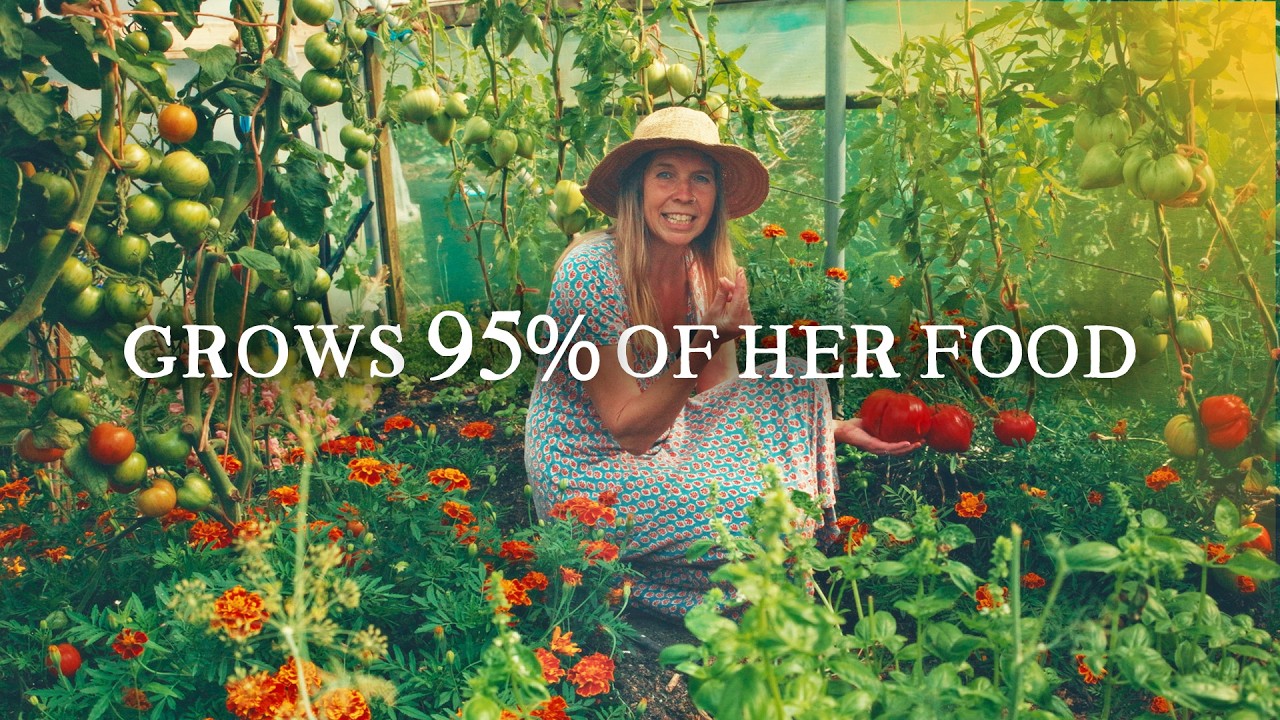
Use code PEDIKER20 for 20% off the Compost Masterclass: https://thegrowersguild.teachable.com/p/composting-hot-bed-masterclass
This videos showcases the power of homemade compost and what it can achieve, and also shares some of Peni’s favourite crops and varieties for growing for self-sufficiency.
Peni’s Lulu tomato seeds: https://www.seedhub.wales/seed/lulus-best-ever-beefsteak-tomato/
Follow Peni on Instagram: https://www.instagram.com/swnycoed_opd
Intro 0:00
The ‘sheen’ 0:40
Peni’s Favourite Brassica 1:31
‘Best Ever’ Tomatoes 2:41
Dead Compost 4:21
Massive Zinnias 5:50
6 Week Old Carrots 6:23
Squash 6:57
Dahlias 8:10
5 Week Old Compost 9:18
#compost #selfsufficiency #gardeningtips
I’m Penny Ed and I’m a um grower at Sinocoid. I have been running a market garden and OPD farm for the last nine years. Um I’m say 95% self-sufficient in fruit and veg and it all lies in the secret of looking after the soil and the composts. So, I’ve co-made a composting course with Hugh Richards and Jack First, and it’s given away all the secrets of hot composting, slow composting, and my own supercharged um micro rich compost. So, I’m going to show you some of the results that you can get. So, this pink chard has been feeding a lot of us since April, but what I wanted to show you is the sheen. When you get this waxy shiny sheen on on plants, that’s when you know that things are singing. It’s the lipids. It’s the lipids in the soil and the lipids. When you see a plant that’s got this shine, it’s it’s showing you that the soil is really healthy. The plant is really healthy. The lipids help the plant to fight off pathogens and pests. And you will see in this tour that we go around the garden that all my plants, all my leaves have this shine. They have this oily shine. They’re not all dry. They’re shining. They’re healthy. They’re happy. Here’s my ka. And ka are one of basically my favorite brasa. Um they’re a cross between a Brussels sprout and a kale. And they are an F1. They’re an F1 worth growing. Um in the winter when we’re living out of the garden and we’re living from uh Brussels sprouts, purple sprout and broccoli and ka. And Steph and I do taste tests where we’re actually closing our eyes and tasting the veg those three bras to see which one’s the best. And it always comes up top trumps kettles. And even when you get those winters where it’s just minus 8 and it’s raining and just horrid ka they just stand up and they just will just keep giving you. You get you actually get four harvests from a klet. You get the leaf this time of year. You get the flower from about November till about March. Then you get like a purple sprouting broccoli flower. And then you get to eat the tops as well. So I think ka are one of the best brasacas to grow. So every summer one of my favorite crops to grow are Lulu’s best ever. I grow them for myself but I grow them for the seed for the whales seed hub. This poly tunnel is all top dressed yearly with my own compost that I make. And these lulus they never cease to fail me how awesome and how big they grow. And what’s really great about a Lulu is when you cut it in half, it hasn’t got loads of seed. You know, like in a normal tomato, like one of these, when you cut it in half, it’s just full of gloop and seed. Well, a Lulu is not like that. You cut it in half and it’s just pure tomato that tastes amazing and the seeds are just around the edge. And you’d probably think to yourself, what do you do with all those tomatoes, Penny Edica? Well, what I do with them is um we are self-sufficient in pata. So, every year we just harvest all the tomatoes and spend a day canning. And then I’m still eating my pata from last year and I think we’ve still got about 20 jars left. So, the pata it just keeps us going and it’s always an easy meal. Um I also um make pizza beans and ferment ferment like layering up the the beef steak tomato with my beans or with my m too and then just generally eating them with the basil and just yeah enjoying that summer love of tomatoes and basil and you just don’t get better than that. I think when you buy in compost, it’s usually dead and it’s usually very dry and it hasn’t it’s not lively and it doesn’t have the extra minerals like basel rock dust. It doesn’t have the biochar to hold moisture and it doesn’t have the inoculations of the lively micro potions. Um you can see in here that my crops they’re just really abundant. They’re really I don’t have to liquid feed because the compost itself is enough. And I top dress um when I take crops out about that much, about an inch, no more than an inch of homemade compost. And these are the crops I get. And I’m not spending lots of money on seaweed fertilizer. All I have to do is water because the the health is in the compost and the plants are rejoicing. They’re just giving loads of harvests and they’re just happy. They’re just healthy. Um so I think you save a lot once you learn how to make compost in this way. Even though it’s quite a lot of energy um smashing things up and getting all your ingredients and doing the build, you’re going to save a lot of money. you’re going to save a lot of time and you’re not going to be battling with um pathogens and pests. So, in my garden um I’ve got zenyas in quite poor um flower beds that I don’t have time to top dress with my compost. And then I’ve got zenyas that I’ve growing for weddings in here with my inch mulch of compost. And look at them. Some of them are taller than me and they’re just beautiful and they’re strong and I’ve used them for cut flower and literally they will stay beautiful for up to 10 days with a little bit of lab in the water. Great. Look at them. So these carrots um were planted after my um hard neck garlic was taken up. So first week of July, that’s the time I sew carrots. I never sew carrots before July. These carrots will see me all the way through the winter. And I didn’t put any compost on because I’d already, you know, put compost on at the beginning of the year. So, this is 6 weeks of growth with not much rain and I haven’t watered these beds and I got carrots. So, these are delicata squash. They’re really cute. And if there’s only one or two of you, you can just pull one off. You don’t have to peel it. Chop it up. Bit of coconut oil in the oven. Yum. And this beast. So, this is a blue hubard squash. So, these ones are for for my family to eat. But in another secret location, I’m growing blue hubbards for the whale seed hub. and they will be in the on the shop and the catalog in December. So, these lovely little pumpkins are ready and um when I plant a pumpkin, I literally get the equivalent of one um small baked bean tins worth of my really good compost and plant put it underneath where I’m going to plant the squash plant. And literally that’s all you need is one small good handful underneath each plant and you’ll have squash like that. So this year I’ve really fallen in love with um growing flowers um particularly ders. I feel like one of the reasons why they’re 6′ tall is because they’re in really good compost. When you grow ders um if you want to get a head start you start them in February and you you pop them in compost in February. So in February I was here getting my compost, planting each one in about that much compost. And then in May once they were nice and big they were put outside and once we’d got um over frost dates then they came out here. But again if I was going to pot up all my ders and buy the compost one it would cost me a fortune but two it would dry out quite a lot. Whereas my um ders I didn’t you can’t really water ders a lot because you you’re at risk to rot the tuber. So with my compost that h has the biochar that really helped the dia tubia tuber to get nice and strong before going out into the the beds. So on the 10th of July, we harvested our potatoes because they were getting blight and we also harvested our broad beans. So I smashed them up, mixed them with grass and muck and sawdust and biochar and literally that is 5 weeks ago. So, when I clear my beds and get ready to plant my garlic, the end of September, beginning of October, I’ve already composted all my potato tops and all my board beans, ready to fertilize my garlic crop over the winter. It really works. [Music]
20 Comments
You composted the blighty potato shaws?
Does that not just increase the chance of future blight?
I could have sworn she said she made a course with a few bitches and Jack
Well filmed.
Pertinent real information
My allotment wasn't as amazing as yours, but I did get over 95 butternuts from 2 (two) plants.
I also put 10-15cm of compost.
Lot's to learn here. Great stuff 10/10 from me !
An incredible example of how homemade compost can truly transform a vegetable garden 🌿 It makes me curious to see how the soil life keeps improving over time.
❤👏👍🌷❤️
You can't argue with that, can you….everything she grows looks beautiful & healthy! ❤
Thanks for fiming 👍
What a beautiful garden. I am watching from the southeast USA. I am envious of the Blue Hubbard you are able to grow; the dreaded squash vine borer devastates the Blue Hubbard I have tried to grow in the past.
Another amazing video, Mr Huw!! 👍👍👍
I love making compost, the only down side is a wee bit of graft, and the OCD triggering you get when you see neighbor's and friend's throwing stuff away as trash/waste and I'm like . . . . . . . CAN I HAVE THAT? . . . . . the looks I get hahaha
I love and appreciate those series!! Keep them rolling all time. Thx for your efforts
Self-sufficiency at it's finest..
kaylex? calix? how do you spell that green so i can buy seeds?
Magnificent garden!!!
I am always inspired in the winter to do more and more in the spring. By mid summer it always turns into….well, maybe next year 😁.
But I did just order Kalette seeds from Johnny's (expensive, but a trusted source here in the states) so at least I'm off to my usual good intentioned start.
Didn't know you could hot compost diseased parts. I was sad to think of wasting so much material. Thanks for the tip
Compost is my garden weakness. I so want to get it right.
i love your garden tours, it gives me great ideas and inspiration and they are always such works of art
The only thing more beautiful than a lovely garden is a lovely gardener.
Very inspiring! I will try the black tarp come spring to accelerate my pile.
Nice vidéo