
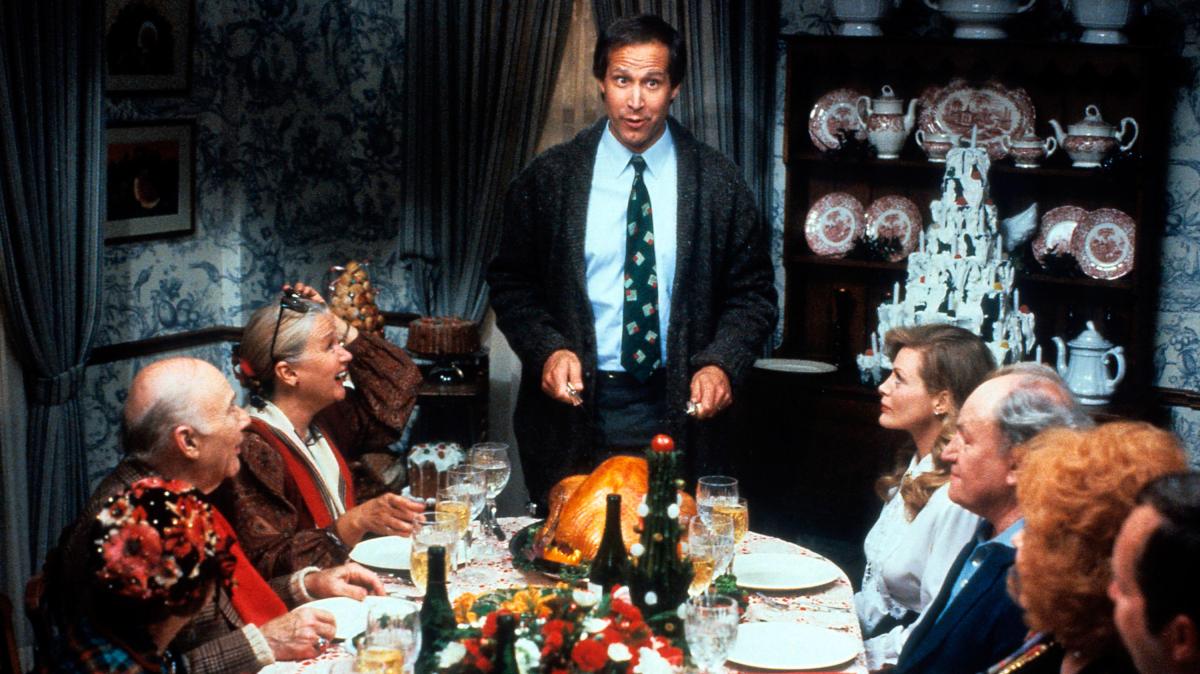
Trying to please everyone at Christmas is exhausting and futile. For years my wife and I would drive ourselves to a festive breaking point trying to see all the different factions of our family, dragging our daughter from house to house to open presents and eat some variation of a roast dinner. There would be thinly veiled tensions and old grudges that caught alight like a Christmas pudding with the addition of alcohol. Everyone was compromising, no one was happy.
On Christmas Eve 2023 we stayed in an apartment to be near my mum and aunt. We spent a nice day together until my daughter’s overstimulated behaviour got too much for the 70-year-olds and we were politely ushered out at 6pm — just when we were drunk enough to start enjoying ourselves — because Call the Midwife was on. The next day we drove to the airport and flew to France — on plane tickets so expensive we might as well have hired a private jet — to do Christmas all over again with my in-laws. At the airport, waiting for our delayed flight with other burnt-out-looking families, we agreed we would do things differently next year.
We did. And we are continuing to do so, thanks mainly to the self-help guru Mel Robbins, whose podcast I got into just in time to hear her first discuss the “let them” theory, which she has turned into a bestselling book. The idea is simple (which is precisely why it works). She argues that rather than trying to control or correct someone, you simply “let them”. Let them cancel plans, dominate the conversation, show up late, watch Call the Midwife or be upset that you’re not spending Christmas with them. Your job is to notice what happens next — do you still want to engage or do you step back? Crucially, Robbins insists the phrase only works if it’s followed by “let me”. Let me decide what’s right for me. Let me take responsibility for my own reactions.

Mel Robbins with her book
STEFANIE KEENAN/GETTY IMAGES
The let them theory has sparked a cultural movement, with people quoting Robbins’s version of the philosophy on TikTok, embroidering “Let them” on tote bags, even tattooing the phrase on their wrists. Oprah called it “a life-changer”, and suddenly “letting them” was the new shorthand for emotional maturity.
Amelia Jeans is an existential therapist in private practice and an associate lecturer at Regent’s University London. She agrees that Christmas is a good time to practise “letting them” for the good of your own mental health. “The intensity during this period is due to the pressure cooker effect,” she says. “At Christmas all those long-held resentments, disagreements, entrenched patterns of behaviour are forcibly thrown together with an added measure of alcohol, so it’s no wonder that emotions run high and explosions occur. The answer lies in letting go of past hurts and not bringing them to the Christmas gathering — more easily said than done.”
• Can the Mel Robbins Let Them theory change my life?
The inevitable backlash is that “letting them” can often be a terrible idea, because of the impact that permitting one person’s “bad” behaviour has on everyone else. But Robbins does heavily caveat the theory by saying that if someone is crossing your boundaries (or those of others) in harmful ways, “let them” is not the correct response — you must act.
For all the theory’s flaws, listening to Robbins talk about it on her podcast made me realise that there could be a different way to approach the festive season. One that centred on my comfort and enjoyment, did away with the rampant people-pleasing and accepted that everyone is responsible for their own happiness. Turning up on different family members’ doorsteps with five Waitrose bags full of expectations and unresolved emotions, and then proceeding to force others into my idea of a fun time (Bananagrams, anyone?) was never going to fix the fact that my family has been broken by divorce and loss and reshaped into something loving but complex and entirely out of my control.
Jeans warns that, for people managing extreme emotions, particularly present in grief, it would be difficult to self-regulate sufficiently to achieve “letting them”. Similarly, she says, “for those people harbouring past resentments and hurts, it would be difficult to flick a switch and turn on an attitude of ‘letting them’ on Christmas Day. It needs a great deal of building self-awareness and understanding relationships to get to a place where ‘letting them’ is achievable.”
I feel like I’m well on my way. In previous years I have attempted to micromanage the holidays on behalf of my wider family. There was the time I insisted on secret Santa and my mum, who was the least into the idea in the first place, didn’t get a present at all due to a mix-up with the names (she was furious). There was the time I made us go out for Christmas lunch to a trendy east London restaurant and the older family members were mortified by the “deconstructed” turkey. And the time I insisted my child would enjoy ice skating on Christmas Eve, knowing full well it would end in tears (it did).
• How to survive Christmas with your family, by the experts
Our “let them” Christmas experiment began with my wife and me discussing what we actually wanted to do if we removed our obligations to everyone except our daughter. We realised two key things: that we hated travelling at this time of year and that we didn’t really enjoy traditional Christmas dinner. So we decided: let us stay home, eat lasagne, watch movies; and let them (our wider family) potentially disagree with our choices. Let everyone make their own decisions about presents and menus and logistics and let us wait and see if we’re invited to any family Christmas events, not of our arranging for once (we were, thankfully). And my new emotionally laissez-faire attitude helped me to enjoy the various festive gatherings way more than usual. When my uncle started talking about politics, instead of trying to set him straight on the issues I care about, I listened when my wife whispered, “Let him!” in my ear. When my cousin told me she had made a vegan nut roast, I simply smiled and said it looked delicious. In the past I would have passive-aggressively grated cheddar on top. “Let them” me wasn’t bothered.
Last Christmas, the idea that my wife and I — two grown adults — might actually be allowed to make such a radical decision to concentrate on ourselves and our daughter felt hugely exciting. Suddenly the possibilities for what else we might grant ourselves permission to do left me quite giddy and culminated in my greatest demonstration of free will yet: giving my daughter a puppy on Christmas morning. Oh, it was logically such a bad idea for so many reasons, and our family would no doubt admonish us for this unwise and impractical life decision. But I would let them think that without trying to prove otherwise, and I would let me deal with the consequences.
How to have a ‘let them’ Christmas
Let them have opinions
Pour another drink and walk away. Silence is self-care.
Let them host … or not
If you’re the default organiser, hand over the reins. If no one steps up, order a takeaway.
Let them disapprove
Raised eyebrows at the price of a gift? Quiet tutting about your child’s behaviour? Not your problem.
Let them feel what they feel
Someone will cry. Someone will sulk. Emotional regulation is not a group activity.
Let you decide what matters
Do the “let me” part too. Let me rest. Let me say no.
Let it be good enough
Take a deep breath and remind yourself: it’s just Christmas.
Dining and Cooking