
The bûche de Noël, or yule log dessert, is the star of French holiday tables. In its Parisian birthplace, the pastry is reimagined in endlessly imaginative ways, sometimes in collaborations with designers. It’s a veritable battle of the bûches as star pâtissiers compete to show off their creativity. More akin to sculptures, these laboriously crafted oeuvres are a showcase of talent and artistic flair.
The classic bûche that we make at home, decidedly not as pretty, resembles a bark-covered log. Rolled into a cylinder shape, the sponge cake is covered with flavored buttercream that’s forked into the texture of wood and topped with sprigs of holly. Despite its crude appearance, the bona fide bûche is tricky to assemble; thankfully Tata Raymonde’s hand-written recipe (carefully safeguarded since 1965) has at least helped with the flavor combos. Forget chestnut in our household; coffee reigns supreme.
How did the yule log become a cherished Christmas centerpiece? The idea harkens back to the ancestral practice, initially linked to solstice celebrations, of sourcing a massive log from the forest and burning it over the course of several days. The ritual, said to bring prosperity and happiness in the new year, was later Christianized with a 12-day log-burning from Christmas until Epiphany. In the 19th century, the tradition was transformed into pastry in Paris, where the urban milieu wasn’t exactly conducive to fires. The inventor of this trompe l’oeil creation is unknown— pastry chef Sébastien Gaudard believes it was Seurre, whose historic store he now occupies on the rue des Martyrs. Whoever we have to thank, the truth remains: it was a runaway success. Food critic François-Régis Gaudry equates the popularization of the bûche to the baguette, another Parisian invention that spread across the country.
“At its origin, the bûche de Noël evoked a log burned to bring warmth and light into winter’s longest nights,” explains Maxence Barbot, head pastry chef at Le Bristol Paris. “That symbolism is still at the heart of the pastry — a sense of comfort, gathering, and celebrating the season. We revisit the bûche de Noël yearly, not to rewrite its past but to channel that feeling — crafting new expressions through different shapes, textures, and seasonal inspirations. It remains beloved because it stands at the crossroads of tradition and creative expression, offering a familiar story told in a reimagined way.”
For Maxime Frédéric, head pastry chef at Cheval Blanc Paris, “the festive yule log is above all a story of family and friends – a moment each year when we gather to share something warm and generous. It is also a highlight of the meal, arriving at the very end to bring this moment of togetherness to a close. Over the years, I have witnessed – and now contributed to with my pastry team – the transformation of this ancestral dessert. Each year it becomes lighter and more imaginative. It’s a chance to express our creativity and to surprise and delight our guests.”
Ultimately these tasty triumphs represent hours of brainstorming and culinary experimentation. Here’s a selection of my favorite creations this year. Wait until you see this dizzying display of haute pâtisserie. Note: Even if you aren’t in the market for a limited-edition, couture-style bûche for your feast, you can get your hands on individual portions at the city’s myriad pastry shops.
Nina Métayer
Food & Wine / Photo by Louise Marinig
Take a trip down memory lane with this work of art designed to look like a decorative Christmas ball you hang on your tree. Lift the hand-painted chocolate sphere, crafted as an intricate ornament, to unveil the entremet flavored with citrus, gingerbread, honey, passion fruit, and cinnamon. The surprise doesn’t stop there: Crack the pedestal base and you’ll discover an array of tiny treats to share. Though this bûche is already sold out, you can pick up an individual portion of “The Taste of Noël” entremets for 10.50€ at Nina Métayer retail locations, including Printemps du Goût in Paris. Note that the Christmas collection also includes classic yule logs in fun flavors like pistachio and cardamom. Serves 10, €150, limited edition
Maxime Frédéric, Cheval Blanc Paris
Food & Wine / Courtesy of Cheval Blanc Paris
A log has morphed into an edible Christmas tree in Maxime Frédéric’s “King of the Forest” creation at Cheval Blanc Paris. Inside the 75% dark chocolate tree, you’ll find praline, speculoos shortbread, and mendiant made with nuts and candied orange peel, while at its base a circle of “gifts” is really another dessert entirely, inspired by the classic Poire Belle-Hélène. The poached pears get a glow up with tonka beans, fir liqueur, and fromage-blanc mousse. The ornament at the top? A nod to the “white horse” emblem of this stunning luxury hotel inside the historic Samaritaine department store. Serves 6-8, €180, limited edition, preorder for pickup
Yannick Alléno, Le Pavillon Ledoyen
Food & Wine / Courtesy of Yannick Alléno at Pavillon Ledoyen
It’s a first for the Pavillon Ledoyen, the historic dining venue on the Champs-Élysées. (In 2014, top chef Yannick Alléno took over the 18th-century establishment, and it’s now home to three Michelin-starred restaurants.) Alléno has created his first-ever bûche, a collab with Chef Pâtissier Valentin Mille, for this luxe dining destination. The creation was inspired by the traditional Japanese art of Yakisugi (a charring technique used to preserve wood). Hence the color, which is echoed by the smoked chocolate flavor. Textures are just as playful and surprising: a smooth hazelnut mousse and coffee-infused dolce de leche with crunchy cookies and sobacha (roasted buckwheat seeds). Serves 8, €95, limited edition, preorder for pickup
Anne Coruble, The Peninsula Paris
Food & Wine / Courtesy of The Peninsula Paris
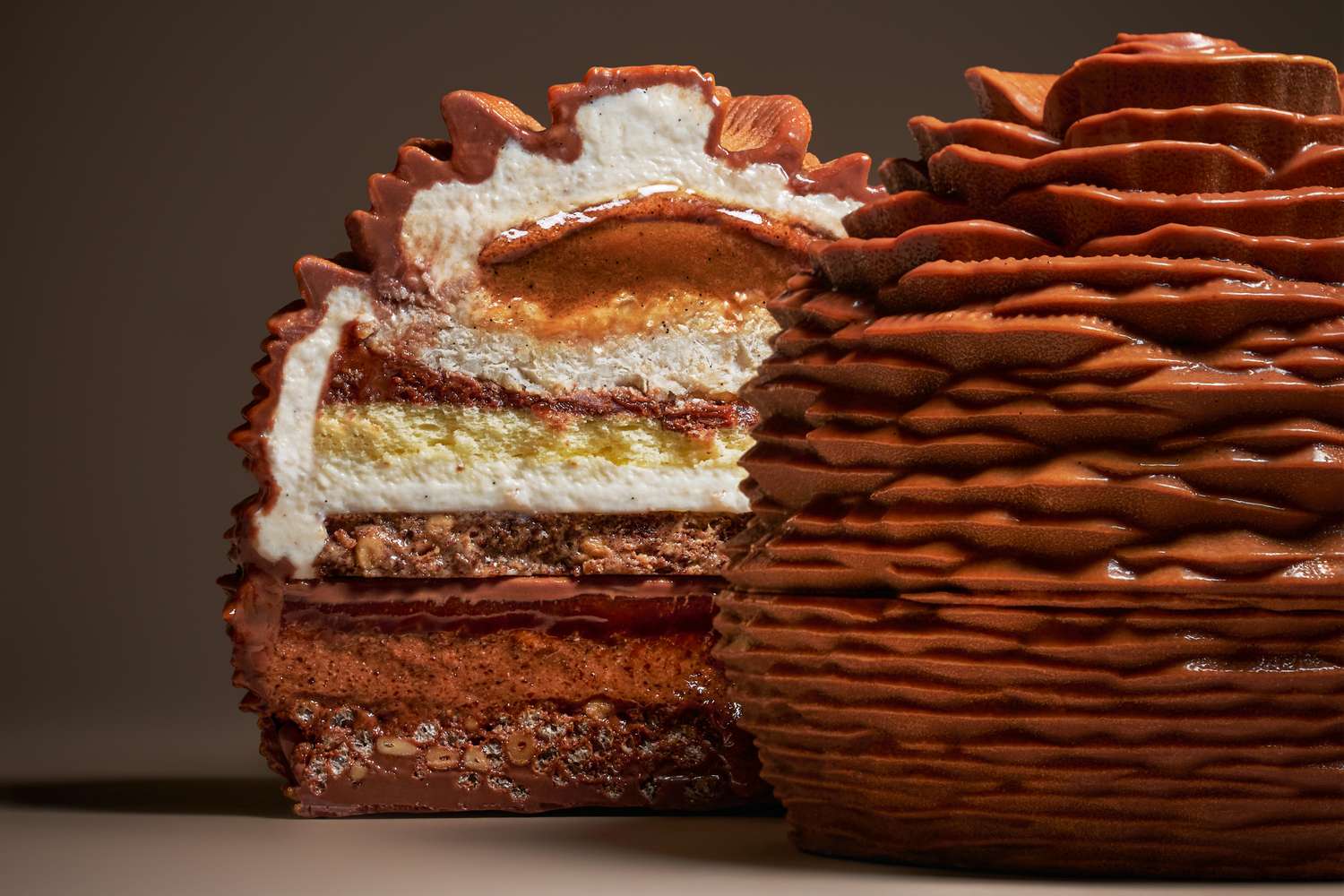
Designed to look like a pine cone plucked from the forest floor, Anne Coruble’s Joyau des Pins (“Jewel of the Pines”) at The Peninsula Paris is laden with symbolism. It’s composed of 13 layers, a nod to the Provençal tradition of 13 Christmas desserts. To name a few: cedar-toasted rice mousse, pine-nut praline, shortbread made with crispy rice and pine nuts, and a dulce de leche of pine-nut miellat. The aromas in this masterpiece are reminiscent of resins and the woods. Serves 8, €105, limited edition, preorder for pickup
Maxence Barbot, Le Bristol Paris
Food & Wine / Courtesy of Le Bristol Paris
“For my very first Christmas creation at Le Bristol Paris, I wanted to go beyond the traditional format,” Maxence Barbot explains. “This year, I envisioned a true gourmet tree. Inspired by the firs that illuminate our garden, this sculptural chocolate piece required the design of a completely bespoke mold.” The base of the tree is a textural melange of crispy gavotte cookies, Tahitian vanilla cream, and a Madagascar chocolate mousse. Serves 10, €140, limited edition, preorder for pickup
Yann Couvreur
Food & Wine / Courtesy of Yann Couvreur Patisserie
The Taiga bûche is inspired by its namesake: the coniferous boreal forests that ring the North Pole. Beneath a milk chocolate shell, a family of fox cubs is curled on top of a multi-layered cake of shortbread, sponge cake soaked in vanilla and cinnamon syrup, caramelized apple, maple syrup caramel, and vanilla cream. Yann Couvreur identifies with the fox — he describes his mascot as “wild and free like me”— and these fox sculptures are filled with vanilla caramel. Serves 6, €95, available online and at all Yann Couvreur Paris boutiques
Christophe Michalak
Food & Wine / Courtesy of Christophe Michalek
TV personality and self-described “rock ’n’ roll pâtissier,” Christophe Michalak has devised a collection of classic yule logs — chocolate pecan, cappuccino, and clementine are in the mix — alongside the pièce de résistance: the Bûche aux lettres. Recalling the mailbox (boîte aux lettres) where kids send letters to Santa every Christmas, the yule log incorporates Dubai-style chocolate with chocolate mousse and crunchy pistachio praline. Serves 8, €95, available online and at Christophe Michalak boutiques
Dining and Cooking