
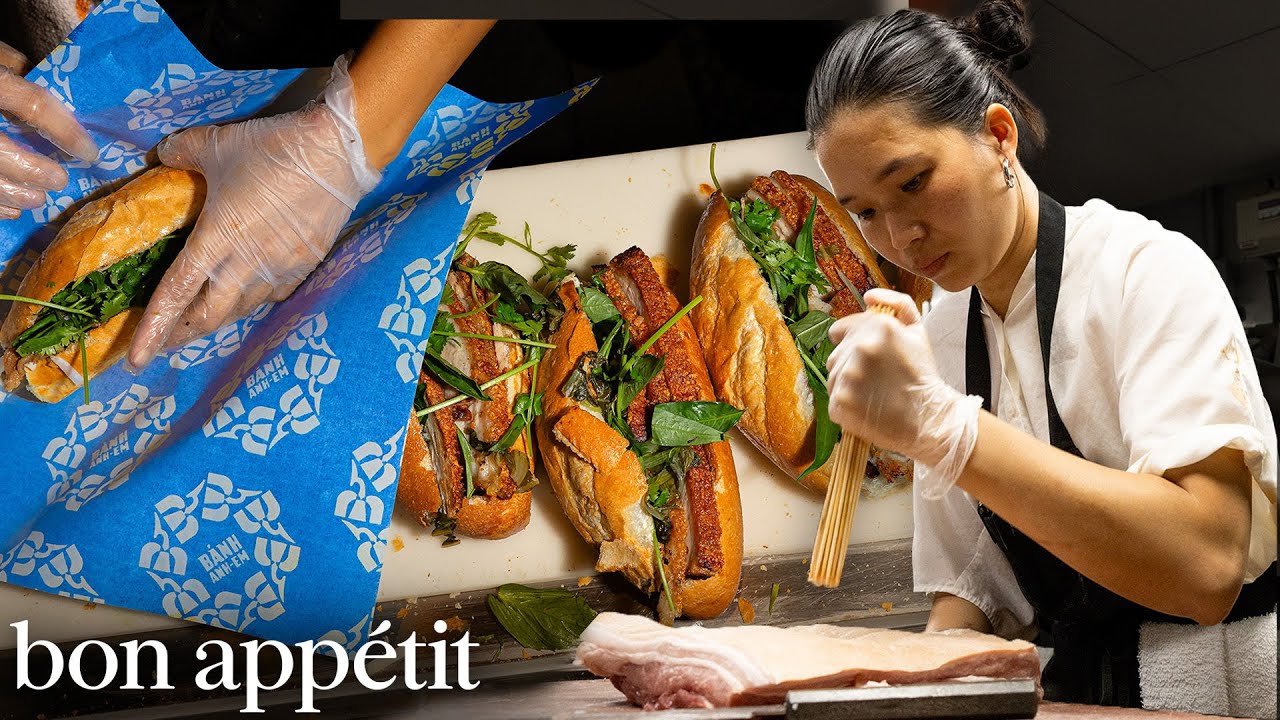
Bon Appétit spends a day on the line with Chef Nhu Ton, Executive Chef and co-owner of Bánh Anh Em, the Manhattan spot serving what many call NYC’s best bánh mì. Inspired by her travels across Vietnam, Chef Nhu brings authentic Vietnamese flavors to New York through hand-baked bread, house-made hot sauce, and crispy roasted pork, resulting in one of the city’s most hyped sandwiches.
00:00 Intro
01:05 Checking on bread
04:00 Making roast pork
06:35 Making pâté
09:15 Making hot sauce
10:37 Making bánh ướt chồng
12:33 Making Phở
14:03 Baking bread
15:06 Service
Director: Ian Stroud
Director of Photography: Luke Riffle
Editor: Nicole Salmeri
Talent: Nhu Ton
Senior Creative Producer: Mel Ibarra
Line Producer: Jamie Rasmussen
Associate Producer: Oadhan Lynch
Production Manager: Janine Dispensa
Camera Operator: Paola Esquivel-Oliveros
Assistant Camera: Sarah Alexander
Sound Recordist: Lily van Leeuwen
Production Assistant: Zack Maguire
Post Production Supervisor: Alexa Santamaria
Post Production Coordinator: Stella Shortino
Supervising Editor: Brandon Henninger
Additional Editor: Rachel Kim
Assistant Editor: Justin Symonds
Director of Content; Production: Ali Inglese
Senior Director; Creative Development: Dan Siegel
Senior Director; Programming : Jon Wise
VP; Head of Video: June Kim
Want Bon Appétit shirts, hats and more? https://shop.bonappetit.com/?utm_source=youtube&utm_brand=ba&utm_campaign=aud-dev&utm_medium=video&utm_content=merch-shop-promo
Still haven’t subscribed to Bon Appétit on YouTube? ►► http://bit.ly/1TLeyPn
Want more Bon Appétit in your life? Subscribe to the magazine! https://bit.ly/313UWRu
ABOUT BON APPÉTIT
Bon Appétit is a highly opinionated food brand that wants everyone to love cooking and eating as much as we do. We believe in seasonal produce, properly salted pasta water, and developing recipes that anyone can make at home.
Banan we try our best to showcase the beauty of Vietnamese craftsmanship. I want to showcase different type of banmi in Vietnam. It could be from the south like the OG or it could be from the north like bani pate ham. [music] Anm is mean brotherhood and sisterhood. when I came to America when I had nothing and I wouldn’t be who I am today and where I am today without all the brother and sister that I met along the way. >> Hi, this is Chef Mu. Welcome to Banan. This is 9:30. We have a lot of things to do. Come on in. This is our upstairs kitchen. That’s is the bread oven that we bake bread every day. So we have different type of bunme. We have OG bunme pate hyong barbecue pork rip eye and chicken. And we also offer vegan sandwiches. We’re going to start to go downstairs to check on the dough. And we’re going to start to make our buni. Let’s go. This is our prep kitchen. We make a lot of bread here. But first thing first, I need to double check the dough to make sure that the quality of the dough is good. In Vietnam, the weather is really hot. Normally, it take only like couple hours. But for me, it’s important for the flavor of buni to develop. So, we make it and let the dough rest in the walk-in overnight. In order to check the dough, you see like how smooth it is. It will determine how the bread turns out. Like when you pull it, you don’t see any like gluten structure. Great. The buni itself, it had to be like very puffy. So it’s expand rapidly inside the oven. And we need the gluten structure strong otherwise it will collap and it won’t be airy. The outside it won’t be crispy. The dough look really good already. This is our auntie the bread baker. It took me over two years to come up with this recipe. I took a motorcycle from Saigon all the way to Hanoi and tried different kind [music] of buni. I went back five times after I came back from Vietnam. I work on my recipe for over 2 years. The other side of it is like it take a lot of time. There’s so many night that if we bake a lot more bread than I stay at the restaurant and sleep at the restaurant. But again, the restaurant is just so small. So I just brought like very small blanket so I could sleep here. I don’t have pillow or anything. So, we’re going to put the flowers and eyes in here. So, while we wait for the dough to get ready, I going to start shaping the bread butter to the tray. Later on, after everything is done, it’s easier to remove the bread. We’re going to do three bread here and two here to make sure the air could go evenly. It’s really important to have enough room, especially with our OG bunme. It come with our homemade pate which is the star of that sandwich. We also do different kind of Vietnamese coconut in house and it’s also come with pork floss pork [music] skin which we marinate and mix with roasted brown rice. In order to create the fluffy super airy inside we got to create some layer inside of the bread. That’s why we have to roll it. We pinch it over here in order to like seal it. If you don’t seal it and the bunme is rapidly expand inside the oven, this one it could open and it will destroy the shape. We ship in 600 bread by hand. Today sometime like I sleep at night and I have nightmare that I overproof the fun. We still have a lot of bread to make but I’m going to let Andy do it. I going to move on to making roasted pork buni. So, it’s now 10:45. We going to grab some pork from the walk-in. So, this one we’re going to prepare for tai, which is the roasted pork sandwich. One of our bestselling items. The skin is crispy and the meat has to be really moist. As you could see here, the belly part, so you want it a little bit fat. It’s also thin, but you don’t want it too much meat either. So, it’s like very specific kind of cut that I’m looking for. That’s why the entire pork a whole big pieces. Sometime we get only one pieces for roasted pork. Sometime luckily we have two. It’s like gambling. You don’t know. Sometime you spend so much money and you get only like two pieces like this. So, with the crispy uh pork, it’s very important to prep the skin. This ain’t my tool. I want this area together and with the metal tool I can really adjust it. So this one it just work for me. You have to puff this one to create hole that later on it will help so for the skin to puff and create the crispiness. So we want to use like younger pit the skin is softer and it’s easier to puff. So I going to start to marinate the pork belly. I will cut it in a way that I don’t touch the skin. Because if you touch the skin, it will create a gap right here and this part it won’t be crispy. It’s important that the meat itself is have flavor. And we create our own rough here that have five spice, salt, garlic powder, black peppers. And I even have customer from Saigon, you know, she say that it tastes like the one that she have in Saigon, which mean a lot to us. The food from Saigon, which is southern of Vietnam, it’s always a little bit more sweet. The central Vietnam, which where my family from, the flavor is really bold. It’s spicy, it’s strong, it’s salty. I really massage it to make sure that the seasoning really go inside the pork. This one, it’s um sit overnight already. I going to start putting salt on top. This one it have nothing to do with the flavor. Just make the skin as dry as possible. I gonna put inside the oven for 30 minutes to remove the moisture from the skin. Then we start to roast it. Going to move to the next step. Making pate. So now it’s 11:30. We’re going to move to making pate. It’s a combination of liver, grab pork, and with Vietnamese pate, we add crispy onions in it too. So, it create a thick paste that we spread it on our banani. It’s called banmi pate hyam that we serve at our restaurants. The ingredients super simple. The bread is very small pate and then the crispy pork floss. We’re going to use the old bread and soak it in heavy cream. The purpose of doing this one, it make the pate a lot more moist. What different from Vietnamese pate and French pate is we use crispy onions, crispy shallot, and we use fish sauce to add more umami flavor to it. And I think the process of making pate like traditionally Vietnamese pate is also very different. We slow cook it. For example, I learned how to make pate from a grandmar in the north of Vietnam. The process of making pate take her generally like eight hours. The pate is the key ingredient for all the flavor. I’m going to bring this upstairs and we will continue with the process. It’s noon. Now, in order to make pate, I I normally grill the liver over charcoal. I like that smokeoky flavor and it’s also like to kill the smell from pork liver. I think working with charcoal it could be a little bit tricky. We use the Japanese charcoal because it hold the heat a lot better. So we want like the heat as consistent as possible. While we waiting for the charcoal to heat up, I going to talk about crispy onion. We go through probably around like 200 lb of onions every week. Every batch like this, it will take probably like 20 30 minutes. Some places when they make pate, they would use just regular onions. But to me, the flavor of fried onions is very different. So this is the final product. We don’t fry a lot of onions at the same time because there’s so much water inside oil, it won’t create crispy onions. So this is the pork liver that we’re going to grill it over charcoal for our pate. I going to put all the ingredient inside the pot and then the next step I going to add chicken liver and then bake it in the comi oven for 2 three hours. It become like super soft. We finished with the pate. Then now we’re going to go downstairs to make hot sauce. So at 2:15 we going to start to making hot sauce. My staff already helped me to peel some already but this process it takes so much time. Most of the time I my staff doesn’t want to do it. [laughter] This is the bird eye chili. This is the ingredient to make dungbak which is the hot sauce that we make to pair with our soup. Particularly it you with our for each batch of hot sauce normally it take for us six to eight months. We really struggle to find spaces. The rent in Manhattan is not cheap, but we sacrifice the rent for our hot sauce, for our pickling. That also take a lot of time. So, the next step, I’m going to blend it in hot water. A lot of people ask us why we put so much time into making [music] hot sauce. But in Vietnam, we pair different dishes with different type of hot sauce. I’m really surprised that when I came to America, then I saw only Sriracha. For this sauce, it come with uh salt, tomato, garlic, and a little bit sugar to help with the fermentation process. But we don’t use anything else. Is very simple. So, this is all cooking right now. We have some time. So, I going to move making lamb bar. [music] The cure beef ham that we’re going to use for the rice roll towel. The rice sheet towels. It originally from my hometown. It’s like a fun dish wrap and roll with grilled pork and we grill it over charcoal. So we have some beef here. It’s really lean. With this dish, you got to make sure everything dry. I have the garlic powders and black pepper. So when I mix it well, it create like the chewy texture for the namu. So this dish it come with the steamed rice roll. It have a lot of component in this dish. So with the bananuk jong, you want something like umami, you know, great grill flavor. That’s why we use pork j. It juicy and you also want some sourness, you know. So we have green mango, we have muscle green pickle, but it’s all come together and balance everything out. It’s just so many components. So I had to debate with myself that should I put it on the menu or not because I know that the amount of dishes that my dishwasher had to go through every day is is such a nightmare and there’s a lot of time especially during weekend my dishwasher had to stay here until like 5 in the morning to really finish everything and uh and I feel bad. So this is fish sauce and sugar and garlic. So the very last step, I’m going to add pork skin to it. It create very nice chewy texture. We’re going to move it here. And you have to press it really hard otherwise there’s a gap between the ham and it will get broken. So after we done with everything, I going to weigh this down. I going to put this away and then we’re going to move it to the next test. I want to introduce you to another component for for us. This is called peanut warm sassong in Vietnamese. I partner with a family in Wangnan. They really go out there and then harvest this one. It create very nice deep umami flavor, but it’s also like a natural ingredient as MSG that it balance everything out. A lot of restaurant they uh they don’t want to use this one because it’s a little bit expensive. It take time to shift from Vietnam. But this key ingredient it make our bro so much different us from any other restaurants. It have a lot of sand. So we have to wash it really carefully. So I’m going to add some water in here. You just have to massage it so all the sand can just go out of the wand. I would let it soak for 10 15 minutes and then I going to come back and wash it again. So the uh the warm have been soaking for around like 30 minutes. It’s like normally I would wash it for like six to eight times. It’s have a [music] lot of sand here. We don’t want any sand that get into the soup. Then the water start to get really clear. Then this one is ready. So this one you can just put it inside the soup. I just need to uh season the stock 30 minutes before we open and it’s ready for the service. So, it’s 5:00. I going to start to score the bread. So, this is the bread that we uh ship this morning and we proof it for 4 hours. The process of scoring the bread, it make the bread band a lot better. I have to like calculate the time to make sure that we bathe the bread right before we open and we have fresh bread throughout the night. I’m going to put this one in the oven. I put the hotel pan with hot water at the bottom and provide a lot of moisture to help the dough to expand as much as possible in order to achieve the thin crust and the fluffy inside. Then I bake very high heat. I b at 500 fah and it will bake for around like 20 minutes and it’s ready for service. Every time we make around 30 bread after you take it out the oven you will start to hear the sound of crackling and that’s a good sign of really great banani. So it’s 5:55. We only have five more minutes to open for service. We don’t take reservation. There’s already a live in front of the restaurants. We don’t take reservation because I grew up, you know, there was no reservation uh whatsoever at in Vietnam. So no reservation. So it depends on the day, but normally I going to stand up at expo station to control the food quality. I’ll double check all the food before it’s sent out. If any problem in the kitchen that I jump in the kitchen, you know, to help the staff and I also look like how the staff like plating everything, make sure all the food is hot. If it’s cold, then it has it should be at the right temperature. I normally will jump on the line every day to make sure, you know, everything is done properly whenever I work. Now it’s 6:00. It’s show time. [music] I need one salted car to go. Okay. I need four more sandwich. Four more. Four more. I need one noodle. Okay. I need a noodle first with B3. I need to pass a show. Okay. Thank you for spending a day with me, but the restaurant is really busy right now. You [music] guys should go.
30 Comments
My heart melted when she talked about feeling really bad for her dishwasher. You could see it in her eyes xo
❤❤❤❤❤❤❤❤❤❤❤❤❤❤
May she be very successful with her restaurant!! ❤
⚡((((((💗
Vietnamese bánh mì is adding more spice and everything nice to New York City!!!
Love all of this and her❤
Beautiful execution! Watching this definitely pushes me to level up my own cooking experiments.
She has to fully know her "no reservations" policy is a shout out to the late, great Anthony Bourdain. For his part, he certainly loved Vietnamese cuisine and helped many to know something of it.
She is US hard working cowgirl all day long! Cool lady…. may you live well… would love to taste her talent and experience; I LOVE BANH MI !!!!! A passionate talented smart woman, dialed in her profession. Cheers; eat, live, share… and love well.
Looks great
this is my kind of art. 🥰
Shoutouts to my people. GO CHI!
This lady truly takes pride in her food
She is a masterchef!
Immigrants make America GREAT!!
This is so interesting to watch how to make Vietnamese foods.
she's locked in
Well deserving chef
its funny how she says "dough" like "đậu"(tofu)
Beautiful, just very beautiful. Thank you!
Watching this while having lunch at a Vietnamese restaurant is such a blessing 😄
12:40 – You know it’s an authentic, top-tier phở spot when they use these ‘worms’ to make the broth.
Looks amazing.
Much support and respect for hardworking Vietnamese people repping excellent examples of food.
this made me wanna cry and play 5k for one banh mi
she does it all! amazing
She lives in American dream and charges like it too.Banh mi should not cost $15 outrageous!
isn't 500 fahrenheit for 20 minutes a bit too much?
Vietnamese people took the french baguette and elevated it into something better.
She looks young to like maybe in her 30s wow immigrant successful businesses restaurant owner in NYC making it big so happy for her