
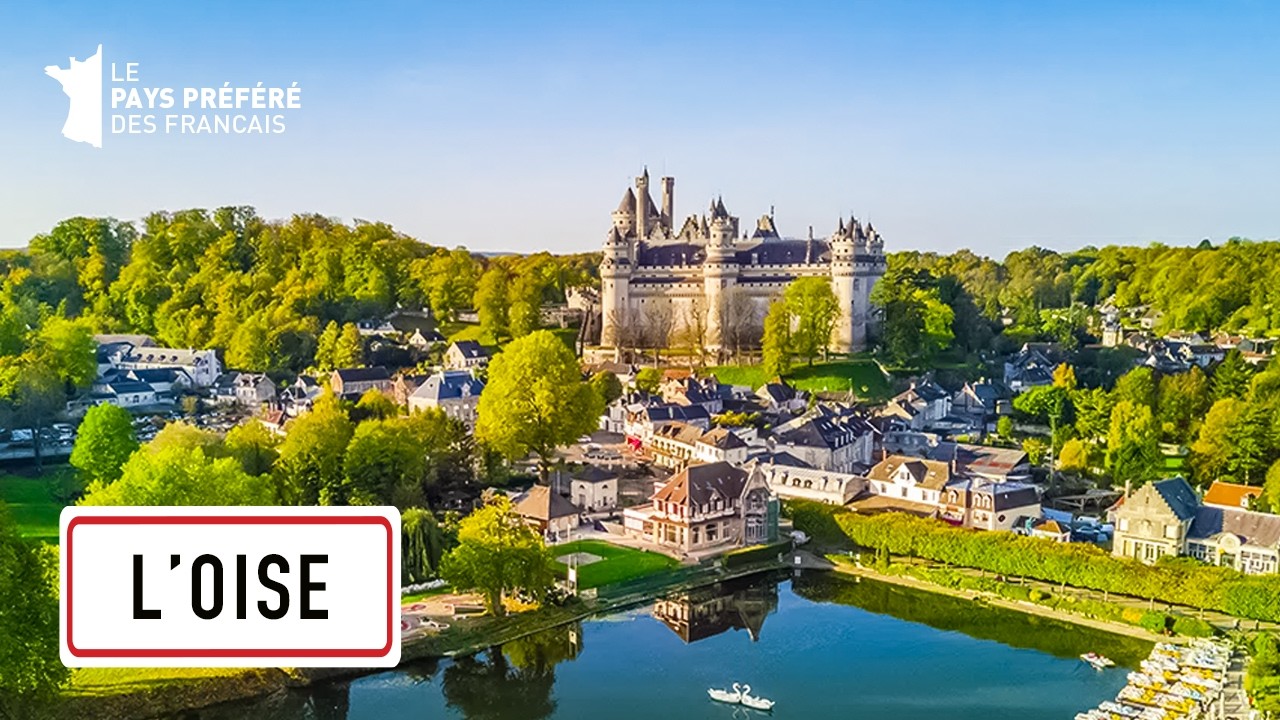
Entre forêts majestueuses et villages préservés, l’Oise dévoile un patrimoine unique.
Pour découvrir les merveilles des plus belles régions de France, c’est ici – Abonnez-vous 👉 http://bit.ly/3zjR2Vj 🙏
Ce voyage dans l’Oise débute à Chantilly, joyau d’art et d’architecture dont le château abrite l’une des plus belles collections françaises. L’itinéraire se poursuit vers les grandes écuries, témoins d’une tradition équestre historique, puis vers Senlis et sa cathédrale gothique, où les vestiges gallo-romains rencontrent les créations culinaires locales. Plus loin, Gerberoy charme par ses ruelles pavées, ses maisons fleuries et son atmosphère hors du temps. L’ascension continue à Pierrefonds, dont le château réinventé par Viollet-le-Duc mêle Moyen Âge et romantisme. Enfin, la forêt de Compiègne révèle la clairière de l’Armistice, lieu symbolique de la mémoire européenne. Une traversée complète d’un département où nature, histoire et art s’entrelacent sans cesse.
Réalisé par Anne-Sophie Margerel
© MORGANE PRODUCTION
#Oise #Chantilly #Gerberoy #Pierrefonds #Senlis #HautsDeFrance #Patrimoine #France #Les100Lieux
Do you like France? Do you enjoy exploring it,
discovering it, going out to meet it? You even sometimes get
the impression that you know her well. We all have a small beach,
a small cove, a clearing, a hamlet or a path that belongs only to
us, far from the beaten track and that we only want to share
with those we love. This is the France we want
you to discover through 100 places you absolutely must see in your lifetime.
Today, we are setting off to discover the Oise, a splendid department in the Hauts-de-France region,
located less than an hour from Paris. Famous for its immense forests,
this little corner of paradise is also renowned for its flamboyant architectural heritage
, from fairy-tale castles to stone lace cathedrals. It had been a long time since I’d been up
here, but every time, the view is breathtaking. Our wire-grilling journey will begin around Chantilly. A remarkable mineral treasure trove,
some of whose most precious gems we will unveil to you. A pink diamond. It’s a real diamond. Then we will explore the area around Gerberoy,
rightly classified as one of the most beautiful villages in France,
with its superbly preserved cobbled streets , sumptuous facades
and romantic gardens. I could impress my friends with
everything I know now. Finally, we will visit the impressive
Pierrefonds castle and its surroundings, whose charm and history will
not fail to seduce you. This country of unsuspected treasures,
it is of course in the company of passionate men and women,
proud of their heritage and traditions, that we will explore them. Come and see, take a step back, it’s
Guinness Book material. Our getaway to the Ariennes region
begins in the south of the department, in the magnificent park of the Château de Chantilly. When you first discover the splendor
of this imposing monument , it is
hard to imagine that the site was completely razed during
the French Revolution. The current castle dates from the 19th century. It houses one of the finest
collections of paintings and art objects ever assembled in France. It is in the company of Frédéric Nancel
that we will discover this architectural gem. This lover of whipped cream spent
a large part of his professional life promoting its
exceptional heritage. The first and last thing that strikes you
when you enter the castle grounds is its
perfect state of preservation. And for good reason, since it is among
the last built in France in 1864. After spending his life collecting
admirable paintings, drawings or books, its owner, the Duke of Aumale,
wished to offer them the most beautiful setting. When she begins a tour,
Nicole Garnier, curator of the castle, never forgets to pay homage to him. The Duke of Aumale, Henri d’Orléans,
our donor, the man who did everything at Chantilly. So, the fifth son of King
Louis-Philippe, the son of the last king of the French,
who had a good classical education at the Lycée Henri IV, who then embraced
a military career, and he inherited the Chantilly estate at the age of eight
. And I am told that when passing by, one
should always say: Good morning, Your Grace. Absolutely, that’s what we
do every morning. Okay, well listen, I’ll let you guide me. Let’s go
. Upon his death, the Duke of Aumale,
who was also Prince of Condé, bequeathed all his collections
to the Institut de France, on one condition: that they remain
gathered here under the name of Musée Condé. And it is naturally with the
museum’s centerpiece that Frédéric and Nicole begin their visit. This is the heart of the Musée Condé,
the heart of the Château de Chantilly, with its extraordinary collection of paintings. Listen, they’re all piled on top of each
other. This is the 19th-century hanging,
because the Duke of Aumale wished that his presentation not be changed. Edge to edge, touching each other. One of these paintings,
the oyster lunch at the court of Louis XV,
signed Jean-François de Troy, tells us an
amusing anecdote from the history of France. But you still need
good eyesight to see it. Why are they all looking up?
Well, look. I am the
domestic being watched in the background. There is one brighter point,
the champagne cork. So, this is the first time we’ve had
champagne at the King’s court? Absolutely.
Amazing. Do you have another
painting to show me? So, there is a famous painting,
it is the Madonna of Loreto, by Raphael. The amazing story of this painting,
certainly the most beautiful work in the gallery, would make many
collectors dream. The painting was very
famous in its time. It adorned the church of
Santa Maria del Popolo in Rome. There are 124 copies
in public museums alone, not to mention privately held copies. So, we thought it was
one of his copies. Not at all, it was an original. It’s extraordinary to discover
a Raphael when you thought you had a different painting. It’s another treasure trove of whipped cream. Yet another of Chantilly’s treasures. It’s so beautiful from here, honestly. Yes, there is a very nice view
of the art gallery. While the Château de Chantilly owes its
reputation to its art collections, it was once a
prestigious residence with a grand decor, some of which can still be
seen in the heart of the monument. We are in the grand
apartments of the Princes of Condé. It’s a classic apartment, there’s
a bedroom, an office and an anteroom. This antechamber alone,
nicknamed the Great Saint-Gerrie, testifies to the incredible luxury
in which the condés lived, who made it their duty
to impress their visitors. The most beautiful room in the large
apartment, you see. A setting with Chinese people and monkeys,
because the monkey was an exotic animal in the 18th century. And so, France is fascinated
by the arts of Asia. There, you have America with this lady who has
red feathers on her head, she’s a bit like an Indian. Here you have Asia, with this Chinese treasure.
There, you have Europe. And there, the image that France had
of North Africa at the beginning of the 18th century with this character. Was this a room designed to invite people
to travel, or was it for telling stories?
It was more like an anteroom. This was the antechamber to the
Prince of Condé’s apartment, beyond the gallery, where supporters and guests strolled. And then, we waited to go
into the prince’s office. And so, there was a fun setting. Frédéric and Nicole now continue
their visit to another major room in the Château de Chantilly,
where the Duke of Aumale devoted himself to his favorite sin: literature. This is the library of the Duke of Aumale,
who was a very happy bibliophile. At less than 26 years old, he says: I think
I have bibliomania. Here, for example, you have
the Très Riches Heures du Duc de Berry. It is said to be perhaps the
greatest manuscript in the world. The famous one.
The Mona Lisa of manuscripts. Absolutely.
And did the Duke of Malle read all these books? He catalogued them all, at least.
All right. How many books do you have here? So, there are 30,000 books
in the Chantilly library. 30,000 old books. What you need to read
Fireside in winter. Ten visits would not be enough to discover
all the treasures contained in this extraordinary library. And since Nicole knows
Frédéric’s passion for the heritage of Cantilien,
she has reserved one last surprise for him which is located in a part
of the library inaccessible to the public. Why is it called the
Theatre Library? It was a theatre in the time of the Princes
of Condé, at the beginning of the 19th century. All the treasures, the drawings,
everything was brought together here by the Duke of Oman. These are truly
extraordinary objects. We have what is called the Grand Condé, that is to say a pink diamond worn by the Grand Condé on the pommel of his cane. This diamond was stolen from us in 1926
and after three months, the diamond was found hidden in
And a chambermaid in a hotel found the apple, broke a tooth
on the apple and on the diamond. Is that a real diamond?
It’s a real diamond. And you think I can hold it? Yeah, right. It’s extremely lightweight. Yes, indeed
. Oh dear! I am holding a diamond, nine carats. That’s a pretty pear, though. It’s a pear-shaped diamond.
It’s extraordinary. So, you
never present it to the public? So, since 1926, it has
never been presented. I’m leaving it because…
We’re going to put it back in its case. And there you have it. Who knows, perhaps the Grand Condé
will be on public display again when you come to discover
the wonders of Chantilly. Meanwhile, Frédéric now wants to
reveal to us the behind-the-scenes of the imposing decor of this castle. Because what visitors don’t know
is that the dressed stones used in its construction came
from gigantic quarries located very close by, about
twenty meters underground. These are quarries to which we owe
many monuments in the Paris region,
as Fara Ponchaud, a cultural mediator passionate
about this little-known underground world, will reveal to him. What type of monument were you
able to build with this stone? First,
the Paris-Haussmannian at 70 percent. Then, part of the Opéra Garnier, and
the Saint-Jacques Tower as well. They have quite a few well-known buildings there. I also believed that the
Saint-Lys arena was built with this stone. Quite. So here, Frédéric, 45 million
years ago, we had a tropical sea here. And when the mountains emerge
from the ground, particularly the Alps, this sea will move. And everything it contains, all
the marine sediments, will be compressed. And this will form the rock that we find
everywhere in this quarry today. The protuberance that Frédéric illuminates with
the beam of his torch is one of the many traces of these
millions of years of evolution. It looks like a giant candy box with a bit of whipped cream on top. What was it? Was it a huge snail? That’s it , a kind of sea snail. The quarry in which
Frédéric and Farah wander forms an immense slab of galleries,
whose impressive dimensions allow one to imagine the millions
of cubic meters of stone that were extracted to build on the surface. And this hard work
was that of the quarrymen. So Frédéric, we are here
in a typical extraction site. A very important tool is the pickaxe. Therefore, the quarryman’s pick could
weigh between four and eight kilos. And imagine, 10 to 17 hours
of work per day with that tool. It was used to cut the rock,
so the quarrymen made a first cut like that. Then, it was with the help of these
steel rods more than 1.50 meters long, nicknamed the needles,
that the quarrymen operated. Okay, Farah, there’s something
I don’t understand. How do you break into a block
with a spear when it’s so hard? So, Frédéric, look,
the stone is very, very crumbly. I dig my fingers into the rock. But then, how could
buildings be constructed with such crumbly rock?
That’s incredible. This is also a very surprising phenomenon,
since in fact, the rock remains very crumbly inside. But once the block of stone is taken
outside, it hardens very quickly thanks to contact with the air. But before bringing the de Mouet-Long
to light, they had to be cut up neatly. This stage, too, is very physical,
as Frédéric will soon realize. We’ll have to take turns playing the game.
I’ll begin. Ah, but that’s…
Phew, well! So. It’s impressive when I think of those
thousands of quarrymen who spent half their lives here. I am very moved, Fara,
because now I will see the monuments above
ground in a completely different way. Among these Chantilly monuments,
which Frédéric will now see differently, are the great stables
of the castle, famous throughout the world. In the 19th century, it housed up to
240 horses for the Duke of Aumale’s hunts. He was so proud of it that he loved to
organize memorable banquets there. This explains why the city is
still considered a temple of the horse today. An ancestral tradition that Frédéric
wanted to approach in an original way by learning a
unique discipline: competitive carriage driving. And it is Anne-Violaine Brizeau,
vice-world champion, who will teach him the rules. To climb up, you will put one foot on the
part in front of you, and one hand here. And then, normally, it will work. And I pull… You don’t pull the horse’s tail. I don’t pull the horse’s tail. He’s very nice, but… And that sets boundaries.
All right. No, because that…
You still want it. So. Zero. Ready. To walk. There, you beat me there,
because I tried, but… Even so, it’s the voice of his master. Carriage driving competition is a highly technical discipline that combines three events:
speed, endurance, and maneuverability. For this first approach,
Anne-Violaine chose a handling training course. Here we see the cones,
and what does this exercise consist of? So, the goal here is to get through
the cones. There is a ball on it and each
ball that falls costs us three penalty points in competition. Ca n’t you find a way
to stick the balls to the cones? We considered it, but it’s
not very compliant with regulations. Okay, so it’s about maneuverability, but
also precision and speed.
And speed. Steering a horse-drawn carriage with a straight line
at high speed is quite perilous. One mistake, and the horse could get hurt,
and the carriage could overturn. There, in the bend, it’s a bit… Am I grabbing onto you or what? No, that would be better than no. With my whip touching him
there, I say: Go that way, go that way. Actually, it helps me. And conversely, if I put
my whip on the other side, it can indicate to him, hey, you see, that he has to go that way
and zigzag like that. And then I can tell him to move forward. Hop, hop, hop. So. For a heritage enthusiast
like Frédéric, competitive carriage driving and its vintage carriages are
an excellent way to perpetuate traditions. In his view,
anything that helps to promote the history of the Oise region is welcome. It is, in fact, to present us with
an original initiative that he is now taking us to Sanlice,
very close to Chantilly. Here, the most famous monument
is of course the superb cathedral, a masterpiece of
12th and 13th century Gothic art. But what is less well known
is that Sanlice is also home to magnificent Gallo-
Roman arenas from the 1st century. To enhance their value further,
Yvon Bertelot, a pastry chef from the town, had the idea of planting quince trees there. Ah, you came to see
the upcoming treats? Well, above all, I’m interested to see
that it’s the oldest orchard in France, dating back to the first century. Yes, indeed
. With the arenas.
With the arenas. When you walk up the path
in the sun, it enhances the entrance to the arena which, in my
opinion, was not highlighted enough. Yvon’s idea is actually quite simple. To associate this magnificent site with a brand
new quince-based treat, called the Cotignac
des Arènes de Saint-Lys. A city becomes known through its
architectural monuments, its famous people, and also
through a culinary specialty. And the idea came to me
to make this Cotignac. It’s quince jelly,
like my grandmothers make. Later, we will know the arenas
of Saint-Lys thanks to the Cotignac of the arenas of Sanlice. But before that, you have to
pick the corners? You’re going to give me a
hand picking them. Is there
a particular technique? When they are ripe, normally,
you turn them a little, and they should fall. So. Then, when they are nice and yellow,
there’s a beautiful one over there, if you want to catch it,
you who are tall, they are ripe. It feels like he’s saying thank you. You see, he’s thanking us for being known.
He is very pretty. We’re going to cook them now. Let me see if it’s… Yes, it is. It’s only 6 kilos, that’s
not heavy at all. I’ll take it because I’m nice. Yes,
you, because you’re the one who’s going to cook. It remains to be seen what
this famous Cotignac looks like. For this, Frédéric follows Yvon to
his pastry shop in the city center. That’s where he will discover
the secrets of its manufacture. Okay then, it’s your place now.
Oh yes. I’m in a hurry… Come on, let’s go to our lab. So now we’re going to cut the corners.
Yes. To make the juice. You see, it’s very difficult, isn’t it? Oh yes. We just cover it with water,
lightly like this. I’m going to heat this up very gently.
Yeah. And after an hour and a half, I’m going to let them
drain overnight. The next day, we get
a sweet juice like this one. It smells very good. We’re already
eating the everyday stuff. So now we’re going to let it heat up
and then we’re going to pour in our sugar-pectin mixture. Otherwise, we would have something
that would be very liquid. Is that okay?
Yes, that’s good. This is my
whipped cream technique. Gently, you stir gently. Yes, indeed,
you can feel when the sugar is coming. Suddenly, we have a kind of paste
with lots of tiny bubbles. Oh my goodness, it’s joy, it’s a celebration. At 105 degrees, I have to stop the…
The heat. Heat, cooking.
Attention. You calculated the exact dose
to fit inside your cone. A bit more than that, though. Because otherwise, the customer will be robbed. You will tell them: It’s made in Frédéric. Listen, I can’t wait to try it. Do
you want to taste it right away? Yes, yes, yes. I put that on a spoon. And then you’re giving me a hard time at the same time. It’s not a discrepancy.
The combination of the sweet and… In the mouth, it’s fantastic. This is where we leave Frédéric to
head now towards another gem of the Oise,
located about forty kilometers west of Chantilly. Because the towns and castles built of hewn stone
are not the only treasures of the department. It also houses some delightful
hamlets with an old-fashioned charm, such as Gerberoy. Its old ramparts,
its old-fashioned cobbled streets and its beautiful half-timbered houses make this
ancient stronghold perched on a small hill an unmissable destination
for any visit to the Île de la Cité. It is with Audrey Magnan that we
will discover Gerberoy, Gherberoy. Passionate about heritage,
Audrey often comes here for walks with her friends. But she doesn’t know much about the history
of the village and is counting on her friend and guide, Virginie Lanier, to
teach her more. So, Virginie,
you gave me a meeting in front of the town hall, I think.
Yes, absolutely, Audrey. Actually, you already know Gerberoy?
Yes, a little bit. Have you had the chance to visit before? So. So, here is the Gerberoy town hall. Did
you see what was underneath there? This is what we call Les Halles. There was a covered market.
All right. Your what. And today, it has been
transformed into a municipal museum. All right. But it is a very,
very beautiful building constructed entirely of brick and dating from the 18th century. And you have something special about these coats of arms
that appear on the pediment of the town hall. Do
you see what they represent? From here, yes, I think those are
three sheaves of wheat. Yes yes.
Very good view. Correct answer. That’s
it. Three sheaves of wheat which will therefore give
the Latin name gerberoy, Garbarium oedum. And we have been listed among the most
beautiful villages in France since 1982. And we are very proud of that.
Yes yes. The
80-meter-high hill on which the village is built has
long been considered a strategic site where several castles
succeeded one another until the 16th century. But after the religious wars
that pitted Catholics against Protestants, the ramparts were definitively
dismantled and the village ceased to be a military objective. This probably explains
the excellent state of preservation of these dwellings, which seem to have been
frozen in time. Virginie, we are here
in the Saint-Amand alley. That’s it, Audrey. Quite. This alley is named after
a libertine poet of the 17th century. And to give you an idea, it was also
the busiest street in the Middle Ages. We’ll find all the merchants there,
the saddler, the tanner. And it really is the
most important street in the city. The main street? That’s it, the main street, absolutely. Okay.
There you go. Famous Blue House? Yes indeed, the Blue House, which is
in fact the emblem of Gerberoy. It is most certainly the most
painted and the most photographed. It’s from the 17th century, you see,
the date is written on it. 1691.
That’s it. And interestingly, it was occupied in turn
by several craftsmen, and it was a house that really
remained in the image of Gerberoy. A
little further on is another house, also emblematic of Gerberoy. Audrey, I’m going to show you a little
gem of Gerberoy, a verdant haven. We owe it to an artist who played a significant role
in the history of the village. Henri-Lucie Daner is therefore
the painter of Gerberoy. His portrait can be seen here. Absolutely, the bust of the painter who was a
post-impressionist, who was greatly inspired by Gerberoy
to paint his canvases, but he also did a lot
on the flowering of Gerberoy. He took the initiative to ask
the inhabitants to plant at least two rose bushes in front of each house and
thus Gerberoy became the city of roses that we know today.
All right. Is that
Henri Lussi-Danaire’s house? That’s it , Audrey, the house
he’s going to acquire around 1900. He’s going to want to create
gardens there with several themes. You see, this is the first part
of the garden he created, which he called the white garden. We only see
white-colored plants being planted. And we will see
tulips and white roses blooming there throughout the seasons . It’s still superb. And I could impress my friends with
everything I’m doing now. If Audrey wanted to end the visit
to Gerberoy with its magnificent gardens, it was because she wanted to show us
that the heritage of the Oise region is not only architectural. The Oise department is largely
rural and offers an endless number of routes for
hiking enthusiasts in the great outdoors. Gerberoy is located right
at the gateway to the Pays de Bray, a typical little corner of the
local countryside that the guide Grégoire Coulon likes to introduce in a rather
original way. Go on, get in, Audrey, get in. Hey , she’s a car. Hey, did you see that?
Yeah. She’s an old lady from 1960.
She’s a stunner, yeah. Thank you, that’s kind of you. Okay, let’s go. So, Audrey, let’s go and
discover this Pays de Bray. Let’s take it easy. Quietly, two horses,
anyway, it’s always quiet. We’re going to gain some perspective. Do you have two horses flying? No, we’re going up and we’ll be able to
observe the Pays de Bray from what is a
rather nice observation point. Alright . So why did you choose this
little ride on a two-horsepower car? I am already a fan
of vintage vehicles. And then, as soon as you start talking about
vintage vehicles, pretty quickly… you get to the Citroën 2CV? You arrive at the Deux Chevaux,
because the Deux Chevaux is really a marker of France. I’m sure you have a story,
you have a connection with the Deux-Chevaux. Yes yes. I think this is my parents’
first car. That’s it, the Deux Chevaux. As soon as you start talking,
there’s always… There’s always a Citroën 2CV
in the family. There’s always a Citroën 2CV
in the family. Hey, come and see over here. It was a good idea to go all the way to
Devant toi, the buttonhole of the Pays de Bray. The buttonhole is very small,
it’s 10 kilometers wide by 80 kilometers long. It straddles the border between Seine-Maritime
on one side and Oise on the other. And as you can see, it’s a basin. And this depression is caused by
the erosion of the Paris basin, which has brought the clay to the surface. This clay is truly the wealth
of the Pays de Brest, it is this land. So, what does “Pays de Brest” mean? Brown country, damp ground, muddy place. You can see today,
we’re a little bit in those conditions. So the moisture of the earth and today
a little bit of the moisture from the sky that falls on us a little bit.
It’s still pretty. To better understand the specific characteristics
of this basin, you have to go all the way down to the bottom, where the landscape changes. The large grassy meadows give
way to a vast marshy area. So, here are the
unique meadows of the Pays de Brun. This is a Natura 2000 classified site. We are in one of the depressions
at the lowest points. So, we have runoff
from the small hills which will flow down and as a result, a
very specific fauna and flora is created. It’s true that it looks a little bit like the
Bay of Somme, well, a seaside landscape with this vegetation. So, you have the wet and acidic moors. We have some of the garden,
which we can see a little bit over there, the little yellow flowers that are over there. There’s nothing we can do here. We can’t grow crops, it’s too wet. So, there’s not much we can do. There is some farming
where it is shallowest. A bit of grazing, that’s it. Besides this protected wilderness,
the Pays de Bray offers many other surprises that are
also worth a visit. It was to see as much as possible that Grégoire
had the idea of proposing this discovery tour in a Dodoche, which allows him,
for example, to go as far as the charming village of Saint-Germain-de-Fly. And there you have it, Audrey. I promised you one of the
jewels of the Pays de Bray. Well , listen,
I’ve come several times already, but it’s true that I’ve
never really stopped there. Besides, we have the sun here,
it’s really beautiful. So, the Abbey of Saint-Germain,
which was founded by Saint-Germain, who was an advisor to the King of Agobern. The famous one who put his underwear on backwards. That’s
it. And so there, in front of you,
you have the abbey which is rather in a Romanesque, early Gothic style. And behind me, one of the jewels of the Pays
de Bray, the Sainte-Chapelle, which is in the style of a
radiant Gothic style and has an exceptional rose window and stained glass windows. We have light entering the building. That’s quite remarkable. To me, who was more used to
passing through the village a little earlier and without stopping. But here, it’s true that it makes you want to
extend the walk a little and then stop there
a little longer. It’s really very beautiful. As evidenced by this amazing abbey,
lost in the middle of the countryside, the Oise region possesses one of the most fabulous architectural and religious heritages in France. The department is even nicknamed the Land
of Cathedrals, since it was here that Gothic art flourished
from the 11th century onwards. First in Noyon, then in Saint-Lys,
and of course in Beauvais. Notre-Dame de Beauvais is actually
Audrey’s favorite cathedral. With its impressive
stone lacework structure, the monument is the epitome of flamboyant Gothic. Here, the cathedral builders
pushed back the laws of gravity to their extreme limits,
as the architect of the buildings of France, Jean-Lucien Guénoune, will reveal to him. Jean-Lucien, shall we go? I think we’re going to discover our
beautiful cathedral. I pass by this cathedral every day
and every day I find it different with the light. Yes, it’s true that
Beauvais Cathedral is an exceptional building and the light enhances it
even more. What we see here, in fact,
is in front of us the transept which completed the construction
during the Renaissance, but in the flamboyant Gothic style. And we see that it is attached here, to the heart,
in a more sober style, the heart of the 13th century. Construction stopped at the core
because there was a collapse in 1284. And I believe there was a second
collapse a few centuries later. Yes, always this idea
of seeking height. So, at that time, we decided to create
a lantern tower and a spire that reaches a height of over 150 meters
, therefore higher than that of Strasbourg Cathedral. It truly is the
highest spire of Christendom. And this arrow, unfortunately, doesn’t
last very long. It collapsed in 1973,
three years after its construction. Because of these two disasters,
Beauvais Cathedral will never be finished. And yet, despite this handicap,
it undoubtedly remains one of the most accomplished testimonies of
Gothic art and the philosophy that inspired these builders. What you can see in
Beauvais Cathedral are these large sets of stained glass windows. There, light must
penetrate the building. Divine light must
penetrate the building. It’s a glass cage, actually. We are in Gothic architecture where we
find the spirituality of light, in opposition to Romanesque architecture. So here, we can clearly see the stained glass windows that
start from the floor up to the vault. With these very large, tall windows. Yes, they look
a bit like lace. It looks fragile. For your information, the high windows,
from the Triforium to the vault, are 25 meters high. That is to say, we have an eight-
story building that would only cover half the cathedral. There are stained-glass windows that are as tall as
a large Parisian building. To understand how such a feat could have been
possible, one must climb a hundred steps
and go to the roofs of the building. It is here that one can admire
the technical innovations without which this cathedral could not have been built. This view from here, of the city of Beauvais
and the cathedral, I can say that it is quite astonishing. We can clearly see the construction system
of the cathedral, with all these metal tie rods
that connect the buttress and flying buttress piers,
and which help to stabilize the cathedral, since there was a time
when they were removed, but we realized that it was
really necessary to put them back because it was very important for stability,
especially with the wind pressure. Without this marriage of iron and stone,
the builders could never have built so high or created such
gigantic openings to accommodate the stained glass windows. And that’s not the only wonder
of Notre-Dame-de-Beauvais. Before leaving,
Audrey wants to show us the incredible astronomical clock in the cathedral. A 19th-century masterpiece that boasts
no fewer than 52 dials, 68 automata
and 84 statuettes to indicate the seasons, marshes and even eclipses. A jewel
lovingly cared for by watchmaker Jean-Paul Crab. Oh dear! So, when was
it built? Well, it was built in 1865
by a local man named August Lucien-Vérité. Come and see, take a step back,
because it is 12 meters high, 5.50 meters wide and 3.50
meters deep. It’s Guinness Book level. This clock, which is also
completely exceptional, has 16 motor blocks, 16 weights,
some weighing up to 60 kilos. That’s huge for a clock,
and most of the weights need to be wound every four days. Except for a weight that triggers
the alarms every year. And so, this weight is
regained once a century. That’s why it’s not always
the same person who puts it back together. If we look at the combination, the
number of dials, the number of automata, the chronometry,
I don’t know of a more efficient one. All right. The astronomical clock of Beauvais was
therefore made during the Second Empire, an era marked by
Napoleon III’s desire to promote the know-how of artisans
and archivists. From a French architect
with a worldwide reputation. The Oise region has greatly benefited from the tremendous
artistic revival that resulted from it, as evidenced by the next
stage of our Oise getaway. Located in the northeast of the department,
here is the village of Pierrefonds, dominated by its imposing fortified castle. A curious building that seems to straddle
two eras, between a medieval bastion and a charming 19th-century residence. An inimitable style that sometimes earns it the
nickname of Sleeping Beauty’s castle. And it is with Guillaume Fournier,
a local boy with a passion for history, that we will discover it. Guillaume is so proud of his village
of Pierrefonds that he constantly promotes it on social media. It’s really exciting
to go for a walk, you know. We’re immediately drawn into
the story by taking just a few steps, right? In even the smallest village in the surrounding area,
there’s plenty to dream about, you know. Guillaume had the privilege of being a guide
inside the castle, but he still never tires of it and could spend
hours there with the other guides talking about its history. This time, he will be testing himself against the knowledge
of his historian friend, Arnaud Thunberg. Are you okay? You didn’t get lost, did you?
No not at all. Going through the forest
was wonderful. You could say that there was a time when it was
more than just a pile of ruins, almost. We must thank Richelieu for
destroying it, otherwise Viollet-le-Duc would not have rebuilt it as it was in 1857. It’s true, he recreated things. He also used a lot of his
imagination. At the very least, he projected
much of what the 19th century imagined to be the Middle Ages. It’s true, when you arrive here, it looks like
a fairytale castle. It’s an architecture for Yes,
it’s a courtyard architecture. That’s pretty much it. Ultimately, it’s not meant to be
inhabited. So, if the castle was reborn in 1857,
it was thanks to him. Eugène Viollet-le-Duc,
one of the most famous French architects of this era,
to whom we owe a great many restorations of medieval monuments. Wishing to have an
unparalleled stately castle built for themselves, Napoleon III and his wife Eugénie
hesitated between two ruined sites. Legend has it that the one
in Pierrefonds was chosen by lot by the empress herself. And so Viollet-le-Duc was given
free rein to restore the building while also extensively redesigning it. The main courtyard perfectly reflects
its desire to draw inspiration from the past in order to better reinvent it. This courtyard is still as
impressive as ever. It is impressive, it’s true, so much so that
it contrasts with the outside, but above all, it is
educational because you have the Lord’s keep, the priest’s church
and the town hall of communal power. That is to say, in a castle courtyard,
a village square is brought together. We have a history book here. Here we see the
impressive work of the architect. One can only imagine the number of
incredible drawings he must have made for… Hundreds of drawings. He leaves nothing to chance. That is to say, Violy-le-Duc designs
everything, down to the smallest detail, from the whole thing to the doorknob. When you come from a stone-hearted background, you don’t
come to a 19th-century castle. We enter into the soul of Viollet-le-Duc. That’s
it. This is undoubtedly one of his
finest masterpieces. This is his masterpiece.
It’s his masterpiece, yes. A chef that Viollet-le-Duc wanted to be
romantic, conducive to dreaming and creation. But Pierrefonds also had to
impress the emperor’s guests. From this point of view,
the most amazing room is undoubtedly yours, the armory. The Hall of Heroines. At that time of day, with that light,
it’s dazzling. This great hall, the largest and
most complete hall in the castle, is still as impressive as ever. The most complete and then the most luminous,
that is to say, totally painted. This is what gives it this
very soft tone, with these very understated yellows. This was the emperor’s armory,
his private collection, which is still owed to Les Invalides.
Oh yes. These statues of women that sit enthroned
on the sublime fireplace gave the room its name. In the Middle Ages, they were called the valiant women,
because they were the ones whom the valiant knights served. But in reality, the faces of these ladies
are all contemporary with the work of Viollet-le-Duc, who wished to pay
homage to his patrons. In the center, the empress. Empress Eugénie. And on either side, the
Empress’s ladies-in-waiting. That’s it. So, each of them
has a crown on her head. Except for one.
Except for the last one. Who wasn’t noble, Madame Carrette. To conclude this visit,
Guillaume asked his friend Arnaud for an exceptional favor. Climb to the top of one of the
castle’s defensive towers, which is off-limits to the public. A privilege reserved for the bravest employees on site
, as the staircase has nearly 400 steps. So, look. It’s worth it. Yes. What a view. It had been a long time since I’d been up
here, but every time, the view is breathtaking. It’s truly spectacular. I could hear you completely through the forest. This sunshine is superb. We can see really far. This fantastic view of the village
of Pierrefonds and its surroundings is obviously an invitation to take a walk. And it’s no coincidence that visitors
who come here often ask for a good place to eat before
going for a walk around the pond, for example. However, there is
no shortage of good restaurants in the area. But when he was a guide,
Guillaume often recommended a small inn located in the heart of the village. Its chef, Loïc Delacourt,
prepares a very simple recipe like no one else : the ficelle picarde,
now considered the culinary emblem of the entire region. We’ll start with the apron.
Yes. A self- respecting chef puts on an apron.
Yes, we were forced to do it a little bit. We need a helping hand. Do you know the story
of the Picardy string? No, I don’t know her,
but you’re going to tell me about her. The Picardy string dates back to 1950. It was created by Marcel Lefèvre. It was a recipe created
for the city’s notables. All right. And with products that are, in fact,
relatively simple. It seems like you can find all these products pretty much
everywhere. Relatively simple products,
cooked ham, shallots. All these products,
it’s a very simple recipe to make. We’ll start by
slicing the mushrooms. Let’s go . It’s your turn. Okay
, let’s go. It’s not easy.
It’s not easy, but you’re off to a good start. Do you think so? Because I’m doing well here,
the bit of meat sticking out isn’t a big deal. It’s perfect.
That’s my finger. Are you a beginner?
Yeah. Okay, I’ll finish. Go ahead
. Is there a reason why
you put this recipe on your menu? When I was a child, my Grandma Colette used to
make Picardy-style string cakes for me. All right. And that little taste in your mouth
that you get when you’re a kid, it leaves a mark on you. You wanted to share that. And I want to share
that with my clients. With your clientele, okay. Alright
. That’s why I
put it on my menu, the local produce. Okay.
There you go. Okay, let’s go. What is called the string
is the crepe batter which will wrap all the ingredients of the recipe together
to better cook them in the oven. What do we need to assemble the Picardy string
? The crepe.
The crepe, the cooked ham and the mushroom duxelles that you made perfectly. Yes, yes, yes, yes, yes,
we’re going now. What’s the next step? On top of that, we’ll add
the thick cream and the Emmental cheese. All right.
Put it in the oven to brown. Aren’t they pretty, Picard string?
Go Guillaume. Stunning. Besides, the first time I came to
eat your ficelle picarde, it was precisely here. Well, there you have it
. Perfect.
I wish you a good appetite. THANKS. Really good.
Excellent. Excellent, yes. No other words. We don’t speak with our mouths full,
but when something is good, we have to say so. THANKS. Once restored, it’s time for a walk
to explore the surroundings. And there’s no shortage of
destinations. But the one Guillaume recommends
is the very pretty fortified village of Saint-Jean-au-Bois,
nestled in the heart of the Compiègne forest, just a few
kilometers from Pierrefonds. A 13th-century gem whose history her friend and
guide, Blandine Guénau, knows by heart. You know I’ve passed through here hundreds of times and I don’t have much
to say about this fortified gate. The only things I know,
since I am interested in Pierrefonds, are that the last of the lords
of Pierrefonds was Agathe. Agathe, is that right?
Agathe de Pierrefonds. She spent her last days
here and died here. Pierrefonds was a fortified castle. And here, since there was a
women’s abbey, they were also protected by walls and an enclosure. And there, that’s the fortified gate. You can still see the brackets,
those protruding stones. They maintained a walkway
and between each stone, there was a machicolation to protect the gate. So, roughly when does this door date from
? It must date from the 13th century. Most of the buildings of this abbey,
founded by Queen Adelaide in 1152, have now disappeared. But there remains the imposing
abbey church, whose dimensions prove that the village was for a long time a
leading site in Christian France. This Abbey is still as impressive as ever, right in the middle of Saint-Jean, an almost colossal building
in comparison to its riches. Yes, that’s perfectly normal. The abbey had substantial income and the
nuns were able to build. You, the immensity of this building. Yes, it’s a royal foundation. It is an Abbassielle that is remarkable
for its beauty, its elegance, its simplicity. It’s admirable, it’s wonderful,
it’s the beginning of Gothic. I love coming here to admire these little houses, which are very pretty. Does it really date back to the time the
abbey was built, or is it more recent?
No, not really. Not in the time of the nuns. The nuns left at the beginning of the 17th century
because there was a lot of unrest. These are monks who
settled here. And the nuns were right, since
the abbey was looted by the soldiers. This terrible pillaging took place
in 1652 during the reign of Louis XIV. The abbey will not recover from this
and the monks will then build these tiny houses
to continue living there. They were very poor people. One or two rooms downstairs and then
above, an attic for storing food and provisions. And today, in fact, what is it
? Because they are still small houses. Now, almost exclusively,
these are primary residences. It’s very pleasant to live in such a
setting, surrounded by the forest and nature. Beyond its castles and
medieval villages, the Oise is also a land of contemporary history. And if there is one place that can still bear
witness to this today, it is the Compiègne forest
which surrounds Saint-Jean-au-Bois. For it is here that the famous
clearing is located where the armistice of November 11, 1918 was signed between
France and Germany. The site houses a vast memorial
where Jean-Michel, a passionate guide drawn to the history
of the First World War, works. We are really isolated here, compared
to the nearest village which is Retonde. Why such a place, right in the
middle of the forest? Yes, Retonde, three kilometers,
let’s hold six kilometers. Yes. Well, quite simply,
Marshal Foch did not want to expose the Germans to physical
or verbal reprisals. That is why she chooses the calm,
the silence, the discretion of this majestic Pompiègne forest. So, the clearing here did not exist. No, it was the forest,
like the ones all around. It was just a railway line. So. At the end of Victory Avenue,
the two friends emerge onto the clearing dominated by the statue of Marshal Fauche. And the big slab in the middle, what
exactly is it? So, the large slab.
Okay, this is the sacred slab. She is a symbol unto herself. It was the pride of the German Empire
that was supposed to remain immovable under this 400-tonne slab. On it, there is a very nasty phrase
about the Germans of that time. This sentence says this: Here,
on November 11, 1918, succumbed the criminal pride of the defeated German Empire, vanquished
by the free peoples who claimed to serve it. So, you can well imagine that she
uttered that phrase on the other side of the Rhine. It wasn’t necessarily popular. The Second World War is about to begin.
All right. And it was to wash away this affront
that, 22 years later, Hitler would demand to ratify
the defeat of the French Army right here. A tragedy in two acts that
unfolded in this now legendary railway carriage. Ah yes, it was impressive. On one side, we had the Allies, over here,
and on the other side, the Germans. They came to request an armistice
and Marshal Foch received them. And a few decades later, the
process would be reversed by Adolf Hitler. But that will happen in 1940. Are there any objects
here that date back to the time of the first railway carriage? Everything you see inside
is original. It was hidden in Compiègne
before the arrival of the Germans in 1940. Only the wagon,
unfortunately, is not original. Who is not of origin, okay.
But it’s exactly the same. All right. After the second armistice of June 17, 1940,
the French understood that Hitler had decided to take this wagon to Berlin to
display it as a trophy of his victory. This explains why the furniture is
original, while the carriage itself was completely destroyed by fire in Berlin. Once the war was over,
the French found an identical wagon to put back
the furniture they had hidden. In any case, it’s
impressive to be here. It’s truly impressive to be at the heart
of the history of the Oise region and, ultimately, of the history of France. From the Middle Ages to the present day,
the Oise is therefore a department deeply marked
by the history of France. Charming villages,
majestic architecture and superb natural scenery are
the ingredients that will make your discovery of the Oise
a memorable trip.
6 Comments
👍👍
好夢幻的地方!
曾陪國內到法國朋友在此逗留一整天!🎉😅
Minunat! Mulțumesc mult!🎉🎉🎉
J'aime beaucoup la France!❤
Очень хорошие съемки, одно удовольствие следить за действиями оператора – куда он пойдет, какую точку выберет для съемки, где остановится, а где поднимется и так далее. Талант!