
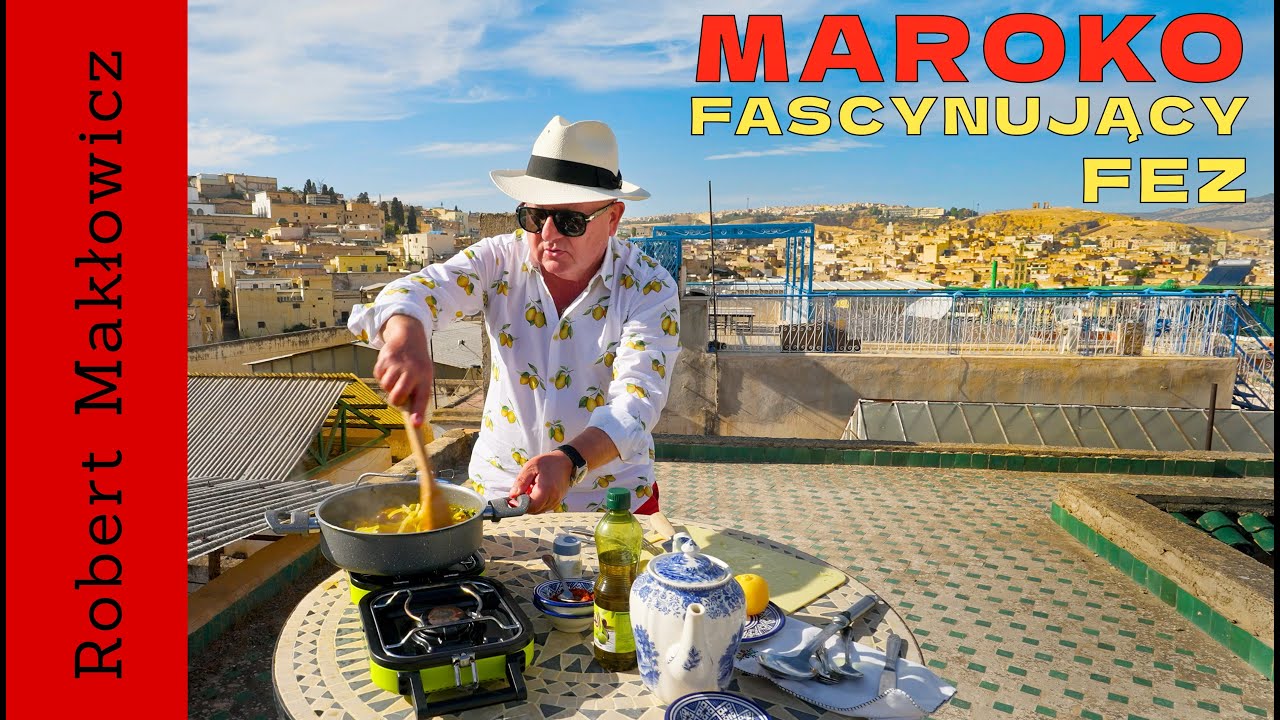
W tym odcinku odwiedzimy jedną z historycznych stolic Maroka, Fez. Jego stara część, czyli medyna lub medina, to jeden z najstarszych i najwspanialszych przykładów historycznych miast w całym arabsko-muzułmańskim świecie. Spacerując po uliczkach, powstałych nierzadko na przełomie ósmego i dziewiątego wieku, będziemy przyglądać się tamtejszemu życiu, podglądać zawartość spożywczych straganów i obserwować lokalną aktywność rzemieślniczą, zwłaszcza garbarstwo, z którego gród słynie od wczesnego średniowiecza. Nie zapomnimy również o lokalnej gastronomii oraz gotujących widzach. Dla nich przepis na kurczaka w kiszonych cytrynach po marokańsku.
Partnerem odcinka jest aplikacja eSim Saily https://saily.com/maklowicz
KOD RABATOWY: maklowicz da Wam 15% zniżki na wszystkie pakiety danych w aplikacji Saily.
Partnerem wyprawy do Maroka jest serwis Wakacje.pl – największa w Polsce platforma sprzedaży wycieczek, gdzie w kilku prostych krokach zarezerwować możecie wyjazd nie tylko do Maroka, ale też do mnóstwa innych pięknych miejsc na naszym globie. Sprawdź oferty wycieczek https://www.wakacje.pl
#RobertMakłowicz #Makłowicz
Link do rejestracji karty ZEN https://www.zen.com/?utm_medium=ROBER… Kod Rabatowy: MAKLOWICZZEN gwarantuje 150 dni bezpłatnego użytkowania ZEN w Planie PRO i korzystania z jego ZENefitów
Jeżeli chcielibyście kupić moje książki lub koszulki zapraszam pod ten adres ➡ https://maklowicz.sklep.pl
Zasubskrybuj kanał, dzięki temu będziesz na bieżąco z naszymi filmami ➡ https://www.youtube.com/c/RobertMakłowicz_official
Jestem dla Was dostępny na Facebooku ➡ https://www.facebook.com/robertmaklowiczofficial/
Moje unikatowe zdjęcia zobaczycie na Instagramie -➡ https://www.instagram.com/robertmaklowicz_official/
The partner of this episode is the eSIM Saily app. The partner of the Morocco trip is wakacje.pl. Is it possible, my dears, to be in Fes and Ephesus at the same time? Well, you can, if you’re in the Turkish city of Ephesus and wearing the appropriate headgear, i.e., a fez. But there’s also another option. If you have bilocation abilities, you can be in Ephesus in Turkey and in the city of Fes in Morocco at the same time. Firstly, I don’t have bilocation abilities, and secondly, I’m wearing a Panama hat, so I hereby solemnly declare: Before me lies the magnificent Moroccan city of Fes. A city that is incredibly important not only for the history of Morocco. Not only for the history of this region. It is also incredibly important for the history of the entire world. Here we have many things that are the most, the most, the most, the most, the most. And it is precisely these things that I will be talking about today , as we descend and delve into the tangle of this ancient city . So let’s begin the list of the most important things about Fes. Well, Fez has the oldest and largest Medina, the old Arab city. It was founded at the turn of the eighth and ninth centuries AD, and because it’s so ancient, it also has the narrowest streets. It’s more or less calculated so that a person on a donkey could barely get through. The narrowness of some of these streets and the overall concentration of buildings were not only intended to accommodate as many people as possible, but also to maintain temperature. In the summer, it’s hot outside, but cool inside. Walking around not only Fez, but all Moroccan cities, it’s impossible not to notice that this is cat country, but an important observation. These cats, although many live wild, are incredibly well-cared for. It’s morning, and look what’s happening here. We have a cat breakfast here. Someone left food for these cats, and they’re eating their morning meal here in droves. One more important thing: the city is very old. There used to be no sewage system here. Today, there is. There’s access to water, but you have to pay for it. There’s also free water. These are public water sources, and if someone wants to avoid paying, or pay less, they come and get their water from there. As I said, the largest medina in the world. When the French arrived here, they were afraid of this vast space full of narrow , inaccessible streets, this thicket and tangled mess, so they decided to change things up a bit. So they used existing gates in the defensive walls, widened them a bit, built new ones, and also created access points , but we’re right in the middle of the medina. There’s a medina, and there’s a medina, and you can’t get in either one by car. One more thing about Fez: the old town of Fez is the largest urban area in the world closed to traffic. So if you’re sleeping in a riad, remember that you’ll have to drag your suitcase several hundred meters or even several kilometers, but the good news is that there are services available. This gentleman has a different load, but the same gentlemen pack your suitcases and deliver them on call. Just like you, they’re on standby here, so don’t worry. Everything will be fine. A grocery grater, or rather, a small section of it. It’s a vast, elemental commodity, so to avoid jumping around like a chess knight, let’s just focus on the contents of the nearest stands. Let’s look here, at these crates. It’s olive season. Well, you can buy raw olives, but they’re inedible, so what do you have to do? You have to brine them and change the brine several times. Only then, after being in such a salty bath, will they be edible. Pomegranates. I’m a huge fan of them and eat them in Poland. I both shake them for yogurt and squeeze their juice, but a pomegranate has a completely different taste. The interior and exterior in terms of attractiveness. If a pomegranate is beautiful on the outside, the inside isn’t sweet at all. I happen to like the tartness and sourness of pomegranates, but the beautiful skin guarantees that tartness. If we want pomegranates with a sweet interior, they simply have to be uglier on the outside. Remember this. Now, the fruit of the strawberry tree. The breadfruit. This grows in Dalmatia, but you won’t find it anywhere else except Fez and the surrounding area. This is khea. What is khea? It’s beef lard with pieces of beef embedded in it, and it’s used to make scrambled eggs. This is what eggs are made with. Let’s go a little further. My nose is calling me here. Good morning, everyone. Excuse me for a second, as we have something to do and finish here. Excuse me. This is a pickle stand. There are tons of them. This is the perfect thing to bring home. Homemade harissa. A paste based on paprika and cumin. You have the boxes. You pack it. Pickled lemons. Of course, they’re already available in Poland, as is harissa, but harissa of this quality. It’s not really available in Poland. We’ve entered the fish sector. And it’s absolutely necessary to show you two of the greatest Moroccan seafood specialties. These are sardines, and here are anchovies. The country is incredibly famous for both. They’re also canned and shipped here. If you buy sardines or anchovies in Poland, they’re often from Morocco, but we also have other wonderful things. We have shrimp, gambas, sea bream, and pieces of shark fillets. Lots of incredibly pleasant things. Cats know exactly where to be. Another Fez favorite, this time for breakfast. The most popular morning food options here. A soup called bissara. What you see on top is olive oil, and this is a kind of cream made from dried broad beans, dried peas, and sometimes even dried green peas. You just season it with ground cumin, stir, and then simply eat it. A practical application of what you just saw at the stall—that canned beef, lard, and the meat dipped in it. These are breakfast eggs prepared with the same. There’s a spoon for that, but no fork or other utensils. Because you get this bread, and now you have to eat it that way. With bread. I’ve seen the locals here, but I haven’t tried this one yet. Good. And quite high in calories, considering that what’s floating around here is beef lard. Yes. Good, but I’m most interested in bissara, as I’m a known broad bean eater. So now… It’s wonderful. The purée is delicate, with a hint of onion and garlic. The cumin spices it up. Olive oil, of course . Yes, it’s the perfect amount of calories to start your day off right. Some of the things sold at the market are also made right there. For example, the famous dough, which is used to make even more famous pancakes called pastilla. It’s a very thin dough, somewhat similar to a jówka dough or strudel dough. The lady already has the dough ready, but uncooked. She takes a portion and stretches it out with oiled hands. Just like with strudel, and then it’s baked in a special oven. It’s good on one side, and then just browns the other . And now the composition of these pancakes is used to create one larger pancake. And that’s the pastilla. This finished composition with various fillings. It can be sweet, it can be savory, and very often it’s a combination of both salty and sweet, as the absolute top pastilla is the one stuffed with pigeon meat. Quite often today, it’s chicken, not pigeon, but the topping, although savory, still has cinnamon and powdered sugar. If you want to try something truly Moroccan , pastilla is exactly that. Here, you buy ready-made dough and assemble the final pastilla yourself at home . Even in the early Middle Ages, Fez was one of the world’s largest craft centers. Why? Because it was strategically and conveniently located, meaning caravans from the interior of Africa, caravans from the Middle East , and shipments from Andalusia, then under Berber-Arab rule , arrived here. Then, after the Reconquista, Islamic artisans, expelled from Andalusia, arrived here. And this tradition still exists and is strong. It’s estimated that in this city of over a million people, tens of thousands of people engage in crafts. And we’re in a place that can be visited, as it were, because we’re walking through the Medina, but it’s a working factory. In this case, we’re dealing with dyeing activity, meaning the gentlemen here are dyeing fabrics. We’re in one of the oldest parts of the Medina, Seffarine Square. Seffarine Square is the coppersmiths’ square. And now we have to tell this beautiful story. Fortunately, it’s punctuated by the sound of a hammer. Why is it beautiful? The coppersmiths’ square, because in the Middle Ages, coppersmiths began to gather here , crafting various large cauldrons, or even small cauldrons just for making couscous and everything else made from metal and copper. But the most beautiful thing about this story is that nothing has changed here for hundreds and hundreds of years. In our cities, we also have cobbler’s streets, coppersmith’s streets, and soapmakers’ streets, but these are only reminders of ancient crafts. And here we are in the coppersmith’s square, and we still have coppersmiths here. A wonderful life that continues almost unchanged. We’re in a place that has been doing the same thing since the 11th century and hasn’t changed much. It’s located in the same location. Chouara, a tannery and leather dyeing plant. I mentioned the city’s strategic location. How caravans from various places arrived here. And also the leather. These leathers were tanned, dyed, and made into various things. We’ll take a look at some of them. Tanning was probably considered an unclean occupation because of the rather unpleasant odor emanating from these vats during the tanning process, so we’re located at the very bottom of the Medina. Tanning and dyeing leather requires a lot of water. Here, we have the Fes River nearby. And so, those who enter are often given mint leaves to hold to their nostrils, so that, frankly, the stench isn’t too bothersome. But a man who has smelled an Icelandic shark, who has opened a can of Surströmming , isn’t afraid of such odors at all. Besides, modernization of the process has made the stench less painful. Of the local leather goods , I’m most interested in footwear, and the king of local leather footwear is baboushes, or slippers. Besides, baboushes, slippers, slippers. See how closely this language travels around the world. Once upon a time, the most valuable, symbols of prestige and social standing, were yellow baboushes. Why? Because in the past, to achieve that color, you had to use saffron, and saffron is still an extremely expensive spice, and now I have two types of baboushes. They differ in shape. The rounded ones are Berber baboushes. Anyway, look, I’m wearing Berber slippers. You see, they’re roundish, and these pointy ones here are Arab babouches. And now I’m going to buy one. Look, they always have a worn-down heel, and you don’t wear socks with them, but there’s another interesting observation. When I’m in Spain, I buy this type of footwear. They’re called botas espanolas in Spain, but they don’t originate from Spain. Now you know where these types of shoes come from in Spain, especially Andalusia. Well, Fez, this is the Mecca of world leatherwork. Which babouches should I take? Well, I can’t, I can’t ask you to vote, but I think I’ll take the Arab ones. Okay, embarrassing, because it’s a sock, but still, it’s a decent item. Yes. I think I ‘ll take these . Decent babouches. I forgot my glasses. Partner corner. And now a few words about the partner of our episode. This is the Saily eSIM app, which allows us to access internet packages in 190 countries and territories worldwide. It’s best to purchase the right internet package before your trip, so you don’t have to desperately search for a local booth with a local SIM card when you arrive. Saily protects us against malware, allows us to block ads, and allows us to set a virtual location. We used it in South America and various locations in Europe, and now we’re using Saily here in Africa, in Morocco, and we know it’s a very practical and convenient solution. With the password maklowicz, you’ll receive a 15% discount on the packages you choose . Details are in the video description. The partner for our entire trip to Morocco is wakacje.pl, which offers a huge number of trips to various destinations around the world. This offer also includes the one around me: Morocco. A country of extraordinary interest, both in terms of landscape, culture, and history. Now it’s up to you which form of vacation you choose. Whether you want to lazily relax in a local resort, such as Agadir, or travel and explore? Using the wakacje.pl app on your phone, you can choose what suits you best. End of the partner corner. These are the walls surrounding the Karawiyyin Mosque. In a moment, we’ll reach one of the fourteen gates leading to this mosque. This mosque, this temple, was founded in 859, and what’s the most important part of this story? The most important part? A Koranic school was also established near this mosque . A Koranic school, where, however, not only the Koran was taught. Other fields of knowledge were also practiced there, including medicine. Therefore, it is considered the oldest, longest-running university in the world. Its importance in the early Middle Ages was extraordinary, as it was from here that the reception of ancient Greek achievements reached Europe . Yes, because the Arabs in Andalusia and here translated the works of Greek philosophers, for example, but also the works of Arab scholars, like Avicenna. It all came from there. It was the light of knowledge that also enlightened us. And both this mosque and the university—because today it is indeed a university—have continued to function in this place since 859. My dears, since everything was the best in the fez today, let this also be the best dish. In other words, the most popular Moroccan dish. In my humble opinion, well, there are probably no statistics, but you’ve all heard of chicken stewed in pickled lemons, and that’s exactly what I intend to make. It’s not a whole roasted chicken. It’s usually the thighs or so-called drumsticks. We call them drumsticks. So be it. And now, yes, we have all sorts of recipes. Some recipes call for marinating the chicken beforehand, but in my humble opinion, it’s not necessary at all. I also want to show you the easiest version of the dish, so here we have chicken. Don’t worry, it’ll be mixed together. Salt, a lot of salt, and the powdered spices— not whole turmeric. A little turmeric. A little ground cumin and a little ginger, but dried, powdered ginger. A little. Now you need to mix it all together. And does it really need to marinate for a very long time? Well, if there was any point in marinating it, it would need to be refrigerated for a good few hours. You can do that, but you can also skip it. We’ll just get to the point in a moment. Just make sure it’s evenly coated in what I’ve added here. Many recipes include one more thing in the marinade: garlic, but in my humble opinion, that’s pointless, because you’ll have to remove the garlic from the chicken because the chicken needs to be seared over high heat. If the garlic stuck to the meat, it would burn, become bitter, and that wouldn’t make sense. We’ll add the garlic later, and it’ll infuse the whole thing with the flavor we’re after. Okay, so it’s evenly coated in spices. We’ll close our little theater here for a moment, and here we heat enough olive oil, locally sourced, to sear it over high heat. This will take a while, because everything needs to be very hot. The oil seems to be already very hot, so now, at a distance from the pot, we add the meat and sear it over high heat on both sides. Voilà. One side is already beautifully browned, the other is getting brown, and now we need to add the onion. Quite a lot of onion. In fact, unlike soups, local sauces don’t actually contain flour. Harira, or that pod-based soup we had for breakfast today, bissara, is sometimes thickened with flour. I mean, probably not bissara, because we have the pods blended there, but if we don’t have enough, and in harira, that’s definitely done, you mix a little flour with water, add it, and thicken it. Sauces, however, are thick on their own, and what makes them thick? Among other things, it’s from what I just added: the onion, which will fall apart, because frying is only the beginning of the process. Then we’ll have cooking and stewing, so now the onion sinks to the bottom, and now I add the garlic. At least three cloves of chopped garlic in the center. And let it simmer for a while. We’re not adding anything yet. The onion has softened due to the heat. The garlic hasn’t browned. Neither has the onion. You can add more ingredients, like more ginger. For now, you can add it anywhere. There will be liquid here in a moment to absorb it all. More ground cumin and a little more turmeric. And now, to prevent it from burning and to let it simmer, and even cook a bit first, I’m pouring in some chicken stock. A local stock cube, which I’ll use. You don’t need anything more. Okay, but that’s not all. Now, I have quite a bit of parsley and cilantro here. Mixed. You need to chop it gently, because it will fall apart during the stewing process anyway . Just like that. And now everything’s in the pot. Voilà. And something that’s not locally standard, but I’ll add it: harissa. The locals make harissa. Harissa isn’t as ubiquitous here as in Tunisia, and local dishes aren’t usually spicy. If it’s a little, but you know, we make it for ourselves. Not much harissa . That’s it. And for now, I’m not adding any salt. We have the stock, we have the salted chicken. I don’t need to do anything else at this point. Just cover it, and at this point, it has nothing to do with chicken in marinated lemons, but they’re waiting for their turn. Ladies and gentlemen, we’re finishing up. Uncover the dish to let the sauce evaporate. You see, this is where the magic happens. It’s already thick. All those aromas have combined, and now the final ingredients that define this dish. Pitted olives. I know many of you prefer pitted olives because you don’t have to spit the pits out, but believe me, pitted olives have more flavor. When you pit them and put them in a brine, the brine washes out the flavor, so it’s better that way. That’s how the locals do it. And something that’s in the name of this dish —lemons. And now, yes, here we have fresh lemon. If anyone wants to add some sourness at the end, here we have two pickled lemons. See, they look different. How do you make such lemons? First of all, you need organic lemons, meaning unsprayed and unwaxed. And you have to pickle them in brine. You can easily find recipes for this online. It’s not complicated. You just have to find good lemons. It’s easy. It’s also possible here, in our country. And now, we cut them into quarters, and we don’t need the insides. The insides of these lemons are the seeds, the pulp. It has no flavor. It’s just salty, basically. It’s all about the peel. That wonderful peel, which gains additional flavors in the process . If you don’t want to do this at home, you can easily buy such lemons in Middle Eastern, Turkish, or Arabic food stores , or online. I buy these Moroccan lemons in Krakow, in jars. That way, I can see what’s inside. I don’t need it. I set this aside, and I cut the zest into strips like these, and this is what will soon be inside: the zest of one pickled, pickled lemon, cut into strips, and the olives. I throw everything in. I mix it all together. Now it needs to evaporate a bit more. It needs to get that lemony flavor. Five, ten minutes at most. Let’s eat. The composition is complete. All the aromas have combined. You really don’t need much here. You’ve seen those powdered spices—they’re in every supermarket. You can easily find pickled lemons. Olives too. If you buy a free-range chicken, you can easily do it, and this is… This, my dears, is one of those things that is incredibly simple. Look how tender it is. It falls apart. Which is not only incredibly simple. I zest a lemon, but also outstanding in the category of the simplest and best —one of the leading heroes. The sun sets. The muezzin calls for evening prayers. We’re delving into the tangle of Medina streets again. We’re walking with a very specific purpose. We’re simply going for dinner. The place we’re going to is called Dar ori, meaning now or immediately. That’s the name of the restaurant. And our dinner won’t be here immediately, but in about two or three minutes. Everything looks great after dark too, but it’s quite difficult to find things. And not just after dark. It’s the largest tangle of ancient Medina streets in the world, but I already know it’s here. That’s part of the genius of Morocco. You arrive somewhere along a winding, narrow Medina street. You stand before a gate or a door. You go inside. It seems inconspicuous at first, and then suddenly you stumble upon something like this. It’s a dar, meaning a house, but it’s also a riad because it has an interior patio. We’re sitting there. Upstairs, there are normal apartments. These aren’t just random people living here, but the owners of this restaurant. And now I have to tell you as quickly as possible about what we have before us, so it doesn’t get cold. So, yes, this is lamb couscous. Here, we have raisins, vegetables, chickpeas, aka pois chiches, and that’s it. Let’s move on to the second type of couscous. This is vegetarian couscous, made with vegetables, but there’s nothing worse in the world than dry couscous. There’s also broth for pouring it over. Dry couscous is for people on a strict diet, or for people in hospitals, or for newborns. Couscous must be moist. This is pastilla. I was talking about those fritters today. We saw how this cake is made, sorry, but the salivary glands are working. This is a pastilla made with seafood, and inside are morels from the Atlas Mountains. This is lamb tajine with beans, and this is braised lamb with salted, pickled lemons. And look, besides the broth, we also have homemade harissa for seasoning. We have Domaine de Sahari, a Moroccan red wine, and now I’ll stick a harpoon into my dish because I want to show you a cross-section of it. Okay, let’s do it this way. We’ll transfer it to my plate without disturbing this floral, wonderful composition, and I’ll show you a cross-section of what it looks like. See? The black ones here are morels, but you can also clearly smell the aroma of seafood and fish. Honestly, the surprise, considering the inconspicuous entrance and the alleyway, and the magnificence of this place, is even greater. Because the cuisine is also wonderful, and that’s exactly the kind of cuisine I wish you in Morocco. A fantastic dish. I can smell the anchovies and sardines. Perfect. Perfect.
24 Comments
Partnerem odcinka jest aplikacja eSim Saily https://saily.com/maklowicz
KOD RABATOWY: maklowicz da Wam 15% zniżki na wszystkie pakiety danych w aplikacji Saily.
Bardzo przyjemnie sie oglada. Ale dobrze, ze udalo mi sie wyprowadzic do polnocnej Norwegii, czuje ze Maroko mogloby byc delikatnie zbyt cieple.
❤❤❤
Pani od ciasta świetna 😃
Material petarda jak zawsze!!!!UK pozdrawia serdecznire💪
Byłem w Fezie 3 lata temu i to jedno z najbardziej fascynujących i zapadających w pamięć miast świata – tego potężnego labiryntu ulic wyniesionego na wzgórzach (w przeciwieństwie do Marrakeszu), z fontannami, pełnego meczetów, medres, bazarów nie da się zapomnieć. Do tego toczyło się tam normalne ale bardzo tradycyjne życie. I te odrapane z zewnątrz budynku które w wewnątrz często są pałacami. Dobrze że to przetrwało do naszych czasów
Spoko to Maroko 👍
Wesołych Świąt kochana Ekipo nałogowych oglądaczy najpiękniejszego Pana Roberta! 🥰
Super odcinek.. … jak zawsze. Wesołych Świąt
Właśnie dowiedziałem się, że Pan Robert, wbrew obiegowej opinii, nie posiada zdolności bilokacyjnych.
Panie Robercie tak od siebie taka rada . Może troszkę mniej tej nieosiągalnej kuchni i jedzenia na kanale a więcej o historii i życiu codziennym miejsca w które się Pan udaje .
Z wyrazami szacunku. Pozdrawiam 🎉🎉🎉🎉🎉🎉
Sos do couscous to nie bulion ale raczej tfaja, duszona cebula (aż do jej rozpłynięcia się) z rodzynkami i przyprawami
Moment na suku z wycieczką z Polski – bezcenny;-)
Bardzo fajnie, że tak dbają tam o koty aczkolwiek zawsze mnie dziwi czemu tak samo nie traktują psów. W ogóle to jest ciekawy temat jak niektórym zwierzętom odbiera się prawo do godnego życia. Przykładowo świnie, które masowo zabijamy i jemy są tak samo mądre (jak nie mądrzejsze) jak nasze zwierzęta domowe. Dlatego też dziwi mnie jak ci sami ludzie, którzy mówią o tym, że Chińczycy to barbarzyńcy bo jedzą psy i koty sami jedzą np. świnie bez żadnych obiekcji. Jestem ciekawy co Pan Robert o tym sądzi. W każdym razie jak zawsze bardzo ciekawy odcinek. Pozdrawiam serdecznie!!
Panie Robercie oglądam pana każdy odcinek odkąd zaczął pan nagrywać filmy na YouTube. Jest pan dla mnie inspiracją ze względu na to że też interesuje się historią i sam gotuje. Mam pana zdjęcie w kuchni jako jeden z mojej Świętej Trójcy i marzę aby zrobić sobie z panem zdjęcie i finalnie wykończyć moja kuchnie takim o to zdjęciem. Chciałbym zapytać czy będzie pan w najbliższym czasie w Poznaniu? Wiem że pan podróżuje i z ciekawością oglądałem podróż do Szkocji gdyż sam byłem niedawno i Cullen skink wyszedł panu rewelacyjnie! Pozdrawiam serdecznie Jarek ❤
Czy można być jednocześnie w Panamie i Fezie? To dopiero nowy poziom wieloznaczności😂
U mnie w domu mówiło się bambosze
Oj Pan nie potrafi kłamać, mówiąc, że ta zalana smalcem jajecznica jest "dobra"
Panie Robercie, uwielbiam Pana programy, ale mówienie z pełną buzią tak blisko przed kamerą jest nieprzyjemne w odbiorze 😅
Dobrze że takie miejsca zachowały dorobek antyczny ,bo chrześcijaństwo wolało ten dorobek palić na stosach 😂
Wyglada swietnie ten kurczak! Ale… zaszokowala mnie ta kostka bulionowa… moze jestem zbyt ortodoksyjny 😆
Wesolych Swiat dla calej ekipy !!!!
dziękuję pięknie i pozdrawiam
To marynowanej czy kiszonej tej cytryny? Bo to się źdźbelko różni. 😅