
The Trump administration is seeking to impose a nearly 92percent duty on more than a dozen Italian pasta manufacturers, accusing them of dumping their products into the American market to undercut domestic competitors.
Pasta made in Italy – along with several types of cheeses, olive oil and cured meats from the country – has already been subject to the 15 percent tariff the United States levied on most goods from the European Union starting on August 1.
If the additional 91.74 percent duty goes through early next year, shops and grocery stores that sell the affected pasta brands – including Garofalo, Rummo, Giuseppe Cocco, and La Molisana – may have to double their prices on those items or pull them from their shelves altogether.
Tino’s Delicatessen, an Arthur Avenue staple in the Bronx, New York, has already decided it will no longer sell any of these pastas going forward.
Rosa and Giancarlo Paciullo, both natives of Salerno, Italy, have been running Tino’s for more than 50 years. The couple found out about the duty roughly two weeks ago and have now opted to only carry a specialty brand that comes from Abruzzo, a region in Italy just east of Rome.
‘Rummo, all the other pasta, everybody’s scared,’ Rosa Paciullo told the Daily Mail. ‘We’ve sold pasta [from Abruzzo for] 40 years and we’ve never had a problem.’
Thirteen companies are being targeted with the import tax being proposed by the US Department of Commerce, which since 1996, has been investigating suspicions that Italian firms are selling their pasta at artificially low prices in the US.
The brands that could be hit are generally higher-end dried pastas that are mass-produced in Italian factories. They are sold in more upscale supermarkets. For example, Garofalo is sold at Whole Foods and Fairway, which are both more high end stores.
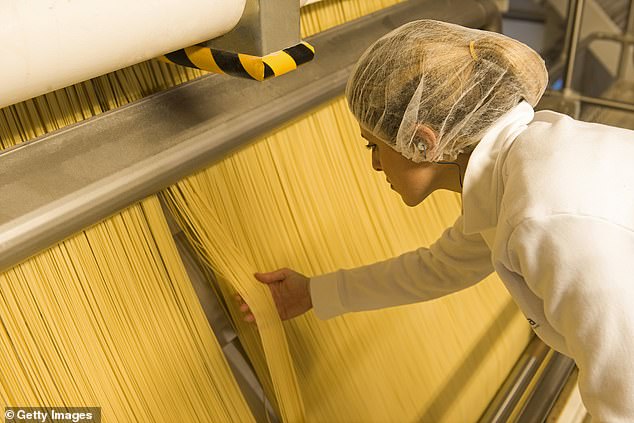
The Trump administration could begin imposing a 92 percent duty on 13 Italian pasta manufacturers by next year. Pictured: A worker inspects the pasta being made at Barilla plant in Foggia, Italy

Garofalo, Rummo, Giuseppe Cocco, and La Molisana are all brands being targeted in the probe. They are generally higher-end dried pastas that are mass-produced in Italian factories

Tino’s Delicatessen, an staple Italian restaurant and grocer on Arthur Avenue in the Bronx, has responded by pulling pasta brands such as Rummo and Garofalo off its shelves
Even Barilla, which was named in the Commerce Department’s anti-dumping probe, makes the vast majority of its pasta varieties, except tortellini and its oven-ready lasagna, in the United States.
A Trump administration official told the Daily Mail that Italian pasta makers have not complied with more recent data requests and that if they do, the Commerce Department will ‘alter the assessed duty rate.’
The official added that ‘there is no “punishment” here that political appointees within the administration are pursuing or legally could pursue’ against the pasta manufacturers.’
Scott Laing, a Clinical Assistant Professor of Finance at the University at Buffalo’s School of Management, told the Daily Mail that there is a ‘punitive’ element to the tariff the Commerce Department is floating.
Laing said Garofalo and other similar companies are almost certainly not selling the exact same product in the US for half the price they charge domestically or in other countries, as the 91 percent anti-dumping duty implies.
‘I can’t imagine any company could justify keeping prices that low in another country when they’re operating in a global space,’ he said. ‘I would expect if there was evidence of dumping, it would be something like a 10 or 20 percent discount. If that.’
It’s not clear that there is a large, US-specific discount on the products the Trump administration is targeting.
For example, a one-pound bag of Garofalo penne at a Fairway in Manhattan bought last week cost $3.49. A 500 gram bag (slightly more than a pound) of the same variety of Garofalo pasta costs €1.59 ($1.87) at a Carrefour grocery store in the center of Rome.
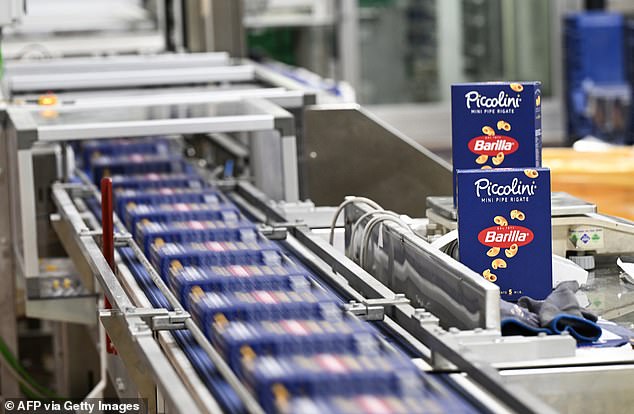
The vast majority of Barilla pasta carried in the US is also made domestically, meaning that most of their products won’t be hit with the duty

Scott Laing, a finance professor at the University at Buffalo, told the Daily Mail that upscale grocery stores will suffer but customers at your average supermarkets will not
Laing added that the pasta duty is narrowly targeted, unlike President Donald Trump’s sweeping reciprocal tariffs, which impose flat rates across broad categories of imports from other countries.
An administration official told the Daily Mail that ‘these duties only affect pasta makers who comprise less than 17 percent of total pasta imports from Italy’.
‘It really shouldn’t impact the average consumer that much. The majority of US pasta is just off-brand boxes, the store brands,’ Laing said. ‘There’s really no reason much of it is going to be impacted, other than the small subsection of the grocery store shelves that have high-end pastas, the Italian imports, and those specialty products.’
In fact, the owner of Buon’Italia, an Italian grocer in Manhattan’s Chelsea Market, said he believes if this anti-dumping tariff were to go into effect, it could actually benefit his store.
Antonio Magliulo does not have pasta from Barilla, Garofalo or Rummo on his shelves. Instead, he sells Pasta Setaro and Marilungo, two brands that are not subject to the duty.
These brands were never investigated for illegal dumping, per a Daily Mail review of Federal Register records.
That’s likely because Pasta Setaro and Marilungo are not giant conglomerates known for rushing their products to market to maximize profits.
Instead, they get their pastas to specialized stores such as Magliulo’s Buon’Italia that will be able to sell them at a premium.

Antonio Magliulo, the owner of Buon’Italia (pictured) in Manhattan’s Chelsea Market, said the anti-dumping duty may actually benefit him and his store
Pasta Setaro and Marilungo both operate out of a single factory in Italy and use traditional, yet time-consuming pasta-making methods. They cut their pasta with bronze dies, giving it a rougher, more porous texture that allows the sauce to better absorb into the noodles.
They also let their pasta dry for 24 hours or longer, whereas companies like Barilla use a fast-drying process that takes as little as six hours to quickly remove moisture for a better shelf life.
‘This will probably help me,’ Magliulo said of the anti-dumping duty. ‘Take a commercial pasta that costs nothing and sells for a very low price. It will probably end up selling closer to the price of the pasta that I sell, which is from a small manufacturer that uses selected grains and flours and is much more expensive.’
‘Which pasta would you prefer now that the price gap has been closed or reduced significantly? Now you can have a much better pasta for almost the same price,’ he added.
For consumers who already enjoy American pasta brands such as Ronzoni, San Giorgio and most varieties of Barilla, there isn’t much to worry about in terms of price hikes.
But for those who dabble in slightly more high-quality pastas found in Whole Foods or Trader Joe’s, they might want to prepare for some sticker shock.
The Commerce Department is now giving Italian pasta makers until February 18, 2026, to provide key sales data before the duty is officially imposed, according to an administration official.
That date could be pushed back by an additional 60 days due in part to the government shutdown throughout October and almost half of November, which continues to delay crucial bureaucratic processes.
Dining and Cooking