
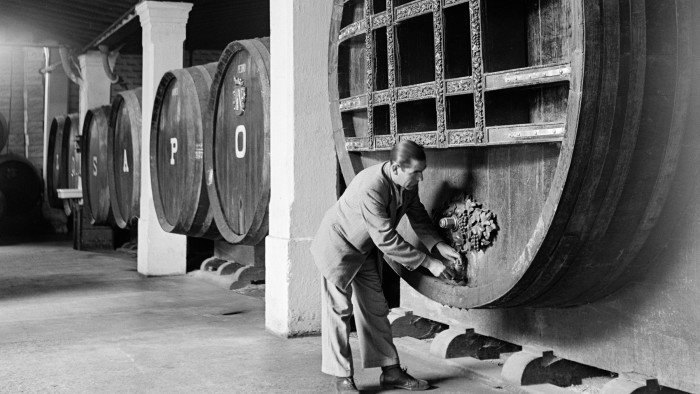
By the time the light fades over the Guadalquivir marshes, Sanlúcar de Barrameda smells of salt and warm stone. Step into Hidalgo’s bodega and the air closes in, dense with yeast, oak and the faint sweetness of fermentation. It’s a grounding smell, familiar, almost domestic. Rows of casks rise in perfect geometry, the youngest wines stacked above the oldest in the solera system, where each feeds the next in a measured exchange. Not ageing, but calibration. A veil of flor settles above – a living film that seals the wine from air and gives it its taut, saline edge.
 The entrance to González Byass in Jerez de la Frontera © Alamy
This small port, together with Jerez de la Frontera and El Puerto de Santa María, forms the Sherry Triangle, birthplace of the wine Shakespeare said could sharpen the mind and loosen the tongue. In these whitewashed cathedrals, three dynasties – González Byass, Osborne and Hidalgo – have outlasted invasions, wars and fashion’s whims. Between them, they’ve defined what we think of as sherry: a drink both ancient and restless, unmistakably Andalusian yet cosmopolitan.
Forget the thimble-sized glass: this is a wine for food
Jerez’s link to wine predates the idea of Spain itself. This corner of Cádiz – just north of the Strait of Gibraltar – is among Europe’s oldest inhabited regions. The Phoenicians brought vines around 3,000 years ago; the Moors reshaped the land through irrigation and gave Jerez its name, Sherish. After the discovery of the Americas, this coastline became the hinge of empire, from where fleets carried goods, language and faith across the Atlantic. By the 16th century, England had developed a taste for fortified wine (when Sir Francis Drake looted 2,900 butts of sherry from Cádiz in 1587, he didn’t just raid a port, he fed an obsession that still flickers in British pubs).
 Bodegas Hidalgo La Gitana’s San Luis cellar in the early 20th century
  Bodegas Hidalgo La Gitana’s San Luis cellar in Sanlúcar, which was built in the second half of the 19th century
It was in this world of transatlantic trade and genteel piracy that González Byass was founded in 1835. Its creator, Manuel María González, was a 23-year-old clerk with a good palate and a better head for export. His uncle, José María Ángel y Vargas – known as Tío Pepe – taught him the craft and helped shape the first soleras. Out of gratitude, González named one of them after him, a gesture that became the foundation of Spain’s most famous fino. A few years later, an English wine merchant, Robert Blake Byass, joined as partner and lent the business both his name and its credibility in London. “From the very beginning we were born with a unique wine and a clear international vocation,” says current chairman Mauricio González-Gordon, a fifth-generation descendant. “That blend of tradition and foresight has always guided our path.”
 Barrels in the Bodega de Mora at Bodegas Osborne
  Solera Pedro Ximenez Viejo, €214.90 for a case
Across the bay in El Puerto de Santa María, Osborne was already an institution. Founded in 1772 by Thomas Osborne Mann, it remains one of Spain’s oldest companies and is still 100 per cent family-owned. The firm made its fortune on sherry and brandy but became a cultural behemoth thanks to a bull: the black silhouette that still stands on hillsides across Spain, and even in Mexico, Japan and Denmark. “The bull was originally an advert for our brandy,” says CEO Fernando Terry Osborne. “Over time it became part of the national landscape – something that transcended the company.” It also became shorthand for a particular kind of southern masculinity: robust, proud and impossible to ignore.
Meanwhile, in Sanlúcar, Bodegas Hidalgo La Gitana practised a subtler alchemy. Founded in 1792, the house built its name on manzanilla – the most saline expression of sherry, shaped by the sea’s proximity. The estuary air leaves a salinity no inland cellar can reproduce. For Fermín Hidalgo, eighth-generation custodian, that character owes less to romance than to physics. Sanlúcar opens to the Atlantic, and the poniente wind that drenches mornings in moisture. Humidity keeps the flor alive; meanwhile the levante wind – hot and dry – is softened by the town’s topography. “That’s why [salinity] thrives here more than in Jerez or El Puerto,” he says. The unique taste isn’t sea air seeping into barrels, but rather yeasts kept unusually active by the coastal climate. Since the 1960s, the Denominación de Origen Manzanilla-Sanlúcar de Barrameda has protected that distinctiveness, even noting how the style shifts across the town: Barrio Bajo fine and ethereal, Barrio Alto broader and more robust.
 The portrait of La Gitana, the bodega’s logo used on Manzanilla La Gitana bottles
Osborne Fino Quinta, £15.75 for 75cl. BUY

Manzanilla La Gitana, £15.50 for 75cl. BUY
If González Byass is the innovator and Osborne the icon, Hidalgo is the poet: bohemian, intimate and forever bound to La Gitana – the manzanilla named after a gypsy woman from Málaga, once the lover of a Hidalgo patriarch, whose portrait still gazes out from every label. “The bodega is a way of life,” Hidalgo says. “Our only goal is to hand it to the next generation.”
Every conversation here turns to albariza, the region’s white, chalky soil, bright under the Andalusian sun. Rich in calcium carbonate and ancient marine fossils, it acts like a sponge, holding winter rain for the long, dry summer. At González Byass, around half the grapes come from the company’s own vineyards, including prized pagos Macharnudo and Carrascal. The rest are sourced from long-term growers. For González-Gordon, control from vineyard to bottle is essential, not just to make a product, but to sustain an ecosystem. The house’s devotion to research dates to the 1950s, when his father returned from California convinced that science would shape wine’s future, so he founded the first private oenological research centre in Spain.
 The patio between two of Bodegas Hidalgo La Gitana’s cellars
When asked how a family firm competes with global giants, Terry Osborne doesn’t flinch. From their cellars in El Puerto de Santa María, the family has built a portfolio that stretches from brandy to jamón ibérico and gin. What binds it all, he says, is not scale but coherence – a distinctly Spanish way of making and eating. “Everything begins with the raw material.”
Sherry once flirted with the trappings of nostalgia, but these houses show how it mutates without losing definition. González Byass, diversified but still rooted in wine and spirits, now operates 14 sites in Spain, Mexico and Chile and exports to more than 120 countries. Japan is among its most faithful markets. “Their appreciation for sherry is rooted in respect for craftsmanship, tradition and nuance,” says González-Gordon. “The taste profile suits the Japanese palate; it pairs with dishes from umami broths to delicate seafood. We’ve found a culture around sherry unlike anywhere else.”
 González Byass Croft Twist, £12.50 for 75cl, vinissimus.co.uk
Sherry’s present tense is practical. Rituals are being rewritten without betraying origin. Croft Twist – a lightly sparkling blend of fino, elderflower and mint – was conceived by González Byass for the UK but became a hit in Spain. Hidalgo followed with Triana Spritz, a manzanilla- based aperitif launched this year for cocktail bars and terraces. The point isn’t to sweeten sherry but to give it more moments in the day. It’s an exigent, not performative, revival – learned in the pour, the chill, the glass.
Recommended

At Osborne, that adaptability reads as persistence. Sherry accounts for barely five per cent of sales within a group turning over about €250mn a year, yet the old soleras in El Puerto de Santa María still constitute the company’s centre of gravity. The imposing complex includes a museum spanning two centuries of brand history – from archival documents and advertising reels to collaborations with Dalí and Annie Leibovitz, and images of Keith Haring’s appropriation of their famous bull. Terry Osborne is often in Madrid, but says decisions are still taken in El Puerto, where he feels “the weight of the company”. Through Fundación Osborne, the firm keeps its bond with the town, running hospitality programmes for young people at risk of exclusion. Most graduates now work in local hotels and restaurants, strengthening the same community that built the house. For him, the project is less charity than continuity, an investment in the ecosystem that sustains his brand.
 A González Byass export warehouse © Alamy
That same quiet intensity defines sherry at the table. Forget the thimble-sized Christmas glass: this is a wine built for food. “Everything that swims goes with fino or manzanilla, everything that flies with amontillado, and everything that walks with oloroso,” says Hidalgo – a rule that contains the logic of Jerez.
The world outside runs on novelty; the Triangle runs on sequence – harvest, classification, solera, tasting, release. Rooms are built for airflow and shade; barrels are kept old so wood never shouts over wine. The flor renews itself endlessly, drawing strength from what came before – much like the families who keep it alive. The future isn’t reinvention but a steady hand, producing wines that are unhurried and certain of their place. If there’s a unifying theme here, it’s tempo; a cadence measured, like palms keeping time.
Dining and Cooking