
On New Year’s Eve, the young chef Matthew Ryle will be in charge of the cooking. He just doesn’t know where yet: either hosting for friends at his home in London, where he lives with his wife and newborn, or at Café François, the lively French canteen in Borough Market where Ryle is executive chef.
Either way, the 30-year-old’s approach at each will be the same: “It is 100 per cent about the preparation, for any dinner party. And on New Year’s Eve you want to enjoy yourself as much as possible,” he says.
“In the restaurant we do everything before. When you come in for lunch, nothing is made at that exact moment — so much is prepped in the morning. And the more you can bring that approach home the better, whether it’s the dressings, cooking the vegetables, or cooking your meat and then flashing it [in a pan] to warm it through.”

Matthew Ryle
PASCAL VOSSEN
Ryle’s debut cookbook, French Classics, is filled with inspiration. Luckily for him, and us, French food lends itself very well to making ahead. “Coq au vin is a favourite dinner party dish of mine that gets better with a day in the fridge,” he says. “I’d do that with a nice pomme purée and a chicory salad. That means there is very little to do on the day.”
Another foolproof dish for busy hosts is a twice-baked cheese soufflé. “You could bake it for the first time the day before. Then when people come, you can cover it with cheese sauce and put it under the grill.”
Aren’t soufflés notoriously easy to get wrong? “Everyone thinks you need to be really careful but these twice baked ones hold nicely in the fridge for a day or so,” Ryle says. “A sweet soufflé you’d only bake once because you want it to be really light. With a twice baked cheese soufflé they are slightly heavier from the cheese and roux. If you let them cool down, they shrink slightly and then you can turn them out of the moulds. Just before you serve, put them under the grill and they puff back up.”
Ryle’s foolproof way to create a menu for such an important meal is to focus on a spectacular main dish, accompanied by simpler sides or a good salad. “A really impressive centrepiece is easier to pull off because you can do it all in advance. If you want to do more elaborate sides, you are going to be faffing around on the day.”
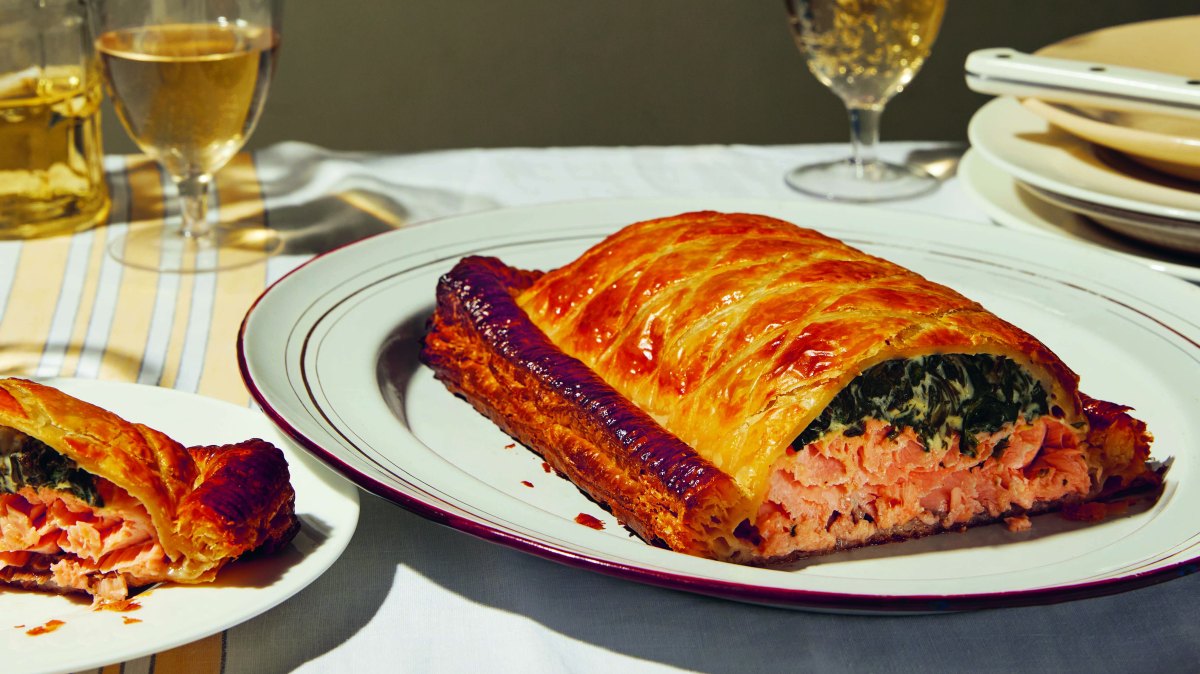
Ryle has just the dish for the occasion that ticks all the boxes. It can be made in advance and will bring out the “oh là là’s” when placed on the table. It’s his salmon en croûte, the elements of which can be prepped several days before.
So much of New Year’s Eve is the preamble before dinner — the cocktails, games and nibbles, which Ryle prefers to a formal sit-down starter. “A whole baked cheese like a Mont D’or is perfect. Serve it with some sourdough, roast potatoes for dipping, charcuterie or pigs in blankets and let people share.”
Anything else he’d like to add? “A bottle of champagne.”
Salmon en croûte
Serves 4

Salmon en croûte
PATRICIA NIVEN
Ingredients
• 50g cream cheese
• 1 tbsp Dijon mustard
• 1 tbsp chopped dill
• 1 tbsp chopped parsley leaves
• Finely grated zest and juice of 1 lemon
• 300g baby spinach
• 30g butter
• 600g skinless salmon fillet
• 2 x 320g sheets of shop-bought all-butter puff pastry
• Plain flour, to dust
• 1 egg, lightly beaten
• Sea salt flakes and fresh-cracked black pepper
For the béchamel sauce
• 450ml whole milk
• ½ onion
• 1 sprig thyme
• ⅕ nutmeg (grated)
• 5 twists of black pepper
• 50g butter
• 40g plain flour
• Salt (to taste)
Method
1. First make the béchamel. Add your milk to a saucepan along with the onion, thyme, nutmeg and black pepper and slowly bring to the boil. Once the milk has boiled, take it off the heat, cover with clingfilm and leave to infuse for 10-20 min.
2. In a small saucepan over a medium heat, melt the butter fully, then add the flour. Cook the roux for about 3 min, stirring constantly. It will be foaming and white; once you see the colour start to turn slightly brown turn the heat down and start adding milk slowly.
3. Add the infused milk one ladle at a time, mix until fully incorporated, and repeat. Once you’ve added half of the milk, start adding the rest 2 ladles at a time. Check the seasoning at the end. (Cover with clingfilm touching the top of the béchamel until required, this will stop a skin forming.)
4. In a small bowl, mix the cooled béchamel with the cream cheese, Dijon, dill, parsley, lemon zest and juice. Cook the baby spinach quickly in a saucepan with a little of the butter and some seasoning. Put the cooked spinach into a sieve and strain off the excess liquid. Leave to cool, chop it through, then stir it into the béchamel mixture.
5. Dry the salmon fillet and season it with salt and pepper. In a very hot frying pan, sear the salmon on both sides in the remaining butter for no longer than 1 min, then leave to cool. Cover both the spinach mix and the salmon and chill overnight.
6. The next day, several hours before serving, put the first sheet of puff pastry on a lightly floured surface. Place the cold salmon fillet in the centre of the pastry sheet. Spread the cold spinach mixture evenly over the top of the fish. Brush the exposed pastry rim around the salmon with some of the egg and place the second sheet of pastry over the top. Trim any excess pastry and seal the joins well, using the prongs of a fork. Brush the entire pastry with beaten egg, score diamond shapes to decorate if you want to get fancy, then place in the fridge on a tray lined with baking paper. Chill for at least a few hours.
7. Preheat the oven to 200C fan/gas 7 and leave a baking tray inside to get hot. Place the salmon en croûte, directly from the fridge and on its baking paper, on to the hot baking tray. Bake for 20–25 min, or until the pastry is golden brown and crispy. You want the final core temperature of the fish to be no more than 50C (I would recommend a probe thermometer for this recipe).
8. Let the salmon rest for 5-10 min before slicing and serving.
• Read restaurant reviews and recipes from our food experts
Duck à l’orange
Serves 4
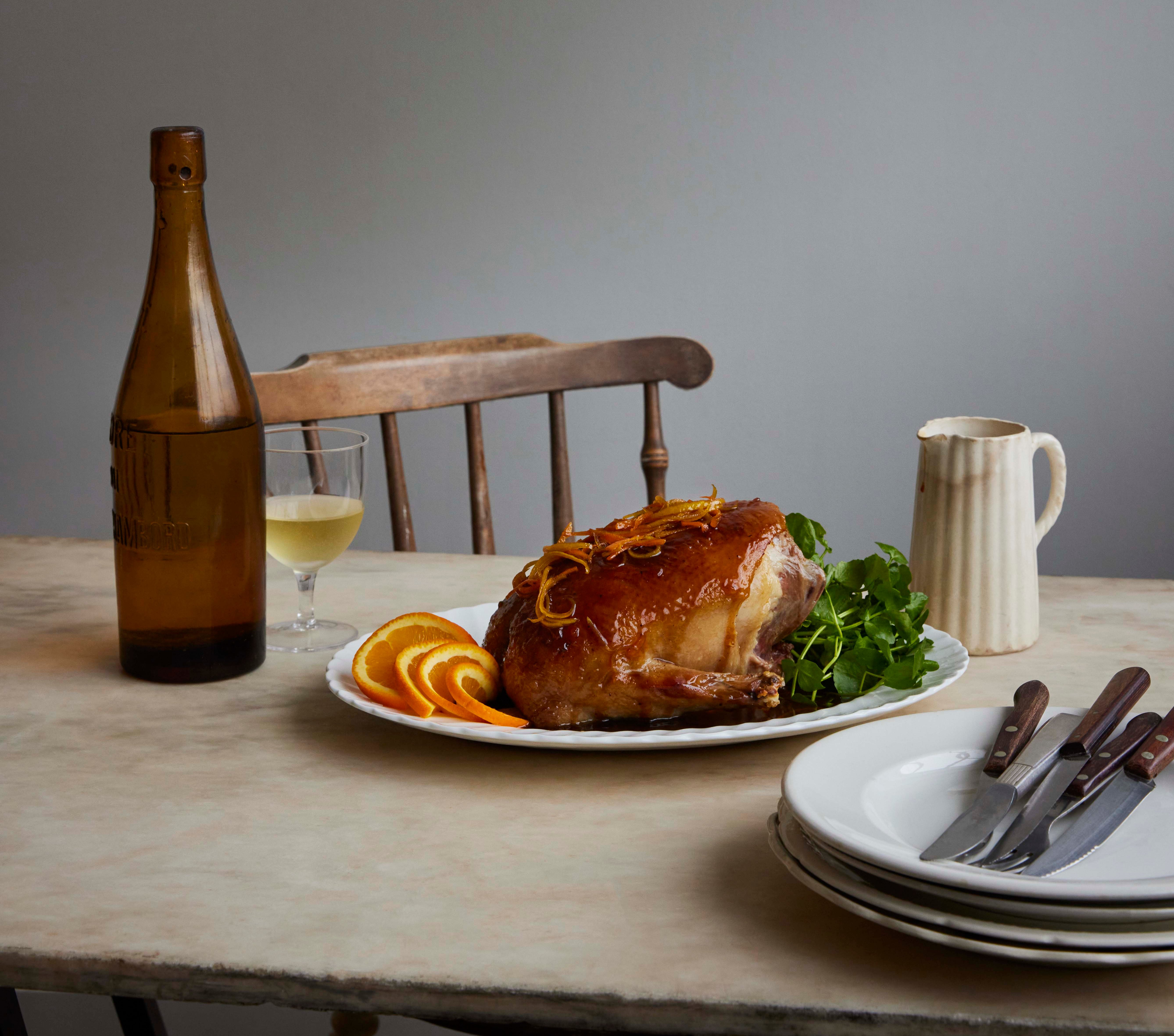
Duck à l’orange
PATRICIA NIVEN
Ingredients
• 1 whole duck (about 1.8kg)
• 1½ tbsp olive oil
• 2-3 shallots, sliced
• 100g caster sugar
• 60ml red wine vinegar
• 200ml freshly squeezed orange juice
• 500ml chicken stock (good quality shop-bought)
• 1 orange, plus orange slices (optional), to serve
• 1 lemon
• 2 tbsp bitter orange marmalade
• Sea salt flakes
• Bunch of watercress, to serve
Method
1. Prepare the duck by removing the legs, wings and carcass, breaking it down into a crown (you can ask your butcher to do this). The wings and carcass will be used for the sauce, while the legs can be saved for another occasion. Put the crown in the freezer for 10 min so the skin can firm up, then use a sharp knife to score the skin, to help the fat render when cooking.
2. Put the oil in a saucepan over a high heat and sear the wings and carcass until golden brown all over, then add the shallots and cook until caramelised (about 5 min).
3. In a separate pan, mix the caster sugar and vinegar, place over a high heat and cook until you have a golden caramel, swirling the pan rather than stirring for 2-3 min. Add the orange juice, again swirling to combine, then follow with the stock. Pour the mixture into the pan with the seared wings, carcass and shallots, then leave to slowly reduce on the stove for 15-20 min.
4. Bring a small saucepan of water to the boil. Using a vegetable peeler, remove the zest of the orange and lemon, with minimal pith. Slice the zest into long, very thin strips and blanch them in the boiling water for 1 min to remove the bitterness, then drain and set aside.
Remove all the pith from the orange and lemon, using a knife, and cut out the segments from between the membranes. Set aside.
5. Preheat the oven to 200C fan/gas 7.
6. Season the duck with salt, rubbing it into the skin, then heat a large dry frying pan over a medium-low heat. Put in the duck and brown it all over: it will colour in its own rendered fat. Take it slow; you want to render the fat as the duck colours, pouring the excess into a bowl (save it for cooking something else like potatoes). This stage should take at least 15 min.
7. Place the duck crown on an oven tray and roast for 8 min in the preheated oven. Remove the duck from the oven, and, using a pastry brush, give it a coating of the marmalade. Put the crown back in the oven and cook for another 2–3 min, then remove and leave to rest for 20 min.
8. Place the glazed duck crown on a serving platter, putting the bunch of watercress into the cavity. Finish the reduced sauce with the blanched citrus zest and segments and pour some on to the serving platter, serving the rest on the side, adding some orange slices if you like.
• Six December recipes from one of 2025’s top cookbooks
Gratin dauphinois
Serves 4-6

Gratin dauphinois
PATRICIA NIVEN
Ingredients
• 1.2kg large yellow-fleshed waxy potatoes, such as desiree or charlotte
• 300ml double cream
• 200ml whole milk
• 50g butter
• Sea salt flakes and fresh-cracked black pepper
Method
1. Preheat the oven to 140C fan/gas 3.
2. Peel the potatoes and slice thinly by hand or by using a mandolin — 2–3mm thick will be perfect. Put the potatoes straight into a bowl, season well with salt and pepper and mix to evenly coat.
3. Mix the cream and milk in a jug. Begin to layer the potatoes in an ovenproof serving dish, adding the cream mix as you go. A good splash every couple of centimetres will do the trick. Cut the butter into small cubes and finish the top layer with butter and black pepper.
4. Cover and place in the oven for 2 hours. Remove the cover and return to the oven for another 2 hours, until nicely coloured on top and completely soft throughout.
Fennel à la grecque
Serves 4

Fennel à la grecque
PATRICIA NIVEN
Ingredients
For the fennel
• 50g caster sugar
• 8 black peppercorns
• 1 tsp coriander seeds
• 1 thyme sprig
• 1 tarragon sprig
• 400ml water
• 100ml olive oil, plus more to sear the fennel
• 100ml white wine
• 100ml white wine vinegar
• 1 tsp salt
• 2 fennel bulbs
• Lemon wedges, to serve (optional)
For the dressing
• 150g crème fraîche
• 50g Dijon mustard
• 4 tsp chopped dill, plus more (optional) to serve
• Sea salt flakes and fresh-cracked black pepper
Method
1. Place all the ingredients for the fennel, except the fennel itself, in a large saucepan, big enough to hold the liquid and your fennel wedges. Bring to the boil and simmer for 2 min.
2. Remove the outermost layer from each fennel bulb and cut each in half vertically, then cut each half into 3 even wedges, with the root attached at the base of each to hold it together. Put the fennel in the simmering liquid and gently simmer for 20-30 min, or until tender.
3. Once a knife easily pierces the flesh, turn the temperature off and leave the fennel to cool down in the cooking liquid. This can be done up to 1 week in advance.
4. Make the dressing: just mix everything together, season and check. It should pack a punch, so prepare for a little Dijon fieriness.
5. Take the cooled fennel out of the grècque liquor and leave on a piece of kitchen paper to dry.
6. In a large frying pan over a high heat, add a little oil and the fennel wedges on a flat cut side. Evenly caramelise all over, then finish with sea salt flakes. 7. Put the dill dressing on a large sharing platter and top with the roasted fennel, or dollop the dressing over the fennel if you prefer. Serve with dill sprigs and lemon wedges.
• Which supermarket has the best festive food?
Crème brûlée
Serves 4

Crème brûlée
PATRICIA NIVEN
Ingredients
• 560ml double cream
• 1 vanilla pod, split lengthways and seeds scraped out
• 3 eggs
• 25g caster sugar
• Demerara sugar, for the sugar crust
Method
1. Put the cream, vanilla pod and seeds into a saucepan over a medium heat. Bring the cream to the stage just before boiling, take off the heat and leave to infuse for 20 min.
2. In a bowl, crack the eggs and add the caster sugar, then whisk until fully combined.
3. Put the infused cream back on the heat and bring back to boiling. Slowly pour it over the egg mix, stirring as you go. Pour everything back into the pan and set over a low heat. Stirring with a spatula, cook until it reaches 88C on a probe thermometer or gently simmer for about 5 min. Take off the heat, pour through a sieve into a clean bowl and leave for 15 min.
4. Blend until very smooth. Pour into individual dishes and place into the fridge for 2-3 hours, or until set (the longer the better, so do this the day before if you can).
5. When it comes to serving, sprinkle generously with demerara sugar and caramelise either using a kitchen blowtorch, or placing it under the grill. You want to take the sugar as dark as you dare; it’s the sweet-bitterness from the caramel which is key to this dish.
6. Leave to cool before serving, so the brûlée has time to cool and the caramel time to set rock-solid. Do not refrigerate though, as that would soften the sugar crust.
Cherry and almond clafoutis
Cherry and almond clafoutis
PATRICIA NIVEN
Serves 4-6
Ingredients
• 60g butter, plus more to grease the dish
• 15g custard powder (gluten-free, if needed)
• 125ml whole milk
• 165g caster sugar
• 3 eggs
• 70g ground almonds
• Any flour, for the dish (gluten-free if needed)
• 250g cherries, pitted
• 50g flaked almonds
• Icing sugar, to dust
Method
1. Start by making a beurre noisette. In a small saucepan over a medium-high heat, add the butter and cook until brown and smelling nutty. It will splutter before going quiet, which is when you need to watch it carefully. When it is a deep golden brown and smells of biscuits, pour into a small bowl and set aside to cool before making the batter. Measure it: you need 35g for this recipe.
2. Preheat the oven to 170C fan/gas 5.
3. In a large bowl, mix the custard powder and the milk with a whisk. Next add the sugar and eggs and mix until fully incorporated, then add the ground almonds and cooled beurre noisette.
4. Butter and flour a 23cm diameter nonstick baking dish about 3cm deep, or 4-6 individual 300ml volume dishes. Pour the batter into the prepared dish or dishes, evenly distribute the pitted cherries and sprinkle with flaked almonds.
5. Bake for about 20 min if you’ve gone for individual puddings, or 30-40 if you’ve baked a large sharing clafoutis. The finished clafoutis should be golden brown, risen in the centre and firm to the touch.
• Seven great festive dessert recipes
Comté gougères
Makes 10

Comté gougères
PATRICIA NIVEN
Ingredients
• 50g butter
• ½ tsp sea salt flakes
• 100ml water
• 100ml whole milk
• 125g plain flour
• 60g parmesan, finely grated
• 85g comté, finely grated, plus more to serve
• 4 eggs, plus one more if needed
Method
1. You will need a piping bag for this recipe. Chop the butter into small pieces and put in a saucepan with the salt, measured water and milk. Place over a high heat and bring to the boil. Once the butter has melted and everything is bubbling away, reduce the temperature to low, add the flour and cook for around 5 min, continually stirring with a spatula.
2. Pour the cooked mixture into a stand mixer fitted with a paddle attachment, if you have one. If not, a bowl, spatula and some elbow grease will work. Add both grated cheeses and mix on a medium speed until the cheese has melted and the mixture is combined. At this stage, the mix should be cool enough to start adding the eggs, but if it is visibly steaming or hot to the touch, leave it for 5 min more to cool down.
3. Add the eggs one at a time, while mixing on a low speed, waiting until each egg is fully combined before adding the next. Once all four are added, you should have a mixture that has a spooning consistency. Take a spoon, scoop up the mix and tap the edge of the bowl to knock off the mix; it should come off with relative ease. If it is still a little too stiff, lightly beat another egg in a small bowl, then add it gradually until the consistency is perfect. Put the mix into a piping bag and leave to rest for 15-20 min.
4. Preheat the oven to 160C fan/gas 4.
5. On a baking tray lined with baking paper, pipe the gougères: you’re aiming for something slightly bigger than a £2 coin, leaving at least a 2cm gap between each. Wet the tip of your finger and tap down any peaks your piping has left.
6. Bake for 12 min without opening the oven door. When the timer runs out, turn the tray around and cook for a further 2-3 min until golden brown. Cover the hot gougères with finely grated comté, then serve straight away.
French Classics by Matthew Ryle (Bloomsbury, £26) To order a copy go to timesbookshop.co.uk. Free UK standard P&P on orders over £25. Special discount available for Times+ members
Dining and Cooking