

Dec 27, 2025
IndexBox has just published a new report: Middle East – Refined Olive Oil – Market Analysis, Forecast, Size, Trends And Insights.
The Middle East’s refined olive oil market is forecast to grow modestly, with consumption volume projected to reach 420K tons and market value to hit $1.9 billion by 2035. In 2024, consumption rebounded to 403K tons, valued at $1.7B, led by Iran, Saudi Arabia, and Iraq. Regional production was 432K tons, dominated by Iran, Saudi Arabia, and Turkey. Imports declined to 6.6K tons, while exports fell sharply to 36K tons, with Turkey as the leading exporter. Significant price variations exist between importers and exporters, with Israel paying the highest import price and Turkey commanding the highest export price.
Key Findings
Market forecast to grow to 420K tons in volume and $1.9B in value by 2035Iran, Saudi Arabia, and Iraq are the largest consumers, accounting for 57% of volumeTurkey dominates regional exports, supplying 83% of total export volumeIsrael has the highest per capita consumption and pays the highest import priceImport volumes are declining while export and import prices are rising significantlyMarket Forecast
Driven by increasing demand for refined olive oil in the Middle East, the market is expected to continue an upward consumption trend over the next decade. Market performance is forecast to retain its current trend pattern, expanding with an anticipated CAGR of +0.4% for the period from 2024 to 2035, which is projected to bring the market volume to 420K tons by the end of 2035.
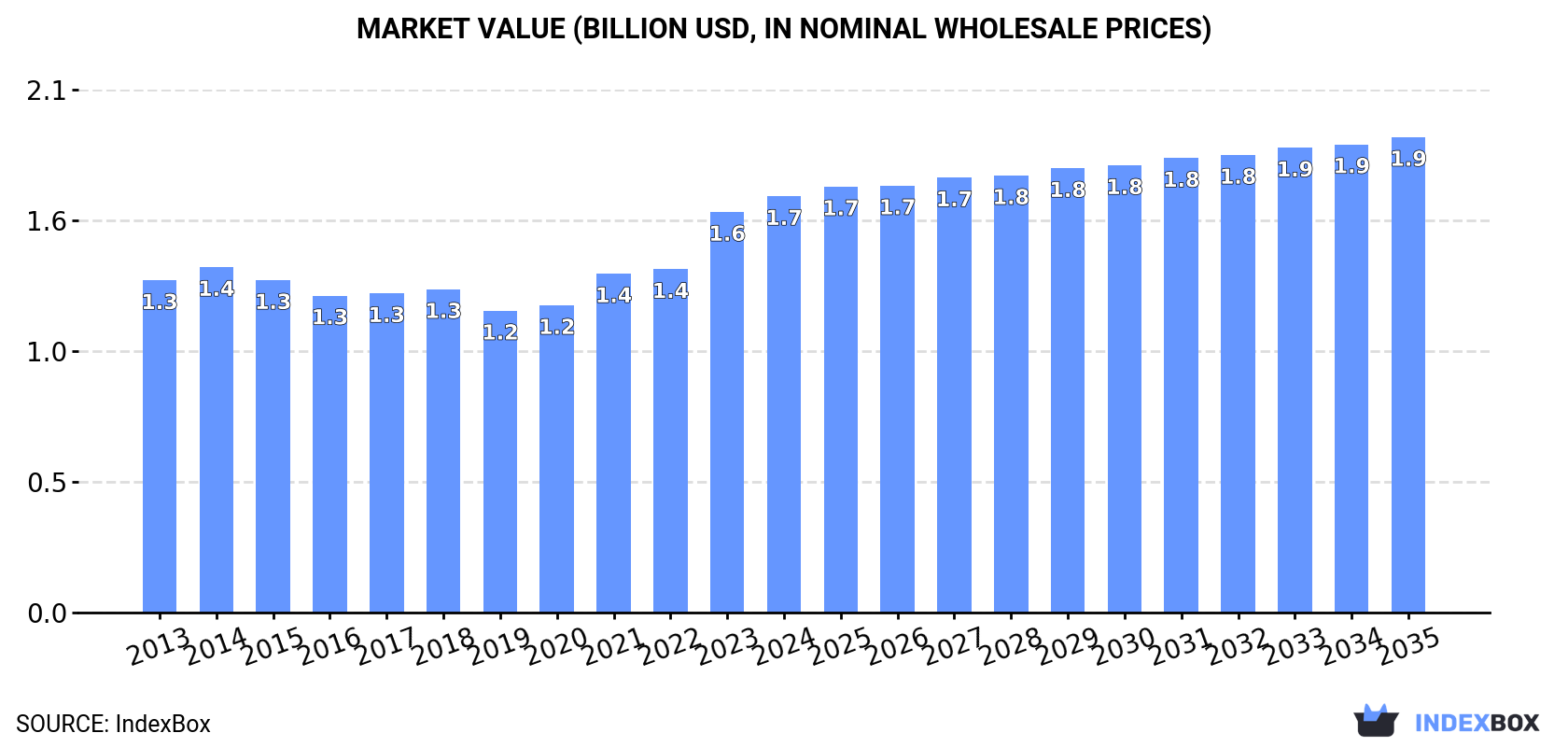
In value terms, the market is forecast to increase with an anticipated CAGR of +1.2% for the period from 2024 to 2035, which is projected to bring the market value to $1.9B (in nominal wholesale prices) by the end of 2035.
 ConsumptionMiddle East’s Consumption of Refined Olive Oil
In 2024, after two years of decline, there was growth in consumption of refined olive oil, when its volume increased by 4.5% to 403K tons. Over the period under review, consumption saw a relatively flat trend pattern. The growth pace was the most rapid in 2021 with an increase of 6% against the previous year. As a result, consumption attained the peak volume of 408K tons. From 2022 to 2024, the growth of the consumption remained at a lower figure.
The value of the refined olive oil market in the Middle East expanded to $1.7B in 2024, surging by 3.9% against the previous year. This figure reflects the total revenues of producers and importers (excluding logistics costs, retail marketing costs, and retailers’ margins, which will be included in the final consumer price). The market value increased at an average annual rate of +2.1% over the period from 2013 to 2024; the trend pattern remained relatively stable, with somewhat noticeable fluctuations being observed in certain years. Over the period under review, the market reached the peak level in 2024 and is expected to retain growth in the near future.
Consumption By Country
The countries with the highest volumes of consumption in 2024 were Iran (104K tons), Saudi Arabia (77K tons) and Iraq (46K tons), with a combined 57% share of total consumption.
From 2013 to 2024, the most notable rate of growth in terms of consumption, amongst the leading consuming countries, was attained by Saudi Arabia (with a CAGR of +2.9%), while consumption for the other leaders experienced more modest paces of growth.
In value terms, the largest refined olive oil markets in the Middle East were Iran ($490M), Saudi Arabia ($267M) and Israel ($225M), with a combined 59% share of the total market.
Israel, with a CAGR of +8.0%, saw the highest growth rate of market size among the main consuming countries over the period under review, while market for the other leaders experienced more modest paces of growth.
The countries with the highest levels of refined olive oil per capita consumption in 2024 were Israel (3.1 kg per person), Saudi Arabia (2.1 kg per person) and Syrian Arab Republic (1.4 kg per person).
From 2013 to 2024, the most notable rate of growth in terms of consumption, amongst the main consuming countries, was attained by Saudi Arabia (with a CAGR of +1.0%), while consumption for the other leaders experienced more modest paces of growth.
ProductionMiddle East’s Production of Refined Olive Oil
In 2024, production of refined olive oil in the Middle East totaled 432K tons, approximately equating the year before. Overall, production recorded a relatively flat trend pattern. The growth pace was the most rapid in 2022 with an increase of 33%. As a result, production reached the peak volume of 560K tons. From 2023 to 2024, production growth remained at a somewhat lower figure.
In value terms, refined olive oil production totaled $1.9B in 2024 estimated in export price. The total production indicated a temperate increase from 2013 to 2024: its value increased at an average annual rate of +2.3% over the last eleven-year period. The trend pattern, however, indicated some noticeable fluctuations being recorded throughout the analyzed period. Based on 2024 figures, production increased by +51.8% against 2019 indices. The growth pace was the most rapid in 2022 with an increase of 35%. Over the period under review, production hit record highs in 2024 and is expected to retain growth in years to come.
Production By Country
The countries with the highest volumes of production in 2024 were Iran (104K tons), Saudi Arabia (76K tons) and Turkey (60K tons), together accounting for 55% of total production.
From 2013 to 2024, the most notable rate of growth in terms of production, amongst the leading producing countries, was attained by Saudi Arabia (with a CAGR of +3.5%), while production for the other leaders experienced more modest paces of growth.
ImportsMiddle East’s Imports of Refined Olive Oil
In 2024, overseas purchases of refined olive oil decreased by -11.4% to 6.6K tons, falling for the second year in a row after two years of growth. Over the period under review, imports continue to indicate a deep reduction. The pace of growth appeared the most rapid in 2016 with an increase of 27%. As a result, imports attained the peak of 17K tons. From 2017 to 2024, the growth of imports remained at a somewhat lower figure.
In value terms, refined olive oil imports declined markedly to $30M in 2024. Overall, imports showed a noticeable shrinkage. The growth pace was the most rapid in 2022 with an increase of 55%. The level of import peaked at $57M in 2016; however, from 2017 to 2024, imports stood at a somewhat lower figure.
Imports By Country
In 2024, Saudi Arabia (1.9K tons) and Kuwait (1.3K tons) represented the major importers of refined olive oil in the Middle East, together accounting for near 48% of total imports. Iraq (666 tons) held the next position in the ranking, followed by the United Arab Emirates (584 tons), Israel (566 tons) and Qatar (492 tons). All these countries together held near 35% share of total imports. Yemen (258 tons) followed a long way behind the leaders.
From 2013 to 2024, the most notable rate of growth in terms of purchases, amongst the main importing countries, was attained by Qatar (with a CAGR of +30.3%), while imports for the other leaders experienced more modest paces of growth.
In value terms, Saudi Arabia ($6.8M), Israel ($4.9M) and Kuwait ($4M) constituted the countries with the highest levels of imports in 2024, together comprising 53% of total imports. The United Arab Emirates, Iraq, Qatar and Yemen lagged somewhat behind, together comprising a further 30%.
Qatar, with a CAGR of +41.6%, recorded the highest rates of growth with regard to the value of imports, among the main importing countries over the period under review, while purchases for the other leaders experienced more modest paces of growth.
Import Prices By Country
In 2024, the import price in the Middle East amounted to $4,498 per ton, falling by -12.5% against the previous year. Import price indicated a temperate expansion from 2013 to 2024: its price increased at an average annual rate of +2.1% over the last eleven years. The trend pattern, however, indicated some noticeable fluctuations being recorded throughout the analyzed period. Based on 2024 figures, refined olive oil import price increased by +45.0% against 2020 indices. The most prominent rate of growth was recorded in 2023 an increase of 26%. As a result, import price attained the peak level of $5,139 per ton, and then contracted in the following year.
Prices varied noticeably by country of destination: amid the top importers, the country with the highest price was Israel ($8,645 per ton), while Qatar ($3,035 per ton) was amongst the lowest.
From 2013 to 2024, the most notable rate of growth in terms of prices was attained by Yemen (+10.3%), while the other leaders experienced more modest paces of growth.
ExportsMiddle East’s Exports of Refined Olive Oil
In 2024, the amount of refined olive oil exported in the Middle East contracted rapidly to 36K tons, falling by -28.1% against 2023. In general, exports showed a noticeable contraction. The pace of growth appeared the most rapid in 2022 with an increase of 659% against the previous year. As a result, the exports attained the peak of 173K tons. From 2023 to 2024, the growth of the exports failed to regain momentum.
In value terms, refined olive oil exports dropped to $207M in 2024. Overall, exports, however, saw a slight expansion. The most prominent rate of growth was recorded in 2022 when exports increased by 200%. The level of export peaked at $238M in 2023, and then dropped in the following year.
Exports By Country
Turkey dominates exports structure, resulting at 30K tons, which was approx. 83% of total exports in 2024. Syrian Arab Republic (2K tons) took the second position in the ranking, followed by the United Arab Emirates (1.9K tons) and Lebanon (1.7K tons). All these countries together took approx. 16% share of total exports.
From 2013 to 2024, average annual rates of growth with regard to refined olive oil exports from Turkey stood at -4.6%. At the same time, the United Arab Emirates (+9.2%) and Syrian Arab Republic (+1.6%) displayed positive paces of growth. Moreover, the United Arab Emirates emerged as the fastest-growing exporter exported in the Middle East, with a CAGR of +9.2% from 2013-2024. By contrast, Lebanon (-6.8%) illustrated a downward trend over the same period. The United Arab Emirates (+4 p.p.) and Syrian Arab Republic (+2.6 p.p.) significantly strengthened its position in terms of the total exports, while Lebanon and Turkey saw its share reduced by -1.7% and -5% from 2013 to 2024, respectively.
In value terms, Turkey ($185M) remains the largest refined olive oil supplier in the Middle East, comprising 89% of total exports. The second position in the ranking was held by Syrian Arab Republic ($8.5M), with a 4.1% share of total exports. It was followed by Lebanon, with a 2.9% share.
In Turkey, refined olive oil exports expanded at an average annual rate of +1.7% over the period from 2013-2024. The remaining exporting countries recorded the following average annual rates of exports growth: Syrian Arab Republic (+9.1% per year) and Lebanon (-5.2% per year).
Export Prices By Country
In 2024, the export price in the Middle East amounted to $5,791 per ton, with an increase of 21% against the previous year. Overall, the export price saw a prominent increase. The most prominent rate of growth was recorded in 2023 an increase of 267%. Over the period under review, the export prices hit record highs in 2024 and is likely to see gradual growth in the near future.
Prices varied noticeably by country of origin: amid the top suppliers, the country with the highest price was Turkey ($6,231 per ton), while the United Arab Emirates ($1,895 per ton) was amongst the lowest.
From 2013 to 2024, the most notable rate of growth in terms of prices was attained by Syrian Arab Republic (+7.4%), while the other leaders experienced more modest paces of growth.
Source: IndexBox Market Intelligence Platform
Dining and Cooking