
If you’re looking for politics or how to elect more and better Democrats, you’d best move on to another story. This is not about politics.
And — sorry for repeating myself, but as background my wife and I own a house probably built in the 1700s in a small hilltop village in Normandie, France. No one knows when it was built, because the prefecture for this area is Saint-Lô. If you’re not up on your WWII history, 95 percent of Saint-Lô was destroyed (along with prefectural property records) by Allied and German bombardment in WWII. The Irish playwright and author Samuel Beckett named Saint-Lô The Capital of Ruins in 1946 after the war and destruction had ended.
The oldest portion of the house shows up on an early 1800s cadastral survey map ordered by Napoleon, who was trying to bring some order into the disordered fashion France previously had managed its records on property boundaries and land ownership. So the best guess is was built in the 1700s.
Anyway, I find things periodically when maintaining the property or clearing brush. Sometimes strange things.
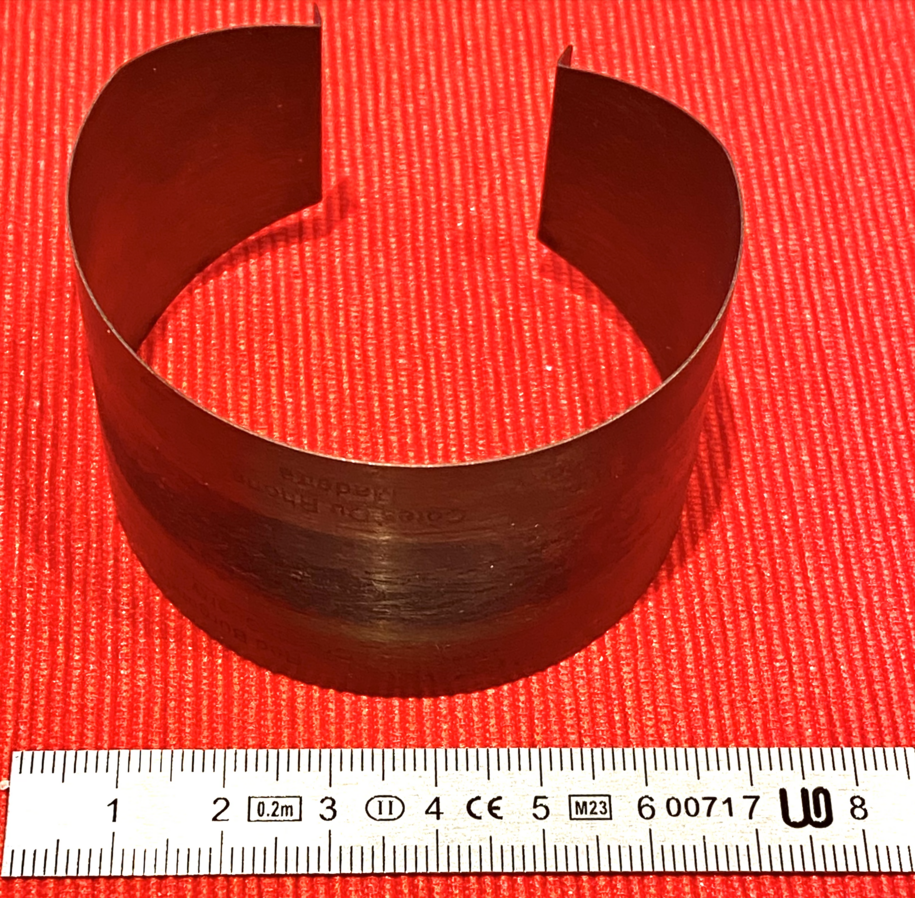
This is one of them. I don’t think it’s as old as the hinge-like thing I found buried at one end of the house last year, but it’s still puzzling.
It’s a partial ring made out of spring steel. I know it’s steel because it’s magnetic. So, despite its bronze color, it’s steel. Probably stainless steel because it’s not rusted, and it had been there probably for decades. A bit of quick research suggests it’s 400 series stainless steel and probably has a martensitic structure, which is what makes it magnetic while having the properties of spring steel.
It’s odd enough but what makes it even more odd are the words engraved into it. They’re English words for types of wine. Not similar types of wine and not a comprehensive list of wines, just some wines. And yes, it will flex and clamp fairly securely onto a typical 750 mL wine bottle.
The ring is about 6 cm in diameter at rest and about 3 cm wide. Viewed from the side, it has three sections. The top section contains names of wines. The middle section is a worn but blank dark colored zone, and the bottom section has the names of different wines, fewer than the top section. I’ll try to post some photos to show the wine names:
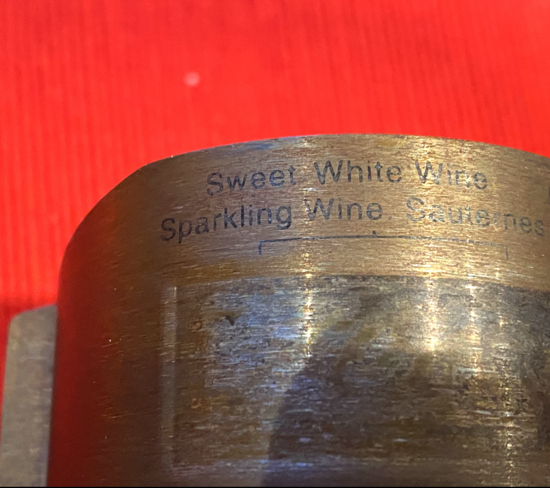
The left most part of the top of the ring
This area lists:
Sweet White Wine
Sparkling Wine
Sauternes
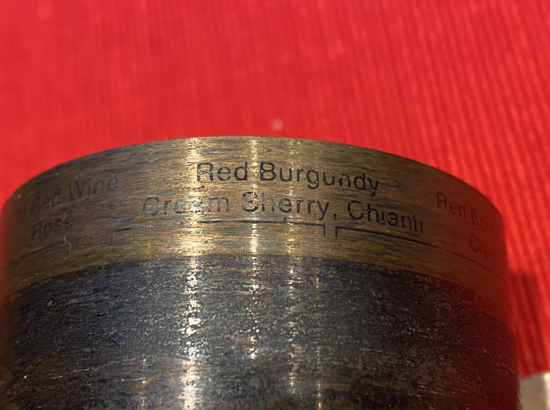
The middle section of the top of the ring
(note the English terminology — “sweet white wine”; “sparkling wine”)
.
This area lists:
Red Burgundy
Cream Sherry
Chianti
(Again with English terminology [“red Burgundy” instead of vin rouge de Bourgogne], plus it commits the heresy of including non-French wines; specifically Spanish [cream sherry] and Italian [Chianti]). Cream sherry is the oddball in this grouping — it’s nothing like the other two.
.
.
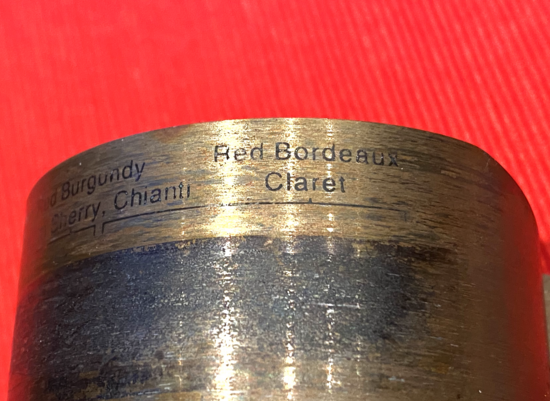
The right-hand section of the top of the ring
This area lists Red Bordeaux and Claret, an English term for a type of red wine from Bordeaux in western France
.
.
.
.
.
.
Note that, on the top of the ring, the wines progress from softer/sweeter to drier and more intense.
Here’s what’s on the bottom of the ring:
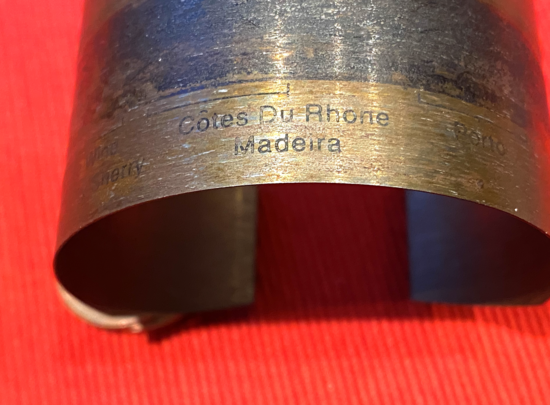
This is the only entry on the bottom edge — it’s in the middle of the bottom
The top listing is in misspelled French (“Côtes du Rhone”, which is missing the circumflex over the “o” in Rhône) and, again, includes a non-French wine wine (Madeira from Portugal). These two wines aren’t at all similar, so it’s unclear why they’re listed together.
.
.
My guess is that it’s intended to be clamped onto a bottle of wine for some reason but the “why” escapes me.
Has anyone seen something like this before? What’s its purpose?
~~~~~~~~~~~~~~~~~~~~~~~~~
While on the topic of stainless steel, here’s a bit of trivia for you to impress your friends: The French word for stainless steel is “acier inoxydable” as in steel not oxidizable, or not rusting. Hardly anybody calls it that, though — they use the abbreviation “inox” instead.
There’s a Swiss company that makes knives and other stuff out of stainless steel — you’ve probably heard of it: Victorinox. It’s a combination of the owner’s Mom’s name (Victoria) and “inox” — referring to the material they used in manufacturing. Victorinox: maker of Swiss Army knives and other branded products.
Probably just me, but I could never remember how to spell (or even pronounce) that company name until I learned about Victoria and inox.
As Michael Caine is known for saying: not a lot of people know that.
Dining and Cooking