
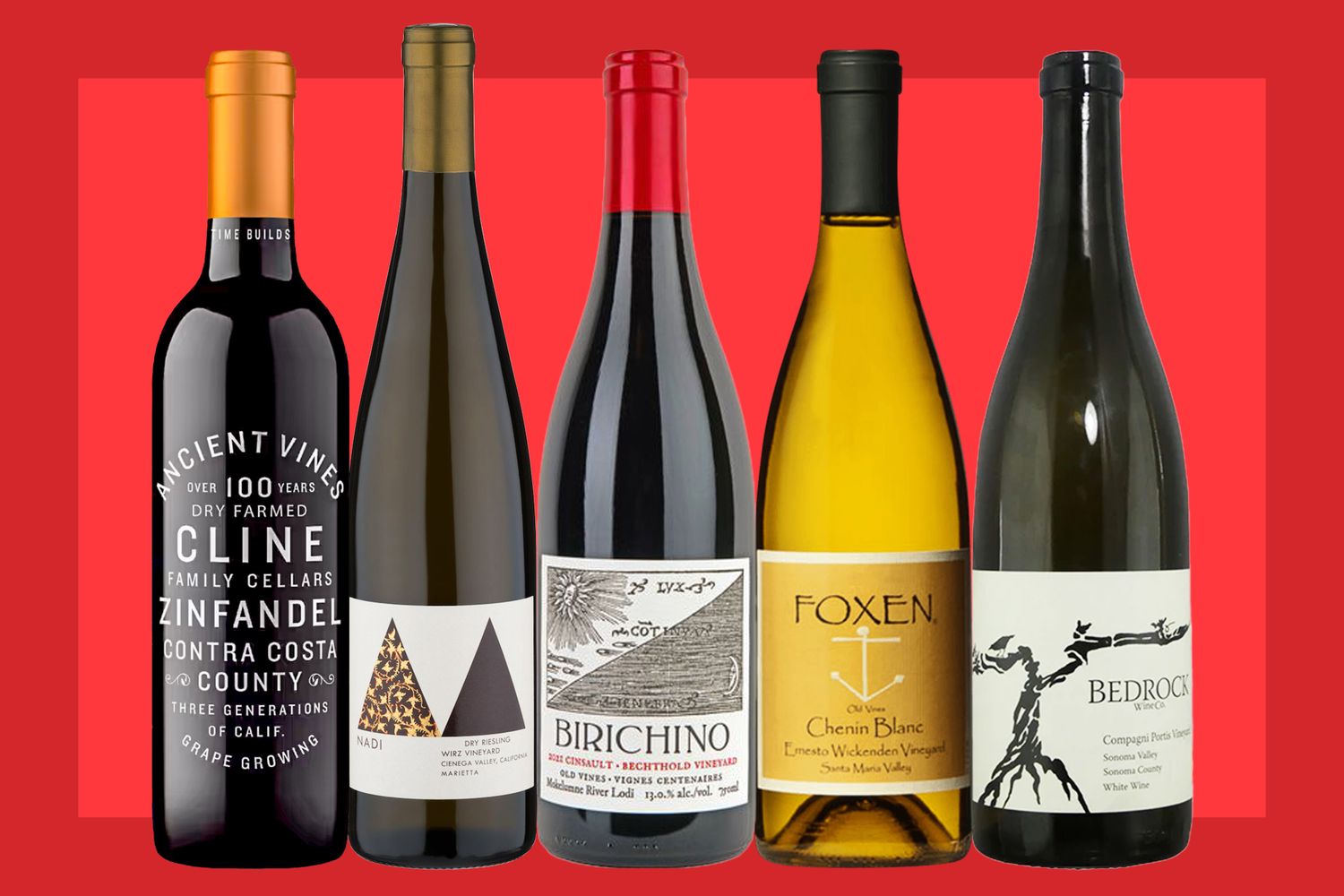
California has a wealth of historic vineyards, some planted as far back as the 1800s. Ancient vines, most winemakers feel, can impart a different sort of character to wine — perhaps a deeper, wilder flavor, possibly less polished but more expressive. The general thinking is that, because yields drop as vines age, the flavors and aromas of the grapes become more intense. There’s also an argument that because their roots reach so deep in many cases, older vines are less battered by extreme weather.
Many old-vine plantings, particularly from the 1800s and early 1900s, are also “field blends” — a lot of different varieties planted somewhat haphazardly throughout the vineyard (varietal planting didn’t really come into favor in the U.S. until after World War II). So, with old vine plantings, if a wine is labeled “Zinfandel,” for instance, it may have 15 or 20 other varieties in the mix, which can give a unique complexity tied to that specific vineyard. Notably, California wines by law only have to have 75% of the variety listed on the label.
If you have an old-vine obsession, one great resource to check out is the Historic Vineyard Society, which maintains a registery of vineyards originally planted at least 50 years ago. They’re scattered throughout the state, though there are concentrations in places like Sonoma County and the Sierra Foothills. That 50-year-age requirement that the Historic Vineyard Society uses is also a good benchmark for what actually constitutes “old vines,” since there’s no legal definition of the term, and it is often used somewhat loosely. Regardless, these nine wines are a great way to start.
2022 Cline Family Cellars Ancient Vines Zinfandel ($22)
California’s Contra Costa County remains a good source for old-vine fruit, even though the Bay Area housing sprawl has eaten up many great old sites — it’s a sad truth that five acres of apartment buildings is worth a lot more than five acres of vines, no matter how old they are. But some still exist, and more than a little fruit from century-old vines in the area goes into this deeply plummy, potent Zinfandel.
2022 Marietta Family Series Nadi Riesling ($26)
Most old vineyards in California were planted with a mix of red grapes, including the Wirz Vineyard in Cienega Valley. But around 1964, the Wirz family also planted 45 acres of Riesling, which, surprisingly, has never been replanted to a more lucrative variety. Those 60-year-old vines produce this green-appley, flinty, dry white — it’s liquid history, and at $26 it’s also a steal. (Also not to be missed is Marietta’s juicy, perennial-great-value Old Vine Red.)
2024 Birichino Bechthold Vineyard Old Vines Cinsault ($29)
The Bechthold Vineyard, planted in 1886, has what are reputedly the oldest Cinsault vines in the world, not just California (a southern French variety, the phylloxera plague in the late 1800s essentially wiped out most of the country’s vines). Bechthold is farmed organically and without irrigation, and from it winemakers Alex Krause and John Locke make this shimmering, light-bodied, peppery red.
2024 Foxen Ernesto Wickenden Vineyard Old Vines Chenin Blanc ($34)
There aren’t that many older vineyards left in Santa Barbara County — most were planted to other crops during Prohibition — but this small plot of Chenin Blanc, planted post-Prohibition in 1966, is still going strong. And it’s a good thing, too, as the Chenin Blanc that Foxen winemaker David Whitehair produces from it is a compellingly floral, luscious white for drinking any time of year.
2024 Bedrock Compagni Portis Heritage White ($35)
There are far fewer truly old plantings of white varieties in California than there are red, but Bedrock’s Morgan Twain-Peterson managed to track down this 1950s-era gem in the Sonoma Valley. Planted to a host of different varieties — Gewurztraminer, Trousseau Gris, Riesling, Burger (yes), Roter Veltliner, and others — it produces a medium-bodied, floral white that suggests melons and green apples, ending on a mineral note. Production is small, unfortunately, but if you can’t find this wine, essentially everything Bedrock makes is (a) old vines-based, and (b) really, really good.
Food & Wine / Turley Wine Cellars / Ridge Vineyards / Scherrer Winery / Nalle Winery / Once and Future Wine / Hanzell
2023 Turley Old Vines Zinfandel ($34)
Turley Vineyards was one of the engines of the initial old-vines Zinfandel craze in the 1990s, and became one of those producers whose wines inspired waiting-list-for-the-mailing-list fandom. These days most of their single-vineyard wines — there are many — are still only available direct from the winery, but this more broadly sourced old-vines bottling can be found fairly easily.
Winemaker Tegan Passalacqua uses grapes from vineyards in Napa, Sonoma, Mendocino, Lodi, Contra Costa, Amador and Paso Robles, all planted 50 to 130 years ago, for a red that’s boisterously fruity, darkly intense, and thoroughly pleasurable.
2023 Ridge Benito Dusi Vineyard Zinfandel ($44)
Ridge is one of the great names in old vines Zinfandel, thanks to longtime head winemaker and now winemaker-emeritus Paul Draper’s early passion for finding and making wine from historic California plantings. The winery’s Geyserville and Lytton Springs bottlings are California icons, but don’t overlook this luscious, peppery red from the Benito Dusi vineyard in Paso Robles, which was planted in 1923. Ridge’s relationship with the Dusi family goes back decades, to 1967, when winery co-founder Dave Bennion (who passed away in 1988) was scouting in the area, knocked on their door, and ended up buying 5 tons of grapes.
2023 Scherrer Old & Mature Vines Zinfandel ($44)
Winemaker Fred Scherrer’s family has been farming in Sonoma County’s Alexander Valley since the late 1800s, with many of the vines used for this bottling planted in 1912 at their family vineyard. Like all Scherrer’s wines, it combines elegance with intensity of flavor, in this case wild blackberries and raspberries, bright and fresh — a balance characteristic of all the Scherrer wines. (I’ve tasted them many times over the years, and always been impressed, so here’s my soundbite: If people don’t check out Fred Scherrer’s wines, they’re making a big old honkin’ mistake. Visit scherrerwinery.com as they can be hard to find in some states.)
2023 Nalle Old Vine Zinfandel ($52)
Zinfandel originated in Croatia hundreds of years ago (where it was known as Tribidrag), but just as Malbec seems to have found its true home in Argentina, Zinfandel’s true home really does seem to be California. If you have any doubts about that, try this complex, spicy red from Nalle, in Sonoma’s Dry Creek Valley; it glides right across your tongue, putting to rest any sense that Zin has to be super-ripe and heavy, its briary cherry-blueberry fruit getting a little white-pepper zip from 5 percent Petite Sirah. It’s a blend from four different old vine plantings: the 1927 block of the Henderlong Nalle estate vineyard, the 1924 Cuneo vineyard, across the street from the winery, and the 1943 and 1951 Henderlong Nalle vineyard estate blocks, which lie behind the winery to the east.
2023 Once & Future Wines Old Hill Ranch Zinfandel Sonoma Valley ($55)
Once & Future owner Joel Peterson has definitely earned his title as the “Godfather of Zin.” He founded Ravenswood Winery in 1976 with a conviction that great Zinfandel could be every bit as complex and ageworthy as great Bordeaux (or great California Cabernet) and was seeking out old-vine plantings at a time when most of their fruit went into bottom-shelf jug wines. After he sold Ravenswood, he went on to found Once & Future, where he continues to make extraordinary Zinfandels, many from the same historic properties he first worked with at his original winery. Among them is the storied Old Hill Ranch, planted in 1852 during the California Gold Rush with Zinfandel and a host of other varieties. Those vines today produce an aromatic, supple, complex red, full of deep raspberry and blackberry flavor, with wild herb and black pepper notes.
2020 Hanzell Ambassador’s Vineyard Chardonnay ($125)
In 1953, Burgundy fan and future ambassador to Italy James Zellerback planted four acres of Chardonnay and two acres of Pinot Noir on a hilltop outside the town of Sonoma. Those Chardonnay vines — now two acres, and organically farmed — are the oldest in the state of California, and the oldest Pinot as well.
They only produce 75 cases of wine each year and you must reach out to the winery to acquire a bottle, but if you want to taste a stellar expression of California Chardonnay, this is it. Nuanced, intensely concentrated, and beautifully expressive, you’ll find layers of citrus blossom, orchard fruits, and sweet wild herbs like lemon balm and chamomile.
Dining and Cooking