
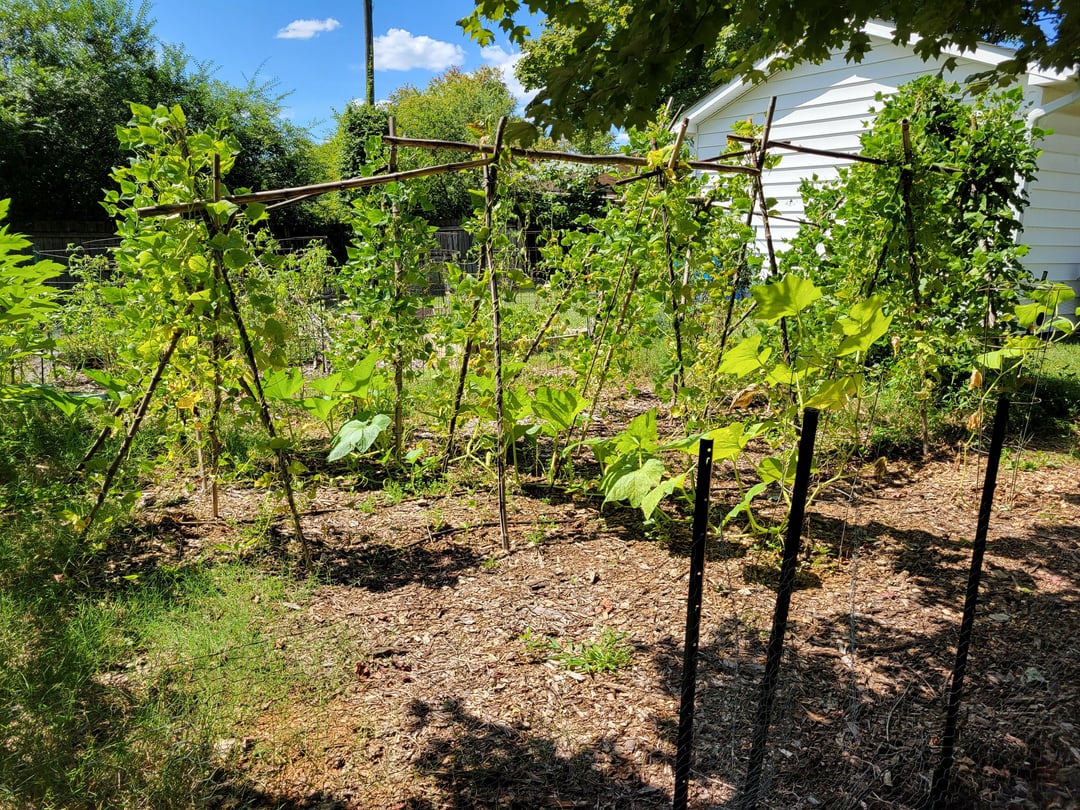
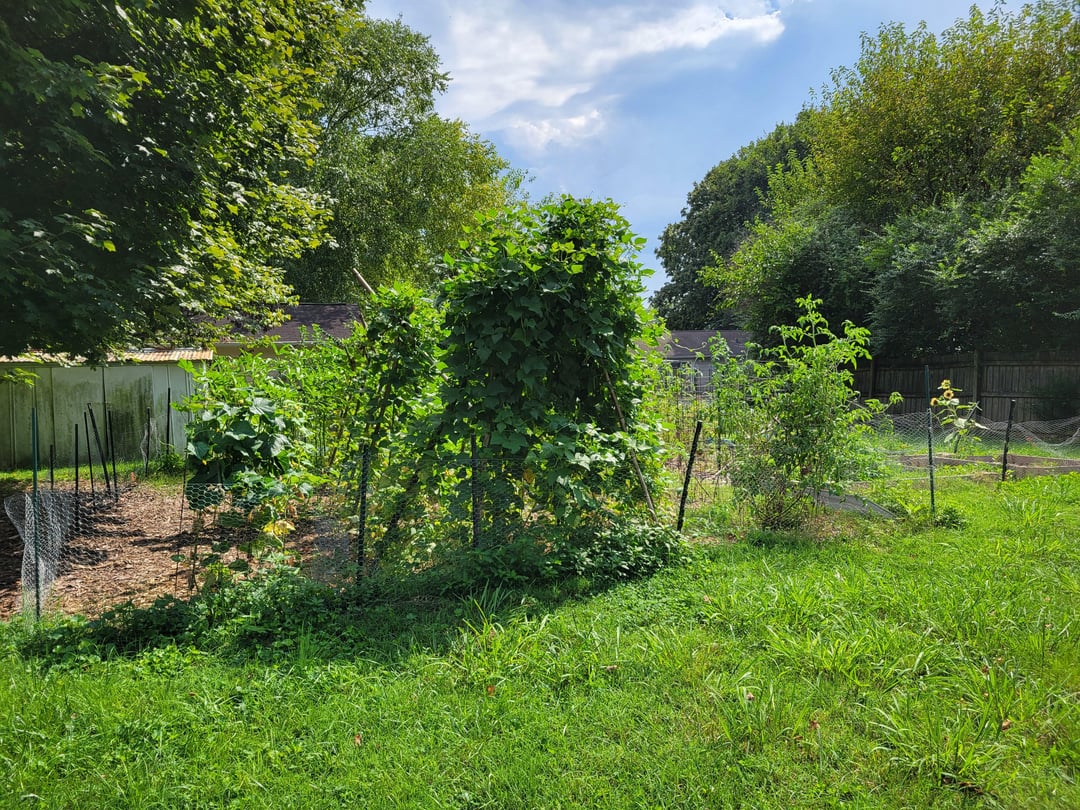
Pictures of my garden at its prime last year, struggling along.
A few years ago, I discovered chipdrop and attempted a somewhat lazy version of no-till gardening. It was amazing for retaining moisture and helping my garden survive our hot summers. It was also great for weed suppression. Now, it's great for suppressing my veggies. I used to have outrageous yields and now my plants barely produce. I put more plants in the ground and get less yield than I got in prior years.
I read that the chips could be tying up the nitrogen and that's why I'm having poor yields. I haven't added any compost over the chips, just move them away and plant directly in the dirt with some fertilizer. The last two years, I have planted with GardenTone and reapplied twice during the season but it still struggled. How do I fix my soil for next year? Spread a thick layer of compost over the chips? Rake it all off and amend with something?
by Anamiriel
14 Comments
Normally people use woodchips on garden paths and around the beds, not inside them! Id scrape it off and replace with leaf mulch or compost of some kind
The whole stealing nitrogen thing isnt really an issue, unless you get the chips mixed down into the soil and then its a problem, but not a long term one. The simplest solution would just be more nitrogen fertilizer while they break down
I’ve been using cedar mulch in my raised beds for years.
I will pull back or remove the mulch then add bags of compost in the first few inches and recover with mulch each fall.
Then Ill move back what I need and plant then recover when seedlings are tall enough in the spring.
Has been working wonderfully.
https://preview.redd.it/o9ynfh74dybg1.jpeg?width=4000&format=pjpg&auto=webp&s=9ef89bec6d15dd551a47e8df0201f27a5980d7da
I would rake it to the side and spread a nice thick layer of good compost and then rake the chips back over top as mulch. I don’t think the nitrogen lock is an issue since the chips are on top, and they will break down over time. The chips aren’t feeding the soil though, so you need to get some compost on there. Do remember that compost feeds the soil, but the nutrients are not necessarily immediately available for the plants to absorb, so you will probably also need to supplement with some organic fertilizer for a year or two to let the compost do it’s thing. I would top dress with compost every year.
First, stop rotating bed locations. Pick beds, clear those spaces and plan to use them for a couple of years. Alternatively, just clear the entire area.
The chips on top of the soil won’t really hurt and will in the long run help but don’t till them in or bury them. The way they tie up nitrogen is that bacteria etc will work on decomposing the wood and use available nitrogen to do that.
Next, you need to build healthy soil. That means a few things – 1) not compacted, 2) good organic activity (bacteria, fungi, worms etc), 3) balanced macro and micro nutrients. So, get a soil test to see what your area needs.
In general, you probably need to add organic matter and make sure it’s not compacted. If there’s not much life in the soil and it’s compacted you might want to till in some compost and plant, but I’d strongly advise you to get a soil test so you’re not just guessing.
I’m an avid no dig gardener and always add about 3″ of compost every year onto my 3′ rows every year. I often don’t rotate crops and haven’t run into disease issues or lower yields. I put in 1’ish walking paths in between rows and use mainly wheat straw but have used wood chips too.
A bit of a mystery though since you did say you were adding fertilizer. Maybe the chips are sequestering N but if you haven’t tilled it in it shouldn’t be. I do sense you need to add a good amount of compost onto the soil and I wouldn’t hesitate to do it now. I would even fertilize with a balanced water soluble fertilizer that the plants could use right away.
Blood meal helps break stuff down fast. Also if you know where older chip is, you can inoculate yours with fungi from it. I’ve done both methods before.
chips have a long list of negative effects, fire up the leafblower, and get rid of them, use a rake, and dig an inch and blow that out as well, let it dry up for a while , then add top soil or garden soil if needed
This likely has nothing to do with the wood chips. You’re probably under fertilizing and the plants had pulled from the bank of nutrients over time. This is common in home gardens where people tend to plant at high density and more so if one is following the label rate on organic fertilizer bags. Those labels of are often the bare minimum and need adjustment based on weather, irrigation, and crop selection.
You can mitigate this most simply by starting each season with a hefty amount of amendment, though I recommend getting a real soil test and applying fertilizer based on the results of that test.
Apply and till 0.5 – 1” of aged chicken or steer manure at the beginning of the season or 1 – 2” of compost. This will not get you through the season on it’s owns but it should help reset the overall nutrition level with your garden tone keeping it from dropping off too much as the season progresses.
You did not messed up your soil, you are attempting a half regenerative/organic gardening leaving out the most important part: cover crops.
You are out of nitrogen? Use summer and winter to plant beans, soy beans or whatever grows good on your zone,let them die and use them as mulch or remove them and compost them. Add eggshells crushed and use dry seaweed to add nitrogen (a little bit) in the mean time. You also need to keep adding a layer of compost every year, doing your own is literally almost free
Please please please watch “kiss the ground” so you can have an idea of how to take care of your soil and help, you are doing amazing with the no tiling but we must keep education ourselves to protect whats left of our healthy soil
Have you conducted a soil test? If not, stop. Test your soil.
https://soillab.tennessee.edu/
The wood chips are fine if they’re on the surface. If you’ve allowed them to mix deeper into the root zone of your soil profile, that’s a concern but it can be relatively easily fixed.
How’s your soil compaction? Got a piece of rebar laying around? On a normal day (not in peak summer and not after a rain) push it into the ground and see how far down you go before meeting significant resistance. You should be able to get as deep as the roots of the plants you want to grow – or deeper.
If you can’t, solve that. Buy a broadfork and use it every time you flip a bed. Within two seasons your soil should improve significantly.
Combine that with the needs highlighted by your soil test and you’ll be moving in the right direction.
Add manure!
Everybody saying wood chips are not utilizing nitrogen are wrong. When on the surface they use nitrogen on the surface. After they find their way deeper in the soil over time they use nitrogen there. I would rake whatever chips I could from the surface and rake in the top few inches chicken manure if I could find it. Chicken manure compost is also high nitrogen. The more you get it broken down over winter the better. Crowding can also reduce yield.
I started a new garden last year by putting down a deep layer of chips over an area that had been filled with infertile construction fill dirt. I covered the whole area, and when I actually built the beds, I raked back most of the chips from the planting areas to form berms around the planting areas , separating them from the walkways.
Then I filled the planting areas with all kinds of soil and composted material to build up mounds inside the berms. I used my own compost, composted horse manure I sourced for free, bagged commercial chicken manure, old potting soil from pots I was refreshing, soil from places in the yard, commercial bagged planting mix, etc. I piled it all in so that the mounds were taller than the walkways and retained by the chip berms. At planting time, I added a generous amount of organic all purpose 5-5-5 plant food, and I fertilized with liquid fish and kelp fertilizer a few times during the growing season. It worked very well!
You might want to do something similar. Settle on a layout with planting areas and walkways. Rake back the chips from the planting areas. Fill with whatever you like for a good planting soil. Going forward in future years, use chips in the walkways, and compost in the planting areas.