
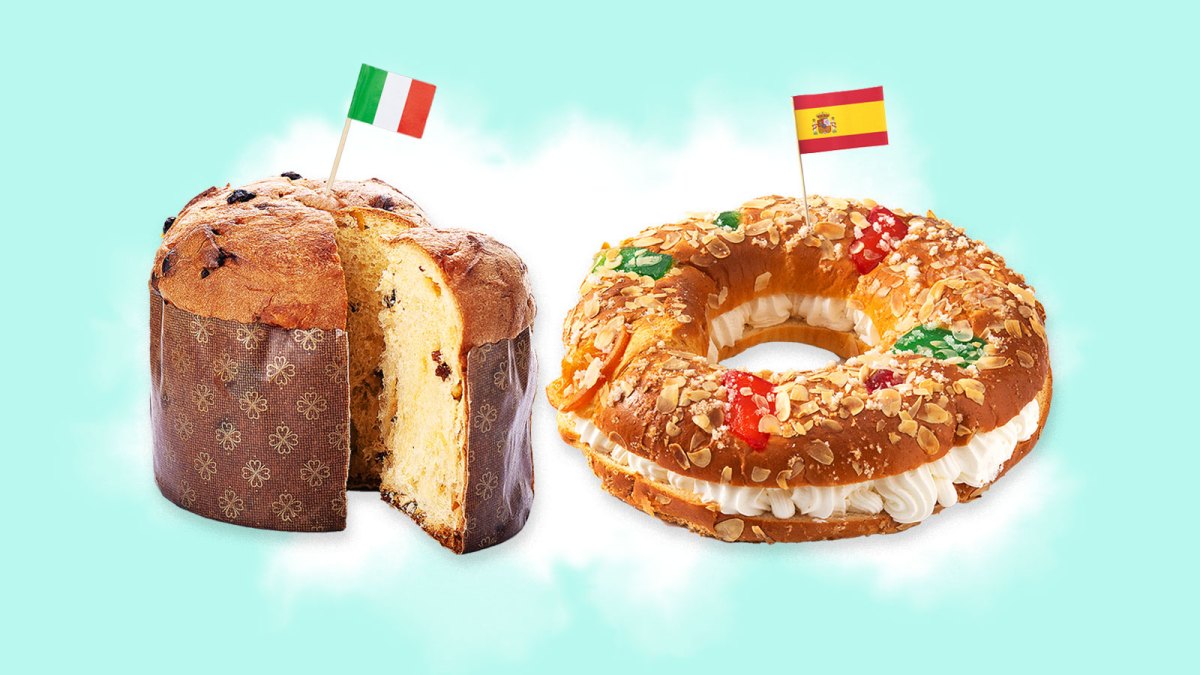
Spain’s annual Epiphany celebrations have become a gastronomic battlefield, pitting the traditional roscon cake against an Italian incursion in the form of panettone.
After families gathered for the feast day on Tuesday to cut into the wreath-shaped roscon de reyes, commentators expressed anguish over the rise in popularity of the foreign interloper.
Writing in the conservative online newspaper El Debate, Bieito Rubido, the editor, wrote that behind the “apparent minor question” of roscon versus panettone lies “a profound reflection on how Spanish culture defends itself from foreign invasions, even in gastronomy”.
The “duel” was commented on by La Vanguardia newspaper, which ran a cartoon with the words: “In a fight to the death between a roscon and a panettone, who would win?” It noted that the advent of the Italian delicacy had been insidious. “There was no domestic referendum; it happened suddenly. Like those fads that don’t seem like fads until they’ve changed everything,” it stated, saying that Spanish traditions “gave way on our Christmas tables to tall, fluffy, fragrant, foreign panettone”.
It added: “Wrapped in fine paper and with its pedantic Italian discourse printed on a designer label, it burst into our Christmas celebrations uninvited. Unnecessarily solemn. Taking it for granted that what we have is no longer enough.”
But Spanish traditions proved resilient this week. Fears of Italian domination appeared, for now at least, to be overstated. Despite years of anxious commentary about foreign culinary fashions edging on to Spanish tables, consumers once again opted overwhelmingly for the citrus-scented cake that traditionally brings the Christmas season to a close.
• Bakers strike gold with hidden gifts in Epiphany cakes
The roscon, a brioche-like ring decorated with candied fruit and sweet fillings hiding within, remains more than a dessert. As El País put it: “For many it is the star pastry of the first days of the year, the sweet that brings the Christmas festivities to a close.” The once-a-year indulgence is celebrated for its moist crumb, light texture and clean hint of orange blossom. Traditionally, a dried broad bean and a figurine of the baby Jesus are baked into the roscon — the latter bringing good luck to the finder, the former the bill for the cake.
The attachment to this tradition translated into sales. In what retailers themselves described as a “gastronomic battle”, the roscon comfortably outperformed panettone. A nationwide Carrefour poll found that 72.9 per cent of consumers favoured roscon over its Italian rival, while a separate company report showed that 73 per cent of Spaniards considered the traditional recipe untouchable, whether plain or filled with cream.

A Carrefour poll found that 72.9 per cent of consumers favoured roscon over panettone
RICHARD PELHAM/GETTY IMAGES
Industry figures underline the point. The Spanish bakery sector estimates that about 30 million roscones were consumed this season, broadly in line with previous years. The classic cream filling continues to dominate, though pistachio has begun to make cautious inroads, a sign that fashion is being absorbed rather than allowed to replace ritual.
That sense of cultural unease, however, is sharpening. Rubido grouped panettone with other imported habits, notably Halloween, as evidence of a globalisation that leads Spaniards, in his words, to “buy what comes from outside” while slowly eroding local markers of identity.
• Why have ‘patriotic’ banquets become the latest front in France’s culture war?
La Vanguardia struck a conciliatory tone, arguing that foreign and local traditions, such as the festive consumption of turrón — Spanish nougat — have learned to coexist. “It is no longer about replacing, but about adding,” the paper wrote. “Panettone seduces, yes, but turrón moves us — and in the end what matters is sharing.” It reminded readers that roscon may itself be of French origin, invented across the Pyrenees, where it never acquired the ritual importance it enjoys in Spain. A foreign import that became tradition.
Roscon de reyes v panettone: the taste test
So it’s Italy v Spain in an enriched bun fight over festive cakes (Hannah Evans writes). But which one do I think should be crowned victorious — and which will end up going stale in the cake tin?

The Times’s Hannah Evans with her cream-filled roscon de reyes
BETTY LAURA ZAPATA FOR THE TIMES
Now firstly, as a purist, I feel as though I should flag that both roscon de reyes and panettone are technically out of season: the Spanish Epiphany cake is traditionally eaten until or on January 6; panettone is, rather obviously, an Italian Christmas cake.
However, in the effort to spread the Spanish festive joy among Brits, several bakeries are breaking ranks with ecclesiastical traditions, such as Miriam Hernandez, founder of Baking Love in north London, who takes roscon de reyes requests year round — £30 for one that serves 14. As for panettone, my good friend Mitshel Ibrahim, founder of Forno, London’s best Italian bakery, and its sister restaurant, Ombra, has kept back a few of the classic panettone his team makes for a January pick-me-up.
So which comes out on top? Roscon de reyes wins points for novelty. Compared with the overexposed panettone that over Christmas you were gifted (and then re-gifted to your neighbour, babysitter or relative), this Spanish festive cake is relatively niche — good luck trying to find one before December!

Roscon de reyes
BETTY LAURA ZAPATA FOR THE TIMES
We all know what a panettone should taste like: light, aromatic buttery dough, studded with raisins and crystallised orange. It shouldn’t be so stodgy that it can be rolled into a ball like Play-Doh, a pitfall of many cheap supermarket versions. The crumb instead should have great big air pockets from the leavening. Forno’s classic flavour ticks all these boxes: cloud-like, fragrant and the fruit hasn’t all stuck to the bottom. The top is encrusted with whole nuts and has a crunchy topping. It might not be Christmas anymore but this panettone is holy.
Now for the roscon de reyes. Not all of them come filled with cream, but luckily for me the one Hernandez has made me is. The golden dough is moist and glistening, it’s topped with crunchy pearl sugar and filled with the most amazing, airy Chantilly cream filling, which makes it soft and light all the way through.
Who wins: Italy or Spain? They have two fine examples of pillowy-light, enriched festive cakes. I am tempted to be Switzerland and choose panettone for the run-up to Christmas, then roscon de reyes in January. And perhaps a few Rennies.
But given that the tsunami of panettone I’m recovering from post-Christmas was particularly large and came with a cohort of ghastly flavours (Tiramisu panettone? Thanks Tesco), and the fact that very few panettones are anywhere near as good as Forno’s, I must say roscon de reyes — but only the cream filled variety — is delicious, welcome relief. It’s just a shame I’ll have to wait until next year to eat it again.
Dining and Cooking