
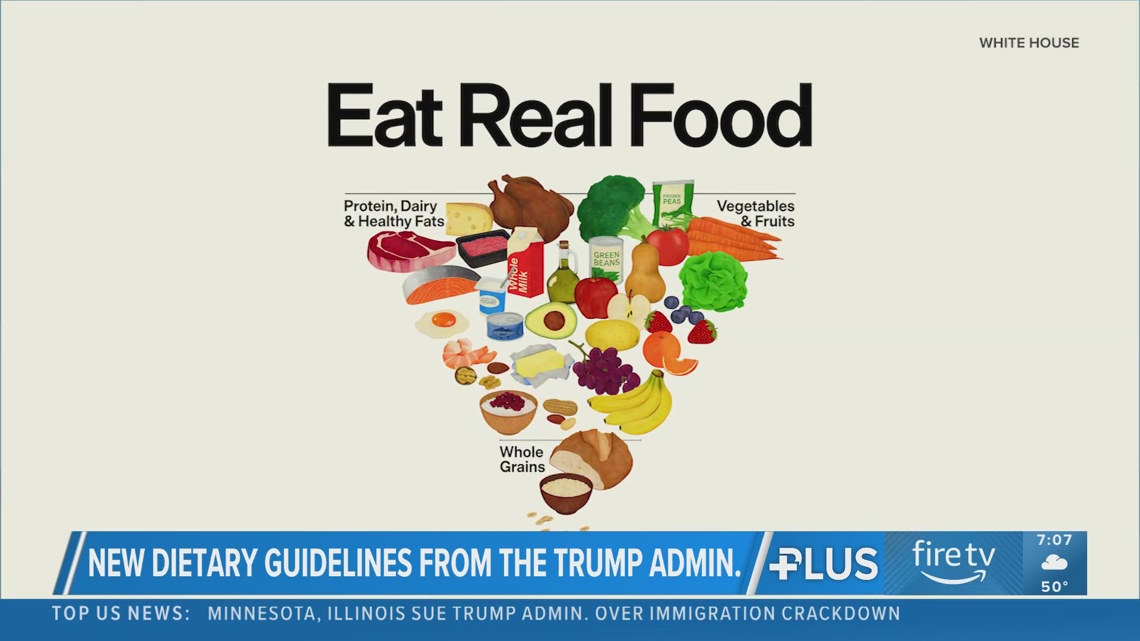
The U.S. nutrition policy is undergoing a significant update with the reintroduction of the food pyramid, which emphasizes whole foods.
Federal health officials are rolling out a major reset to the U.S. nutrition policy, reintroducing the food pyramid and urging Americans to prioritize whole foods over ultra-processed meals.
U.S. Department of Health and Human Services Secretary Robert F. Kennedy Jr. and Agriculture Secretary Brooke Rollins unveiled the 2025-2030 Dietary Guidelines for Americans last week, calling it the most significant update in decades.
The new guidance centers on a simple message: “eat real food.” Officials say Americans should focus on minimally-processed options such as fruits, vegetables, whole grains and lean proteins while cutting back on ready-to-eat packaged foods.
The iconic pyramid graphic – inverted this time – is back for the first time in 15 years. It was previously replaced by former First Lady Michelle Obama’s “MyPlate” campaign. While the visual has changed, many of the core principles remain the same: prioritize protein, choose whole grains and eat plenty of fruits and vegetables.
One major shift in the new model is what officials describe as an effort to “end the war on healthy fats.” The updated pyramid promotes foods such as meat, poultry, full-fat dairy and olive oil.
Elizabeth Klingbeil, an assistant professor and registered dietitian at the University of Texas at Austin, says one positive change is the inclusion of affordable food options.
“The new food pyramid contains canned vegetable options and frozen vegetable options, which might be the only affordable option for someone,” Klingbeil said. “So to have that depicted on the pyramid is actually a plus for public health.”
Klingbeil said while the pyramid highlights nutritious foods, it doesn’t offer enough practical guidance on how to use them in everyday meals or how often to use them. She encourages people to think in terms of what’s on their plate, filling half with vegetables, a quarter with whole grains and a quarter with lean protein.
She said more guidance would help to clarify potential contradictions.
While the recommendations continue to advise keeping saturated fat under 10% of daily calories, the pyramid prominently features foods such as butter, red meat and full-fat dairy, which are high in saturated fat.
Klingbeil said she is happy to see the updated guidelines place new emphasis on gut health and fiber, encouraging Americans to eat more fruits, vegetables and whole grains.
The overhaul comes as the U.S. faces what officials describe as a national health emergency. According to the U.S. Department of Agriculture (USDA), nearly 90% of health care spending goes toward treating chronic disease, much of it linked to diet and lifestyle. More than 70% of American adults are overweight or obese, and nearly one-third of adolescents have prediabetes.
Rollins said farmers and ranchers will play a key role in improving the nation’s health.
“Farmers and ranchers are at the forefront of the solution,” Rollins said. “That means more protein, dairy, vegetables, fruits, healthy fats and whole grains on American dinner tables.”
Klingbeil said the renewed attention on nutrition is a positive step.
“The more we’re talking about it, the more awareness there is about what we’re putting on our plates,” she said. “And that’s a win for public health.”
Dining and Cooking