
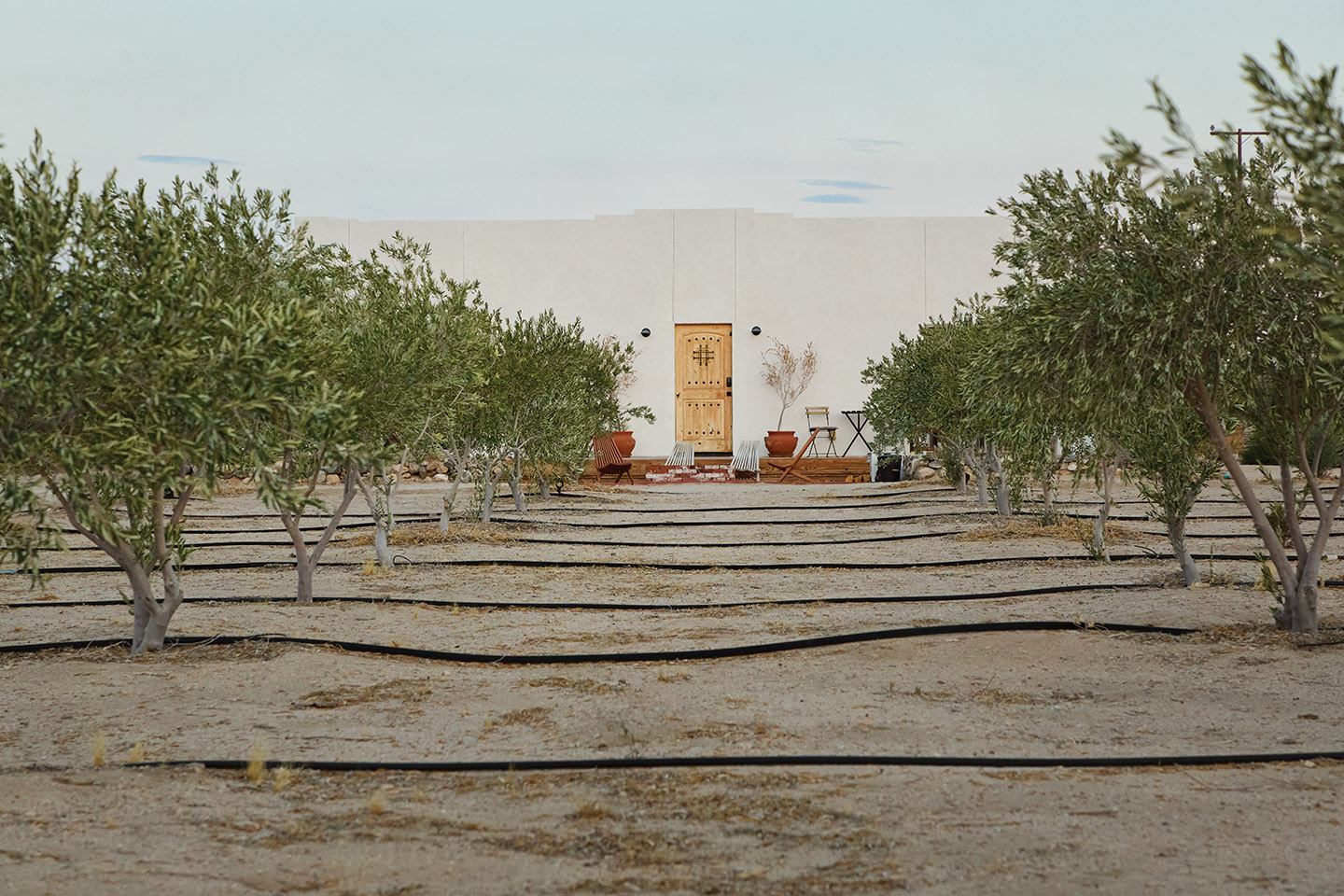
Against that backdrop, Serge and Lucas set out in 2013 to establish their own grove near Joshua Tree, planting close to 2,000 trees on previously vacant land. The Bellabiod family’s olive story goes back further. “My father’s family has done this since the beginning of … I don’t know, since the beginning of time, maybe,” Serge says. “I would not say we are skilled, but we have an understanding of the olive tree.” Serge grew up in Algeria, where his relatives planted and tended olive trees. After moving to Paris, he and Lucas began imagining a farm of their own. Eventually, they landed in the California desert.
When they found the parcel in Indian Cove, they spent their first years homesteading off-grid in a 200-square-foot cabin without electricity or running water, planting trees by hand and learning to work in the extremes.
“I think it’s some kind of genetic knowledge,” adds Lucas, Serge’s son, who nurtured those instincts studying at the UC Davis Olive Center.
Most of their trees are arbequina olives from Spain, which account for roughly 80 percent of the Joshua Tree Olive Oil harvest. The rest — aglandau, bouteillan, cayon, picholine, and cailletier — reflect the family’s curiosity rather than any strict varietal loyalty. Olive trees are famously resilient, capable of living hundreds of years with minimal water once established. One of the world’s oldest, on the island of Crete, has produced fruit for more than two millennia.
Dining and Cooking