
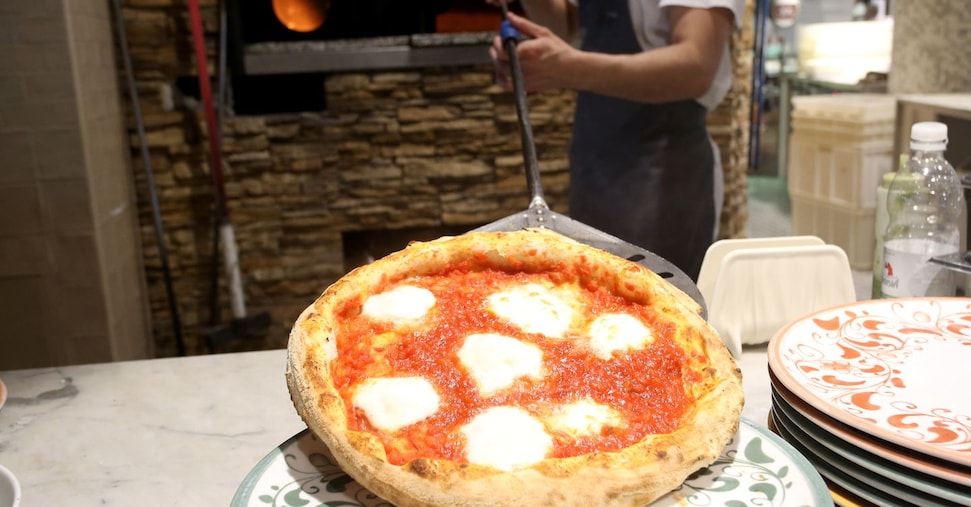
It is the symbol of Naples, it has centuries of history behind it, it has conquered the planet and it is an iconic dish of Italian cuisine. Neapolitan pizza is tradition and experience, quality raw materials and has become a 15 billion business in Italy. These are the findings of the first edition of the Socio-Economic Observatory of Neapolitan Pizza, set up by the University of Naples Parthenope with the Department of Human and Social Sciences, Cultural Heritage of the National Research Council (CNR-DSU), the Verace Pizza Napoletana Association and Fipe Confcommercio Regione Campania and presented today on World Pizza Day, 17 January, at the CNR headquarters in Rome.
“The Socio-Economic Observatory of the Neapolitan Pizza was created with the aim of giving continuity to the analysis of an extraordinarily important productive, cultural and social heritage,’ comments Salvatore Capasso, Director of the Department of Human and Social Sciences, Cultural Heritage (CNR-Dsu). Data and research do not only serve to measure, but to orient policies, training and entrepreneurial choices in a sector that combines tradition and future’.
The Observatory recalls that in the sector, according to Fipe-Confcommercio data, more than 50 thousand pizzerias are active with over 300 thousand employees, while more than 8 million pizzas are churned out every day in Italy. A speciality that has become the banner of eating simply, and well. A healthy dish and all in all cheap because for a Margherita the average price in Italy is 7.04 although there are quite a few territorial differences: euro 6.74 in Naples, euro 6.72 in the South, euro 7.46 in the Centre and euro 7.66 in the North.
The analysis also made it possible to calculate the Pizza Napoletana Margherita Index (Ipnm), which measures the percentage variation with respect to the price in Naples: 99.68 in the South, 110.63 in the Centre and, in particular, 113.70 in the North. Analysts point out that “despite record increases in ingredient costs, particularly for mozzarella and oil, the price of pizza Margherita in the last year has only recorded a very slight increase, confirming a product that remains a bastion of democratic cuisine. Specifically, the price has risen – we report from 0.01 to 0.50 euro for 31.30% of those interviewed, from 0.51 to 1 euro for 22.90%, from 1.01 to 1.50 euro for 11.50%, while no increase was recorded for 14.60%”. “The Observatory’s data confirm that the Neapolitan Margherita pizza remains the last bastion of democratic cuisine,” points out Antonio Pace, president of AVPN. “Despite the price increases in raw materials, our pizza makers are absorbing the costs so as not to betray the pact of accessibility with consumers. However, the research shines a necessary spotlight on a paradox in our industry: the gender gap behind the counter. Seeing that only 2% of those in the bakery are women, compared to a massive female presence in ownership and management, tells us that we need to break down a cultural wall. The artisan mastery recognised by Unesco has no gender and the future of the sector inevitably passes through greater inclusion of women in the role of pizza maker, overcoming the old family models that have so far limited this access’. The Observatory has a specific section on the role of women in the pizza sector, highlighting that while the female presence is strong in ownership (38.5%) and in the management of the room (50.5%), the profession of pizza maker remains an exception, only 2%.
Upstream of this speciality is an articulated food chain that starts with yeast, quality flour, mozzarella, tomato and many other ingredients used according to the speciality to be prepared: alla diavola, capricciosa, marinara or alla romana. The round speciality comes in a thousand variations and is consumed accompanied by a thousand drinks from soft drinks, to beer, wine to water, but also tea as is the case in Japan. Then there are the industrial pizzas such as the frozen ones but that is a whole other matter that has little to do with Italian cuisine.
Dining and Cooking