
Vintage that went global
Yvonne Turgeon – Jan 14, 2026 / 4:00 am | Story: 593995
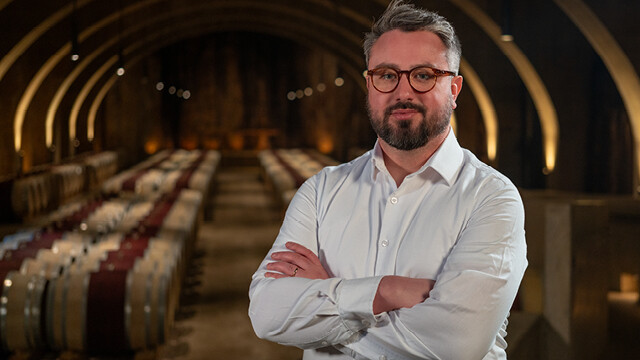
Photo: Contributed
Mission Hill winemaker Taylor Whelan blended distinct Marlborough Sauvignon Blanc wines on site in B.C.—crafting styles for the Reserve and Terroir tiers that balance tropical richness with greener, mineral-driven notes.
While barrels are full and new wine from the latest harvest begins its slow aging, B.C. wine lovers are enjoying a rare global tasting tour, with a distinctive 2024 vintage still pouring at one of the Okanagan Valley’s most iconic wineries.
With no 2024 harvest, Mission Hill Family Estate in West Kelowna sourced wines from Marlborough, New Zealand, Bordeaux and the Rhône in France, Sonoma, California and beyond.
For insight into the story behind those “crafted in B.C.” wines, I’m sharing my my meeting with winemaker Taylor Whelan from last summer.
We descended into the expansive barrel room, honed from the depths of the dormant volcano of Mount Boucherie, where Whelan gathered a group of writers to share the story of freezing days and family ties.
A glass was offered and the first sip was fresh, zippy and fun: Sauvignon Blanc.
“In times of need, we call upon family,” read the new label, sporting a spring green colour and a new tagline, “Grown in New Zealand.”
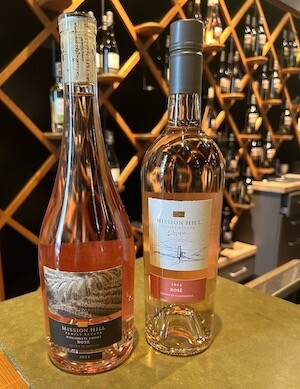
Photo: Yvonne Turgeon
Mission Hill’s 2024 Rosés explore two expressions of Pinot Noir: the Reserve, sourced from California’s fog-cooled Petaluma Gap, and the Terroir Collection, from Oregon’s renowned Willamette Valley.
The 2024 Reserve series labels share the story, “our proprietor called upon our extended family of vintners with a shared commitment of exceptional vineyards to collaborate on an extremely limited series of exciting wines.”
With no 2024 harvest and 2023 yielding only 30 percent, global collaboration wasn’t a choice. The shortfall left a major gap for a winery that typically produces more than 1.2 million litres of wine each year.
“We went directly down to Oregon and started sourcing,” he said, finding Pinot Gris, Chardonnay and a little Riesling. When that wasn’t enough, the search expanded. “We went to California, Sonoma, the Central Coast—still didn’t fill all the gaps.” Eventually, the team cast the net further.
“We went to places like New Zealand, which is where the Sauvignon Blanc is from. We went to France, Germany… to try and pull in high quality wines from around the world with the idea that we wanted our consumers to have really nice wines to drink while they supported us and waited for our vineyards to come back online.”
Marlborough-sourced Sauvignon Blanc wines arrived at the Port of Vancouver by ship.
“I’m not only a winemaker now, I’m a transport logistician,” Whelan laughed. “All of us winemakers had to learn the intricacies of moving grapes, juice and wine around the world this year.”
Among the wines to emerge from this global harvest were Syrah and Viognier from the Côtes du Rhône Appellation d’Origine Contrôlée (AOC) in France. The international lineup included German Riesling and Merlot and Cabernet Franc from the Saint-Émilion AOC in the Bordeaux wine region of France.
Cabernet Sauvignon, Merlot and Malbec were also sourced from surrounding areas. These bold reds would be bottled under the CedarCreek brand.
January 2024 brought more than winter—it brought devastation.
“We hit between -25 C and -30 C in most of our vineyards,” said Whelan. “It became apparent relatively quickly that all the buds were dead.”
The team moved fast to assess the damage, collecting bud mortality data, then dissecting trunks.
“You split them open and read them like a book almost,” he said. “We found, not surprisingly, a lot of trunk damage as well. We made the decision in our business that we weren’t going to trust any of the old trunks.”
In the North Okanagan—Naramata, Kelowna and Lake Country— many vines survived but most needed retrunking.
“You’ll see old trunks cut off above the ground, with a thin shoot coming up beside it,” said Whelan. “That’s going to be our new trunk.”
In the South Okanagan, it was a harder call. Sloped vineyards in Oliver and Osoyoos fared better than the flat ones but the result was the same.
“We embarked on a bit of an economic analysis to try and understand what made sense to pull out versus what made sense to try and continue to farm,” he said. “In the end, we had to pull out a considerable amount of our acreage.”
He expected the South Okanagan vineyards would be a seven- to 10-year rebuild.
“We are rethinking the vineyard operations and what we’ve got in the ground,” he said. “Strategically, we have an opportunity here to rethink the Valley as an industry. What varieties do well on what sites? What’s cold hardy? Where do we get the most margin?”
Cabernet Franc, Merlot and Chardonnay would be the three dominant varieties replanted.
“Cab Franc will be our biggest variety planted after the replant,” he said.
It’s not just what they replanted, but how they replanted.
“We have an opportunity to redesign our blocks based on soil type and aspect, so the vineyards will look a lot different than they did historically,” he said.
Yvonne Turgeon pours her passion into crafting wine adventures and sharing spirited stories at sippinpretty.co.
This article is written by or on behalf of an outsourced columnist and does not necessarily reflect the views of Castanet.
Dining and Cooking