
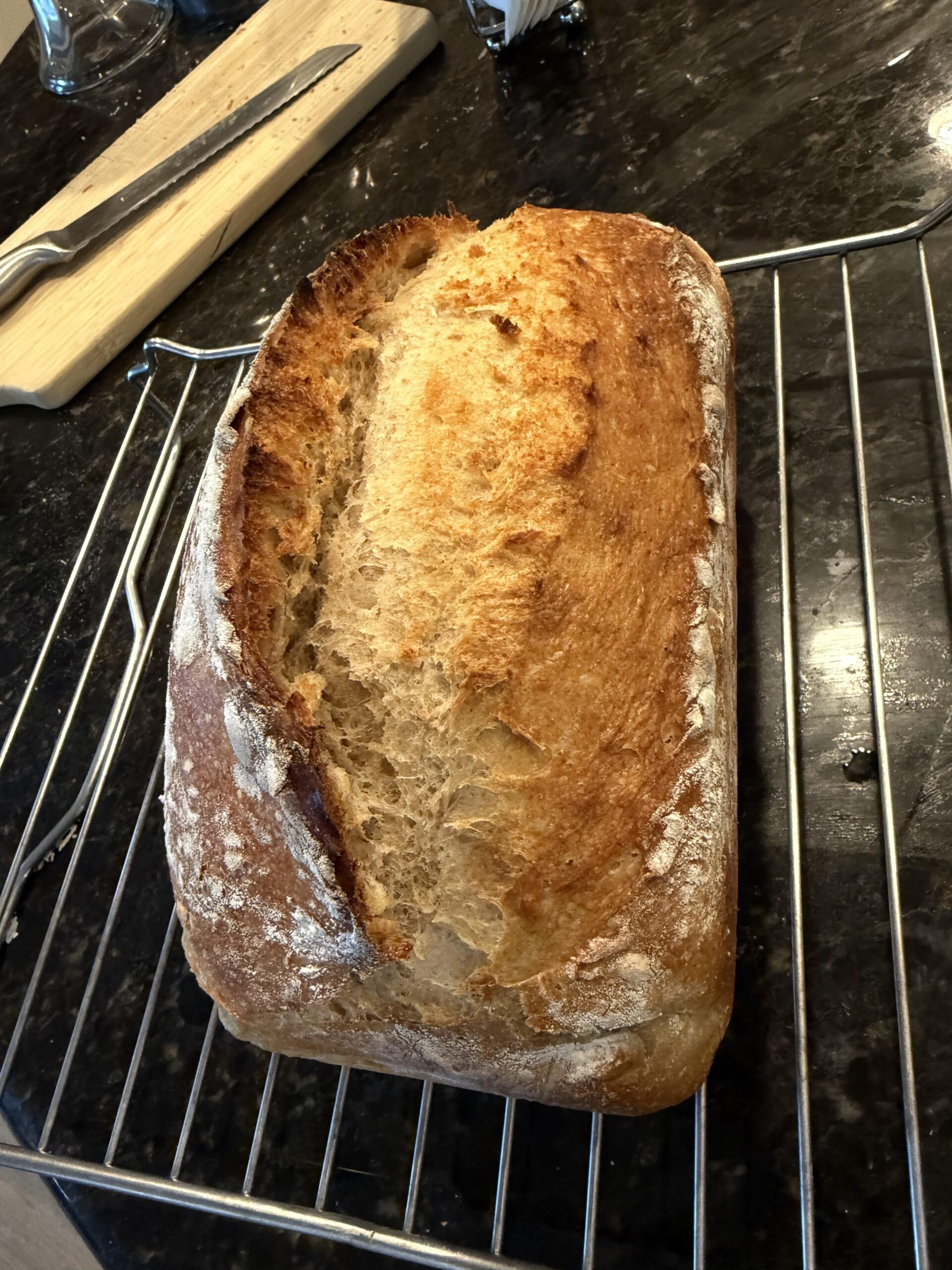

One of you a while back suggested instead of preheating the oven, starting the bread in a cold oven. I wanted to share that it’s just been a game changer for me. It allows the bread to come to one last rise before the severe heat, so I find my loaves are even fluffier, with a improved ear. I wonder why this technique is not more commonly recommended or used. Any thoughts?
350 g water
140 g starter
530 g flour
10 g of salt
Mix until shaggy. Let it rest for 30 minutes. Then do aggressive slap and folds for a few minutes. Let it rest for an hour. One set of stretch and folds. Bulk ferment on the counter for approximately five hours. No cold proofing. Put into buttered covered tin and straight into cold oven and bring up to 450. Once it reaches 450 Bake covered for approximately 40 minutes. Then uncovered for an additional 10 minutes. Total time in the oven 1 hour.
by Nancydrew246
17 Comments
I have not tried this method, so cannot comment in that vein. But, I think I will try this new method.
Are you not doing any final proof? If so, it would make sense that you would get better results as you are probably underproofing and the slightly extra proof while oven comes to temp would assist
2nd post I see about cold start, will try and report.
Probably because not all ovens are created equal. The results would vary greatly. My own home oven takes nearly 20 minutes to preheat 🫠
Conventional vs fan forced, electric vs gas. Lots of variables.
Interesting. I’ve never tried it. I know my wife makes a sandwich bread where she puts the bread in the oven before preheating. I always give her the side eye for it, but it always comes out fine so I can’t really say anything. I should try it with sourdough, but I’m still a bit scared
I’m sure it’s effectiveness varies greatly from oven to oven.
so how did it affect your oven spring?
It’s an extra bonus for me because I used to have to call my son as I was leaving work to tell him to turn the oven on to 450 for me so that it would be preheated by the time I got home. I’m always looking for things that make life simpler. 😊
When using a dutch oven, I always put the dough in a cold dutch oven and then into a cold oven. I do this mainly because I don’t like dropping the dough in a searing hot dutch oven and risking getting burnt.
My loaves still turn out nice.
I am going to try this out, why not, thanks for the instructions too!
My oven automatically lights the broiler to preheat the oven, I can’t work out how to change the settings, if it is even possible. I have occasionally forgotten this and scorched things if I’m trying to adjust the temp or something.
Do you shorten the oven time once you reach 450 vs before?
I’ve been starting with a cold oven for over a year now for the first loaf, the second loaf when the oven is already hot.
And almost every time, the first loaf comes out better: more oven spring, better ear, better looking…
America’s Test Kitchen has had some bread recipes with a cold start I believe. I’ve done it and it worked well!
Example from a pro: https://youtube.com/clip/UgkxtUQFI_86tVB4Vig9HGTvM26dbSqGJ59v?si=gnTkpNx4I9pO6T71
And another: https://youtube.com/clip/UgkxEdehTXVXrTikgdtXi_K3QwfzuYaKEla4?si=slYBebvJny54zvlQ
You know I suppose (or at least wonder) if this is how a bread machine works
It depends on the bread you are making. For me, to save energy I always start with a cold oven when doing sandwich loafs, cakes and muffins. But it doesn’t work for artisan loafs, focaccias, pizzas and biscuits.
FWIW been doing this for a while. Couldn’t tell you my hydration (do it by eye), but make it, put it in a casserole dish (Dutch oven to Americans) cold. Put the oven on to 250c for 45 minutes, then reduce the temperature to 200c and lid off for the last 15 minutes. Works well for me!