
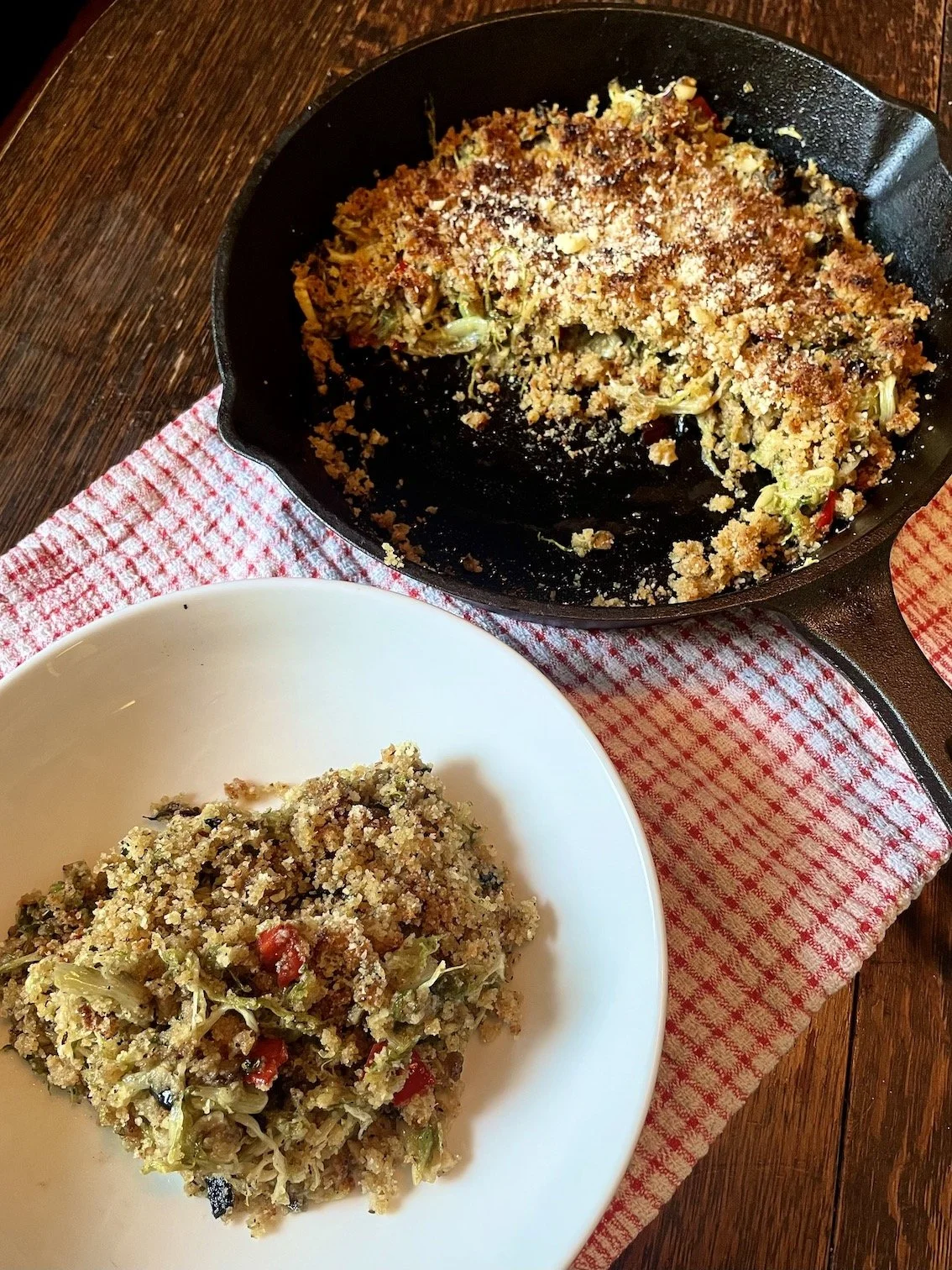
Words and photo by giacinta frisillo
My grandmother always said I liked ‘Depression food.’ To be clear, that doesn’t mean food you eat when you’re depressed – though I assure you this recipe works for that happenstance too – what she meant was that I, as a vegetarian, enjoyed the food she ate during America’s Great Depression. Cheap food. Food that could be grown in a small backyard city garden. Food you could forage growing wild on the side of the road.
I grew up in Utica, the heart of central New York. A rust belt leftover that was, in its heyday, a booming inner-city metropolis full of newly-settled southern Italian families who came by boat. Utica has always been made of a diverse mix of immigrant cultures and with it came a city with an overwhelming and distinctive culture full of Italian cafes, restaurants and shops. My grandparents grew up in this landscape as the youngest members in their large families, having the distinction, and squarely-positioned hope placed by new arrivals, of being first-generation to this new country.
As a result, my grandmother was my non, a shortening of the Italian nonna. Though she spoke Italian fluently and often with siblings, cousins and friends, she didn’t pass down the language to my father, or me. Her mantra? “Why you wanna speak ‘talian? You live in America!” What she, and Utica, did pass down was culture, and with it, food.
She cooked the best eggplant parmigiana and made pastas from scratch. Reared on this food, I assumed it was what all Americans ate. Only later did I find out that not only was not everyone eating it – this food wasn’t even exactly Italian. It was Italian-American and from a time when meat was hard to come by – and utterly delicious thoughts were being paid to vegetables.
The New York Times featured a recipe a few years back called ‘Utica Greens’ and adapted it from an upscale Italian joint. In my opinion, that recipe is too prim and proper. This is food you’re not used to making – how can you put a number on the amount of garlic cloves to use or olive oil to line the pan with? This is food to feel, to tweak to taste and be so comfortable with that you don’t need a recipe. You know it by heart – and by stomach. So I implore you, use this recipe as a guide, but not a strict one. Let your senses guide you. Make it delicious and let it bring you back home.
Recipe
Serves 4 as a side dish
Approx. 30 minutes to make
This is easiest to make in a cast iron pan, which can go from stovetop to oven, but you can also transfer the greens into an oven safe dish after the sauteeing step.
Ingredients
2 heads escarole (often called frisee or curly endive in the UK, though you can also try finely chopped kale or chicory – this author takes no responsibility for the use of experimental greens!)
Medium hot red chilli peppers (jarred or fresh)
Garlic cloves (this is to your taste, but I recommend at least 5)
30g of breadcrumbs
100g of parmigiano, pecorino, or a vegan alternative
Dried oregano, to taste
Dried basil, to taste
Garlic granules, to taste
Salt, to taste
Roughly 125ml of olive oil (for the topping, plus a few tablespoons to saute the greens)
Method
Pre-heat the oven grill on a medium heat to high heat setting. Submerge the escarole in water, wash thoroughly, then drain.
Chop the escarole into bite-sized pieces and dispose of the bottom stems.
Bring a large pot of well-salted water to a boil and submerge the escarole for about 2 minutes. Drain, then run under very cold water to stop the cooking. Squeeze as much water out of the escarole as possible, at least to where it’s not dripping.
In a medium bowl, make the topping. Mix breadcrumbs, oregano, basil, garlic granules, and salt with a bit of olive oil – add enough oil until it’s a bit gloopy, like wet sand.
Roughly chop the garlic and red chilli peppers, then place them into a frying pan over a medium heat with a good glug of olive oil, enough to coat the bottom of the pan (roughly 2-4 teaspoons). Let them get soft. Reduce the heat if they start to burn or brown too quickly!
Add the escarole to the frying pan, as well as half the topping mixture. Feel free to throw in some more parmigiano at this point. Mix everything well in the pan, let it cook for 4-5 minutes, stirring frequently and scraping off anything that gets stuck to the bottom (those are the best bits!).
Remove from heat. Put the rest of the topping on top and put underneath the oven grill for about 2 minutes until it’s browned. Remove from oven and sprinkle with more parmigiano.
Dining and Cooking