
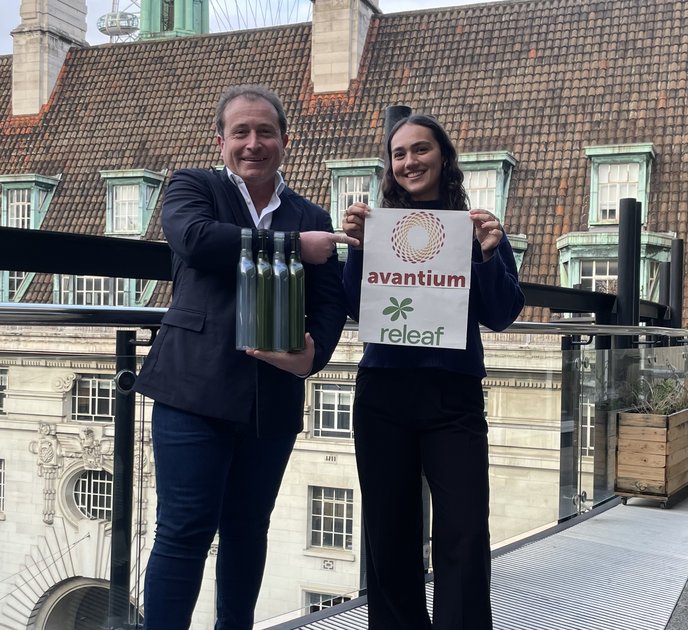
Just over one month after successfully securing $1 million in grant funding through the Australian Government’s Business Research and Innovation Initiative, Packamama has announced its first large-scale, international partnership with Avantium.
Specifically, the UK-Australian climate tech packaging specialist has entered into a capacity reservation agreement for the use of Avantium’s plant-based recyclable polymer Releaf.
By combining Avantium’s breakthrough material with Packamama’s expertise in lower emission wine bottles, the partnership aims to accelerate the development of low-carbon packaging solutions for the global wine sector.
Reflecting on the collaborative partnership, founder and CEO Santiago Navarro said: “We have been searching for a material that meets our performance standards and sustainability requirements, and is made from plants. We believe that Releaf offers a unique combination of high performance, environmental responsibility, and appealing consumer messaging.”
Similarly, Avantium’s Commercial Director Bineke Posthumus says Packamama’s “innovative approach to wine packaging and commitment to sustainability make them an ideal partner for Avantium.
“We look forward to working closely with Packamama to drive meaningful progress in sustainable packaging,” she later added.
 The BRII’s Alternative Packaging for Australian Wine challenge:
The news follows shortly after Packamama became one of two Proof-of-Concept grant recipients from the Business Research and Innovation Initiative’s Alternative Packaging for Australian Wine challenge. The other successful solution from the six Feasibility grant recipients was Wine One’s EcoSteel Wine Bottle project.
According to Santiago Navarro, “being selected by the Australian Government and Wine Australia to help lead the industry’s packaging transition is deeply motivating. It is proof that innovation in materials, design, and technology can protect wine and the planet in equal measure.”
In addition to Packamama, Wine One’s EcoSteel Wine Bottle project was also named a recipient of the $1 million grant funding in late 2025. This funding will be used to further its development of a standardised, shape-optimised, single-walled stainless steel wine bottle that could “reduce emissions by up to 74 per cent whilst ensuring superior preservation of wine quality,” it wrote in February.
Similarly, a 2025 life cycle assessment conducted by the Australian Wine Research Institute’s Affinity Labs found that Packamama bottles can cut emissions by up to 56 per cent and that exporting wine in Packamama bottles produces 32 per cent less carbon dioxide than bulk export.
What is Packamama?
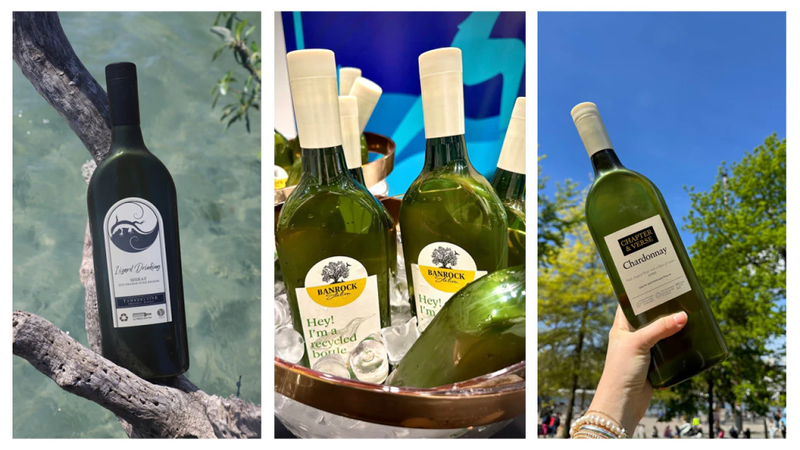
Packamama’s project, which spans a multinational production network in the UK, Australia, Belgium, South Africa, and soon the US, seeks to provide producers and retailers with practical, scalable solutions to reducing wine emissions.
Its eco-flat bottles – made from a material mix of recycled PET and performance-enhancing additives – offers space, weight and energy savings, reducing emissions by more than half compared to traditional glass bottles.
Dining and Cooking