
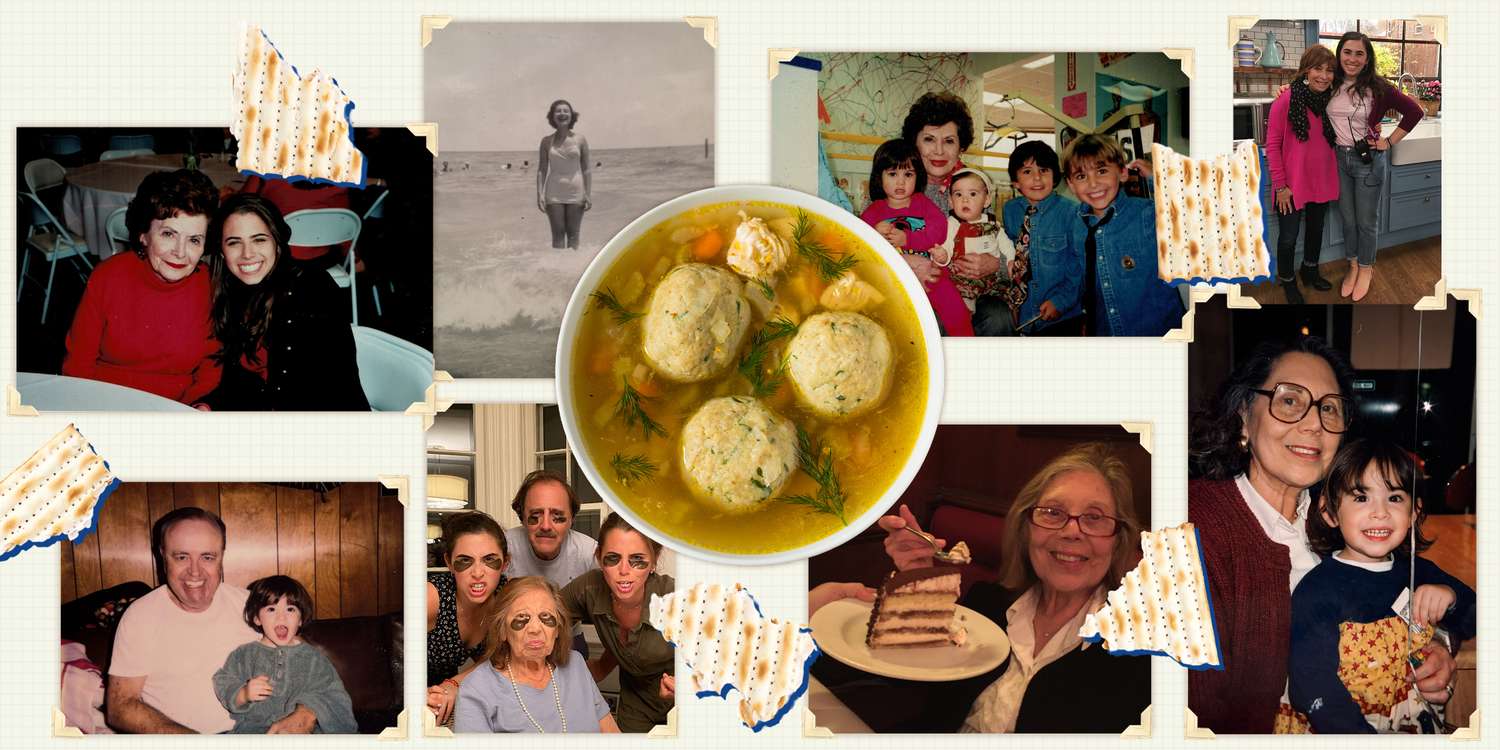
If you ask most Jewish Americans what they crave when they’re sick, when the chill of the air can be felt in their bones, or just when the day has dealt one more setback than one person can handle, I’d venture to guess their answer is—without hesitation—matzo ball soup. This comforting dish instantly unites Jewish people in a collective memory of comfort and healing. It encompasses the best qualities of any cure-all: simple yet rich, nourishing, and nostalgic.
Golden broth glistening with a patina of schmaltz, the beads of encapsulated fat creating a terrazzo on the soup’s surface. Below it, a few stray coins of carrots, perhaps some pieces of chicken to prove the soup’s origins, and maybe a crack of black pepper or a sprig or two of dill for color. And, of course, a gloriously oatmeal-colored matzo ball at the center.
Yet, what that matzo ball does once it gets in that soup is where the trouble starts: Does it float or does it sink? Which is the ideal? It’s an age-old debate in many Jewish families, and mine in particular. I was raised in a family of two matzo balls.
Courtney Kassel
Cheek-pinching and eternally over-feeding, my mother’s mom, Nana, was the quintessential grandma. It was as if she were given a manual for the job, the way she effortlessly offered up the spoon to every pot of chocolate pudding while rattling off Yiddish terms of endearment (bubelah when my sister and I were sweet, schmendrick when we acted up). My mom’s side of the family had been in America for generations, but it was in these small moments, and on holidays, that we were reminded of her Jewish heritage.
I won’t hide my allegiances in the battle of floaters versus sinkers. My Nana would serve up what is, to me, the Platonic ideal of matzo ball soup. She, and later my mom, would start with pullets (young chickens), which were cooked for hours, after which the fat, or schmaltz, was skimmed from the top and later added to the matzo balls. The matzo balls were smooth and rounded, uniform in color, a light flax with a few speckles. A spoon glided through them, the pieces absorbing the surrounding liquid like a sponge. Light but not feathery, they tasted of chicken and salt and floated gently to the surface.
“One or two?” my Nana would ask, though I’d happily accept as many matzo balls as she’d ladle into my bowl.
Courtney Kassel
Matzo ball soup is traditionally served on Passover, a welcome comfort at the end of the intentionally grueling Seder and its equally grueling symbolic foods that tell a story of hardship and strife as the Jews escaped from enslavement in Egypt. Even the soup’s titular ingredient, matzo, serves as a reminder of the affliction, an unleavened bread the Israelites had to rush to bake as they fled.
Both of my dad’s parents escaped persecution in World War II—his father from Germany, his mother from Austria. Their paths to the U.S. were different and far from straightforward. In particular, my grandmother and her family members were forced to separate and forge four separate paths around the world. Their tale is so astonishing and foreign to the conveniences of modernity that it’s hard to believe they all found each other in New York five years later.
Courtney Kassel
In this narrative, it becomes easy to spot the origins of the resilient, stubborn, strong-willed, absolutely authentic woman that was my dad’s mother, Nana Lee. As a mother and grandmother, she was not always the warm-and-fuzzy type, opting instead to express her affection through life lessons, tough love, and, of course, food.
The only trouble? Nana Lee was not a gifted cook. My dad often joked she trained at the “Swanson school of cooking,” referring to the number of TV dinners he and his siblings ate as children.
If you couldn’t guess by now, we have reached the sinkers’ side of my family. Nana Lee’s matzo balls were dense, the size of a golf ball, and frequently took on a sort of grayish-tan hue. The insides were often so dry and tough that no soup could penetrate them. Their flavor was strong and concentrated (as was her soup, which had almost certainly been left to boil down all day), with a much saltier, pronounced chicken flavor. My mom used to whisper to my sister and me, “I need a fork and knife for these.”
“One or two?” One is plenty, thanks.
Sometimes fate deals you a floater, other times a sinker.
And yet, they garnered a dedicated fan base in my father and his three siblings (though my father has since come around to the lighter side). In fact, when my Nana Lee recently passed at 102, I made a point of asking my dad’s siblings and uncle after the memorial if they really liked them or if they were just being cordial. They were shocked. “Of course,” my aunt said, her daughter agreeing. To them, they’re the only matzo balls that ever mattered. “None of those fluffy, flavorless matzo balls,” my uncle Jeff added. My great-uncle Raoul described them perfectly: “Like cannonballs,” he said, laughing. He went on to complain that the ones you find in restaurants nowadays are so soft, “they fall apart if you look at them.”
And though I would never have admitted it to my mom, I secretly liked the reveal of a little al dente center (though Nana Lee took it to an extreme). My Nana Lee’s matzo balls were bold, unapologetic, and maybe not by the book, but perfectly imperfect in their own way.
Matzo balls transform matzo, something born out of necessity, a reminder of suffering and persecution, into the epitome of Jewish comfort and healing. Each bowl of matzo ball soup placed in front of me told the story of a different recipe, informed by vastly different experiences of both Judaism and of living. Sometimes fate deals you a floater, other times a sinker; I’ve learned to appreciate whatever bowl I’m given—and more so, to love it because of the women behind each one.
Adobe Stock
Dining and Cooking