
Newswise — People have long said that “bread is life.” Now, researchers at Tufts University are using the bubbling mixtures of flour and water known as sourdough starters to explore what shapes life at the microscopic level. Their findings, published in Ecology, demonstrate a simple way to predict how microbial species will live together, providing insights that could inform baking, food safety, and human health.
A major question in ecology is if it’s possible to predict which microbial species will thrive together based on how pairs of species interact, or if more complex group effects are needed to explain the patterns of coexistence of species seen in nature.
Some ecologists are skeptical of using “pairwise interactions” to predict real microbial communities because of previous studies, which often featured artificial combinations of species or lab conditions unlike their natural habitats.
By studying microbes isolated from real sourdough cultures, the Tufts team showed that a simple pair-based model could reliably forecast how up to nine species of microbes will interact.
The same model may help explain how microbial communities behave in food facilities, farms, hospitals, and even our own bodies. Realistic models could help scientists anticipate which species will persist and which will disappear—and foretell dangerous events such as foodborne illness outbreaks or the emergence of antibiotic-resistant bacteria.
Sourdough starters work by cultivating wild yeasts and lactic acid bacteria that are already present in flour and in the surrounding environment, including on our hands and kitchen items. By mixing flour and water, bakers create the conditions that let these microbes awaken and begin to multiply until these microbial populations grow large and active enough to make dough rise and to give sourdough its distinctive tang.
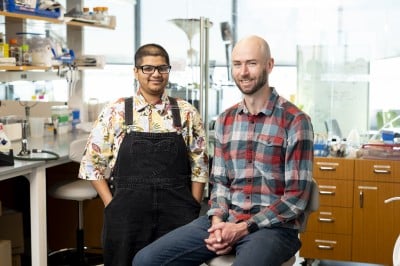
“Sourdough starters include a wide diversity of microbes overall,” says the study’s senior author, Lawrence Uricchio, Youniss Family Professor of Innovation and an assistant professor of biology at Tufts. “Yet within these starters, certain species consistently appear together in non-random patterns.” Most starters contain just a handful of bacterial species and one or two types of yeast.
Uricchio says this provided a perfect microcosm for testing if a simple model based on pairwise interactions could answer big-picture questions about how species will thrive in their natural environment. He compares pairwise interactions to predicting the outcome of a chess game when you know the strengths of each player.
But given that real ecosystems are much messier than a chess match, many scientists argue that natural ecosystems instead involve more complex interactions. Uricchio says these interactions are more like a game of rock, paper, scissors among three or more players. “With so many possible outcomes, it becomes much harder to predict who will win,” he says.
To test a pairwise interaction model and its applicability to circumstances with more than two microbial “players,” the Tufts researchers isolated microbes from sourdough starters and measured the growth of microbes either by themselves or in pairs.
They used these measurements to build the model and then compared its predictions to what actually happened when they let larger communities of up to nine species of yeast and bacteria grow together in lab dishes.
Their findings suggest that pairwise interactions alone indeed can reliably predict which microbes will coexist and how abundant they will be in some complex multi-species communities. Only two of the nine species behaved differently from the model’s predictions. And, critically, the researchers improved those predictions by adjusting their model to reflect sourdough’s real-world life cycle.
Learning from the Life Cycle of a Loaf
This cycle begins when a baker mixes flour and water and lets naturally occurring microbes in the environment begin to grow. Over the next week or two, the baker “feeds” the mixture—refreshing it daily with new flour and water—until the starter becomes active enough to make dough rise properly. For each new loaf, the baker uses a portion of the starter and then replenishes the remainder with more flour and water, maintaining the culture through regular feedings.
“There’s constant fluctuation, where the microbes awaken and grow, then their population size goes way down, and then it goes back up again,” says Uricchio. “When our parameters for pairwise interactions did not include this repeated reduction of the population followed by growth, they didn’t do quite as good a job.”
“We found that certain species naturally found in sourdough starters can outcompete others, but grow very slowly,” says Kasturi Lele, a doctoral student in biology at Tufts who co-led the study in the Uricchio Lab alongside Benjamin Wolfe, associate professor of biology. “When we accounted for the repeated reduction of the microbial population followed by growth that happens in actual starters, our model revealed that these particular species do not reproduce to the point where they actually drive out some of the other species.”
The researchers say this insight could help inform pairwise interaction models that better predict—and potentially prevent—microbial changes that threaten human, animal, or environmental health.
Many real-world microbial communities experience the same kind of boom-and-bust cycles seen in sourdough starters. For example, a course of antibiotics can sharply reduce microbes in a patient’s gut, creating a temporary opening for harmful bacteria normally kept in check by other beneficial microorganisms to surge. Similar population crashes can occur when food-processing equipment is sanitized, when hospital rooms are disinfected between patients, or when soil microbes are disrupted by pesticides.
Home bakers may be reassured to learn that the microbial communities in sourdough starters appear remarkably stable. “They seem to live quite a long time and to resist invasions by other microbes,” Uricchio says. “So perhaps it’s not surprising that some people keep these starters going for many years without them spoiling.”
The researchers are already taking the next step in understanding natural communities, with Lele working on models that can follow these microbes as they evolve. As genetic changes accumulate over time, a once stable microbial community could shift, says Uricchio. “Evolution may well give one microbial species the upper hand, changing the flavor of the bread baked with a starter or reshaping a person’s gut microbiota.”
Dining and Cooking