
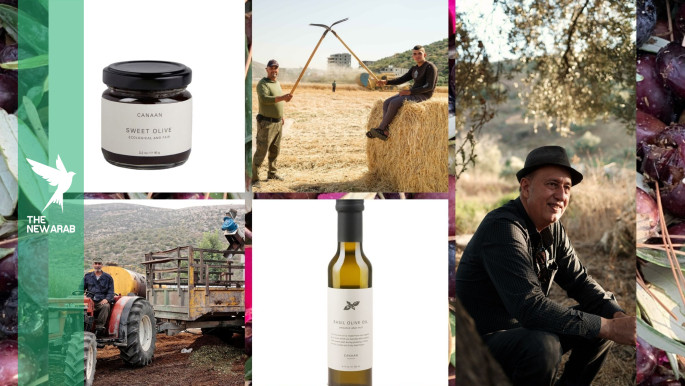
Olive oil sits at the centre of Palestinian cuisine — and for Canaan Palestine, it has grown into one of its most important exports.
Founded by anthropologist Dr Nasser Abufarha, Canaan Palestine works with over 2,000 farmers across 52 villages to, as he puts it, “create a bridge between Palestine and the rest of the world,” and its olive oil is now sold through more than 6,000 retailers, including Whole Foods, the Zaytoun brand in the UK, Erewhon in Los Angeles, and stores in Sweden, Japan, Korea, Dubai, and Germany.
That global reach is built around two primary olive oil varieties under the company’s oversight: Suri, named after the town of Sur in Lebanon, and Nabali, named after Nablus in the occupied West Bank.
According to Dr Nasser, “the taste can vary from season to season, depending on growing conditions, the sun, and the soil” — a variability that he says “makes my mouth water.”
These differences are reflected in Canaan Palestine’s range. The Rumi variety, whose olive trees date back to Roman times and are typically 1,000 to 2,000 years old, is made from several harvests of Suri olives, which Dr Nasser calls “pungent and robust,” and is best enjoyed with warm bread.
Then there is the Nabali, which accounts for 90% of olive trees in production in Palestine and offers a more aromatic, delicate flavour from a later harvest, with notes described as “sweet, buttery, and fruity.”
Canaan Palestine’s Jenin olive oil comes from small family farms in Jenin, Palestine
Canaan’s Za’atar celebrates authentic Palestinian flavours. Handcrafted by women’s cooperatives, this blend combines organic oregano, wild thyme, sumac, and native Palestinian sesame seeds
Heritage meets Fair Trade
Speaking to Dr Nasser, it’s clear he knows his olive oil very well, a knowledge rooted in his childhood growing up in a Palestinian farming community in Jenin.
“There were cucumbers, aubergines, tomatoes and watermelons… Then, from my mum’s side, we had olives. We eat local, so the milk, labneh and cheese from our own sheep and goats, eggs and chicken, and most of our vegetables come from our farm or our neighbour’s farm. Even at the market, produce was grown within a five- or ten-kilometre radius,” he says.
He describes the locality as “beautiful, changing with the season so that there’s always something you miss for a while, and you can’t wait for the season to come back again so you can eat it.”
Dr Nasser Abufarha, a Palestinian-American anthropologist and social entrepreneur, is the founder of Canaan Fair Trade and the Palestine Fair Trade Association
He went on to study education, business and anthropology in America. Returning to Palestine for research, he discovered a crisis in the industry.
“With the restrictions imposed on farmers by the occupation, and the natural shift in the food industry from traditional agriculture to agribusiness, family farmers’ opportunities to access markets have been limited, and it was heartbreaking to see them struggle to make a living,” he says, highlighting the idea for Canaan Palestine as part economic and part cultural.
He adds, “As a Palestinian, I know the significance of the olive tree to Palestine as a food source, as economic strength, and as a cultural grounding. I wanted to link farmers to market opportunities under Fair Trade terms in the West, building bridges that are culturally meaningful and economically empowering.”
It is this mission that Dr Nasser is most passionate about. Feeling a connection to the land and bonding over sharing food were huge parts of his upbringing — but also something under siege.
“If we lose family farming, we’re losing community as well as healthy, nutritious food sources,” he shares. “That’s the beauty of the Palestine that I know. If it’s gone, it’s not easy to rebuild.”
Canaan Palestine sources its organic olive oil from small family farms across Palestine
Farmers and growers face constant challenges, from bureaucracy and unpredictable weather to the cost-price squeeze and harassment by settlers
When starting the business, Dr Nasser also knew that Palestinian farmers had been ahead of the curve in terms of the growing focus on environmental and social consciousness.
“People were interested in being socially responsible, wanting to know the people behind the food they ate. I saw this natural solidarity between the farmers and these movements around the world, so I wanted to link them,” he explains.
However, that didn’t mean Canaan was an easy business to capitalise on. As he puts it, “To have international Fair Trade institutions develop standards for olive oil was hard, because we don’t have that market for olive oil. It was hard to get the farmers working under visible, transparent, and auditable standards.”
Not one to back down from an obstacle, Dr Nasser worked with a team to develop their own standards, based on the Fair Trade International model.
“Once we put that out online, we started getting contracts from Canada, the US and the UK. We realised that we had legitimacy then. Of course, the products vouch for themselves, quality and taste-wise. Within two years, we started getting sizable contracts and could bring the Fair Trade market price of olive oil up to a sustainable level,” he continues.
Tradition amid turmoil
Beyond its work with farmers, Dr Nasser is keen to highlight Canaan’s environmental initiatives. In addition to supporting local communities, the company plants more than 60,000 trees every year through donations and collaborates closely with the Palestine Fair Trade Association.
Despite these efforts, the challenges facing Palestinian farmers remain stark. Twenty-one years on, obstacles continue to disrupt their livelihoods.
“The army bars farmers from entering their land, settlers harassing farmers,” he notes, painting a picture of daily struggles on the ground.
The scale of the problem is significant. At the time of speaking to Dr Nasser, he reported that there had already been over 100 attacks and more than 4,000 olive trees uprooted that year alone.
Raising awareness internationally is part of Canaan’s strategy, though it has limits. “We raise awareness of this to international communities, but we cannot address political challenges bigger than our platform,” he explains.
“We’re working to give farmers a lifeline — a market that is not hostage to war and the occupation.”
Amid these challenges, farming has taken on a symbolic role. In Palestine, many people see it as a form of resistance, connecting communities to the land and preserving culture through agriculture.
And for Dr Nasser, olive oil is not only what he sells but also what he lives by, saying, “I have a tradition of taking a shot of Nabali olive oil every morning. It’s my dose of antioxidants and good fat for the brain.”
Now that’s a habit we can fully support.
Canaan Palestine delicacies can be purchased here, and trees can be planted in support of the Canaan Palestine Trees for Life Program here
Isabella Silvers is a multi-award-winning editor and journalist, having written for Cosmopolitan, Women’s Health, Refinery 29 and more. She also writes a weekly newsletter on mixed-race identity, titled Mixed Messages
Follow her on Instagram: @izzymks
Dining and Cooking