
Pork shoulder is a popular cut for good reason. It’s relatively inexpensive, widely available, and offers plenty of payoff for a modest investment. This cut is packed with connective tissue that, when cooked the right way, transforms into melting tenderness.
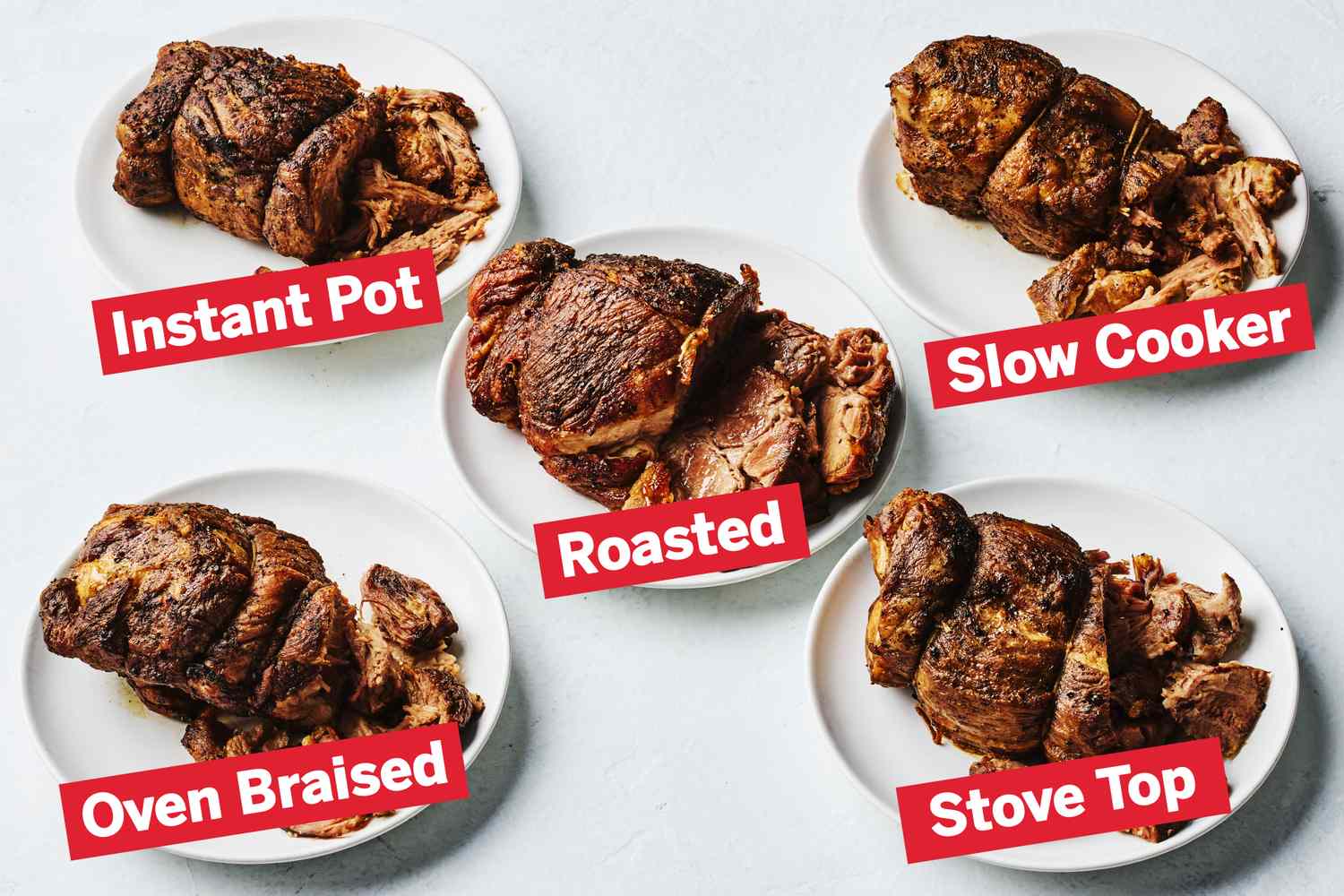
But what is the right way to cook pork shoulder? Should you pull out your Dutch oven, Instant Pot, slow cooker, or sheet pan? To find out, we tested five popular methods and tasted the results side by side. Some approaches delivered impressive tenderness but muted flavor, while others required more time but rewarded us with deeper browning and complexity. In the end, one method stood clearly above the rest, offering the most delicious flavor and texture.
Melissa Gray-Streett tested all of the pork shoulder methods.
A word about our method
We tested all of these methods in our test kitchen and had a panel of editors and test kitchen professionals taste the results. To keep testing manageable, we used a 3-pound boneless pork shoulder for each method. We tied the roast to keep its shape and thickness uniform so that it would cook more evenly. Each roast was coated with 1 1/2 tablespoons kosher salt and 1 1/2 teaspoons black pepper, and we used 2 tablespoons olive oil with each test — either for searing or for rubbing onto the meat. Chicken broth was also used in all but one of the tests.
Our goal was tender, shreddable pork, so we knew we needed to cook it to an internal temperature between 195°F and 210°F. We ended up going toward the middle of this temperature range to allow more of the meat’s connective tissue to break down, and we allowed the meat to rest for 15 minutes before cutting into it. We also took note of the weight of the meat before and after each method to see how much loss occurred after cooking.
Braised on the stovetop
Food & Wine / Photo by Greg Dupree / Prop Styling by Claire Spollen / Food Styling by Emily Hall
Cook time: 1 hour 25 minutes
Total time: 1 hour 50 minutes
Rating: 3/10
Method: We seasoned the pork on all sides with salt and pepper and seared it in olive oil in a Dutch oven, turning occasionally, until evenly browned, roughly 15 minutes. We then added 1 1/2 cups chicken broth to the pot, adjusted the heat to maintain a gentle simmer, covered the pot, and gently cooked the pork until it reached the desired temperature, about 1 hour 10 minutes.
Results: This roast had a 40% weight loss after cooking and resting, yet it didn’t concentrate the flavor as we had hoped it would. Because the heat source is aimed only at the base of the pot, the bottom of the roast gets the most browning, flavor development, and tenderizing. The top of the roast was noticeably tougher, and the taste was disappointing and almost watery.
Pros: It’s a one-pot method that stays on a consistent heat source.
Cons: The flavor was pale and lackluster, and the texture was uneven — tender in spots, tough in spots.
Cooked in a slow cooker
Food & Wine / Photo by Greg Dupree / Prop Styling by Claire Spollen / Food Styling by Emily Hall
Cook time: 1 hour 45 minutes
Total time: 2 hours 15 minutes
Rating: 5/10
Method: Before placing the meat in the slow cooker, we seasoned it with salt and pepper and seared it in olive oil in a skillet, turning occasionally until evenly browned. Then we placed the roast in a slow cooker, added just 1/2 cup of broth, closed the lid, and cooked on HIGH until the pork reached the desired temperature. Surprisingly, this only took about 1 1/2 hours.
Results: This roast had the second-lowest weight loss after cooking, just 37.5%. The closed, humid, relatively low-heat environment of the slow cooker kept the meat exceptionally juicy and tender — perfect for shredding and tossing with barbecue or enchilada sauce for pulled pork sandwiches or enchiladas. That said, the flavor was rather pale compared to that of other methods; this pork would not hold its own as a standalone entrée but would need more robust sauces or flavorings added to it.
Pros: After searing, this is a hands-off method. It produces incredibly tender meat that would work well as a component in a recipe.
Cons: Since the meat cooks in a sealed, wet environment and there’s less evaporation, the flavor gets muted and lacks the richness of the top-performing methods. Also, if there’s a fat cap on the roast, it doesn’t render but instead gets unappealingly soggy.
Braised in the oven
Food & Wine / Photo by Greg Dupree / Prop Styling by Claire Spollen / Food Styling by Emily Hall
Cook time: 1 hour 30 minutes
Total time: 1 hour 55 minutes
Rating: 7/10
Method: This test began the exact same way as the stovetop-braised method: The roast was seasoned with salt and pepper, browned in a Dutch oven, topped with 1 1/2 cups chicken broth, and covered. Then the pot went into a 325°F oven until it cooked to our ideal internal temperature, about 1 hour 15 minutes.
Results: Oven-braising surrounds the entire pot with steady, gentle heat that slowly dissolves the meat’s connective tissue while keeping the pork partially submerged for moisture protection. In fact, this roast experienced the lowest weight loss at just 37%. It tasted far richer and more concentrated than the stovetop-braising and slow cooker methods. It was also more evenly tender than the stovetop method, with a crispier exterior all over.
Pros: The oven provides consistent heat from all sides, which helps the meat cook to even tenderness. This method also kept the browned fat cap crisp.
Cons: Requires two-stage cooking (start on the stovetop and finish in the oven).
Cooked in an Instant Pot
Food & Wine / Photo by Greg Dupree / Prop Styling by Claire Spollen / Food Styling by Emily Hall
Cook time: 1 hour 15 minutes
Total time: 1 hour 55 minutes
Rating: 8/10
Method: After seasoning the pork with salt and pepper, we seared it in olive oil in an Instant Pot set to SAUTÉ (choose HIGH if your machine has HIGH and LOW sauté settings), turning occasionally until evenly browned. We then added 1 cup chicken broth to the pot, closed and locked the lid in place, and set it to cook on high pressure for 50 minutes. At the end of the set cooking time, we allowed the pressure to release naturally for 15 minutes, then quick-released the remaining pressure.
Results: Although the Instant Pot is generally a timesaving appliance, by the time you sear the roast, the cooker comes to pressure, the roast cooks under pressure, you wait 15 minutes to release the pressure, and you rest the meat for 15 minutes, you’re already about 2 hours in. That’s still relatively quick, but not any faster than some of the other methods. However, the real benefit here is the flavor. The pork had a 40% weight loss, which in this case translated to a rich, deep, concentrated pork flavor. The meat was incredibly tender as well, shredding with very little effort.
Pros: After searing, you can leave the roast unattended. The pork has a rich flavor and is very tender.
Cons: You cannot gauge the temperature of the meat as it cooks.
Roasted in the oven
Food & Wine / Photo by Greg Dupree / Prop Styling by Claire Spollen / Food Styling by Emily Hall
Cook time: 3 hours 10 minutes
Total time: 3 hours 40 minutes
Rating: 10/10
Method: Here, we rubbed the pork all over with the olive oil and seasoned evenly with the salt and pepper. We then placed it on a wire rack set inside a rimmed baking sheet and roasted at 450°F for 20 minutes, then reduced the oven temperature to 325°F and slow-roasted until the pork hit the desired internal temperature, about 3 hours longer.
Results: When we first approached this roast, with its crispy-crackly crust, we thought we’d only get slices and not shreddable meat — but we were wrong. The initial high-heat blast in the oven created a deliciously browned crust, while the lower, slower roasting over the next few hours allowed the collagen to slowly break down without drying out the meat. This two-stage method delivered two great textures: a crusty outer bark and a juicy, buttery-tender interior. This pork roast experienced the biggest change after cooking, losing 46% of its original weight. What that meant for the final product was a much more concentrated flavor overall.
Pros: The crispy bark that develops is outright delicious, and the pork ends up with a deeply concentrated, rich flavor. It’s also surprisingly tender and easy to shred.
Cons: This method might make your oven smoky. And it involves the longest cook time.
Final takeaways
If your priority is deeply concentrated pork flavor and a mix of crisp exterior and tender, shreddable meat, roasting is the clear winner — even though it takes the longest. Oven-braising and pressure-cooking in the Instant Pot are excellent alternatives when time or equipment dictates, delivering consistently tender results with strong flavor. The slow cooker shines when pork is destined for sauced dishes, while stovetop-braising proved the least effective for even texture and flavor development.
Dining and Cooking