
The department of agriculture is working to resolve a costly failure in South Africa’s trade with the UK after analysis showed exporters paid nearly R1.3bn in tariffs in 2024 on agricultural goods that should have qualified for duty-free access under the SACUM-UK Economic Partnership Agreement (EPA).
The UK is one of South Africa’s most important agricultural trading partners. In 2023, it was the top G20 destination for South African agricultural exports, with imports totalling £679m (R15bn), dominated by citrus fruits, wine, and nuts.
In 2024, the UK retained its position as the number one destination for South African wine, valued at R2.6bn, and became the country’s largest fresh-fruit export market by value share, ahead of France, Spain and Peru.
 (Karen Moolman)
Total trade between South Africa and the UK increased from R110.2bn in 2019 to R128bn in 2024, according to data by the department of trade, industry and competition (DTIC).
The SACUM-UK EPA — struck after Brexit between the UK and the Southern African Customs Union member states plus Mozambique — provides duty-free access for most goods, though some agricultural products are subject to quotas. Exporters must meet rules of origin requirements to qualify.
However, many exporters are not using the deal properly, leading to billions of rand in avoidable tariffs — and costing the country jobs and competitiveness.
Business Day previously reported that in total, South African exporters across all sectors are paying more than R4.3bn in tariffs on goods that could have entered the UK market at zero duty, according to numbers released by the British high commission.
Fully using the SACUM-UK EPA could help South Africa recover lost savings, potentially softening the blow of the 30% tariffs imposed by the US on key exports.
Among the affected agricultural goods are R870m in beverages — including white wine — and R392m in fruit and nut exports, such as R65m worth of avocados. All of these should have entered the UK duty-free but instead faced tariffs ranging from 4% to 10%.
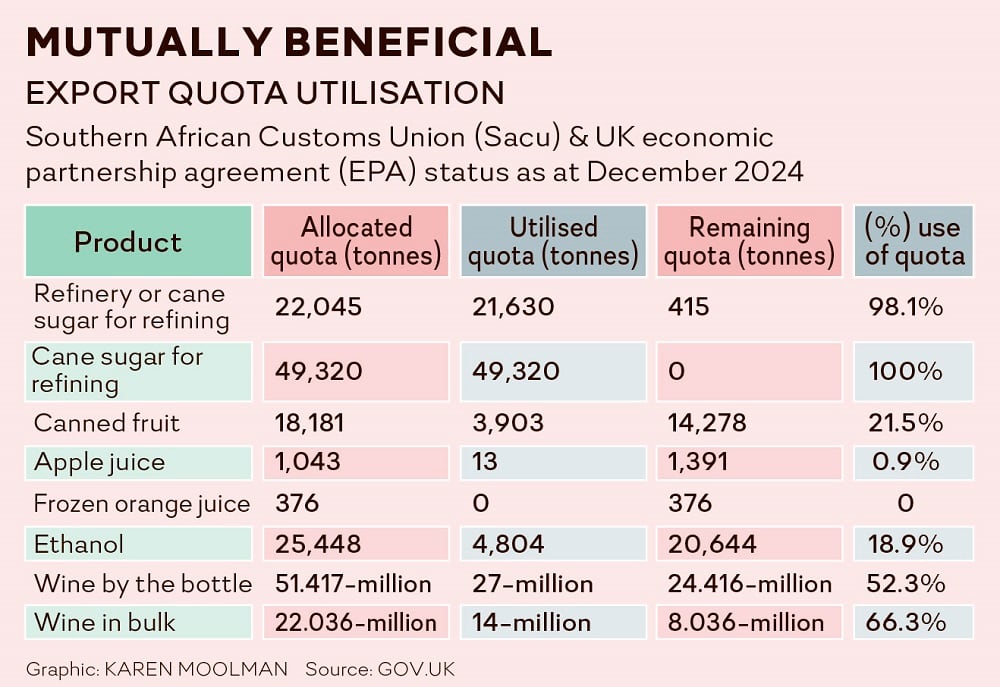
Data from the agriculture department also confirms that the trade deal is being underused. While sugar exporters made full use of their quotas — at 98% and 100% — other categories fell dramatically short.
Only 21.5% of the canned fruit quota was used, just 0.9% of apple juice, 0% of frozen orange juice, and 18.9% of ethanol.
Even in wine — South Africa’s top agricultural export to the UK — only 52% of the bottled wine quota and 66% of bulk wine were used.
Business Day’s previous coverage prompted agriculture minister John Steenhuisen to issue a strongly worded statement warning of a “jobs bloodbath” if the situation continued. The agriculture department has since confirmed it is taking action.
In response to questions, the department said it had analysed 2024 quota utilisation data, alerted industry bodies, and reallocated unused quotas where individual exporters had not taken them up.
It also plans to table a proposal at the Agricultural Trade Forum (ATF) in March to establish a SACUM-UK EPA subcommittee dedicated to improving preference uptake. The forum includes the departments of agriculture, trade, and international relations.
“This ATF subcommittee will actualise the utilisation of the quotas provided for in the SACUM-UK EPA,” the department said. “Furthermore, the department will continue to engage with commodity representative organisations and exporter forums to inform them about the existing free trade agreement between South Africa and the UK.”
According to Natasha Stotesbury, head of trade policy at the British high commission, the commission is working with the agriculture department and the DTIC to resolve the “challenges that are being faced in terms of our utilisation of the agreement”.
The DTIC told Business Day at an awareness event last week that it is hosting export workshops in major cities across the provinces to help businesses access the benefits of the SACUM-UK trade agreement.
It has also made webinars available on its website and YouTube channel.
Business Day
Dining and Cooking