
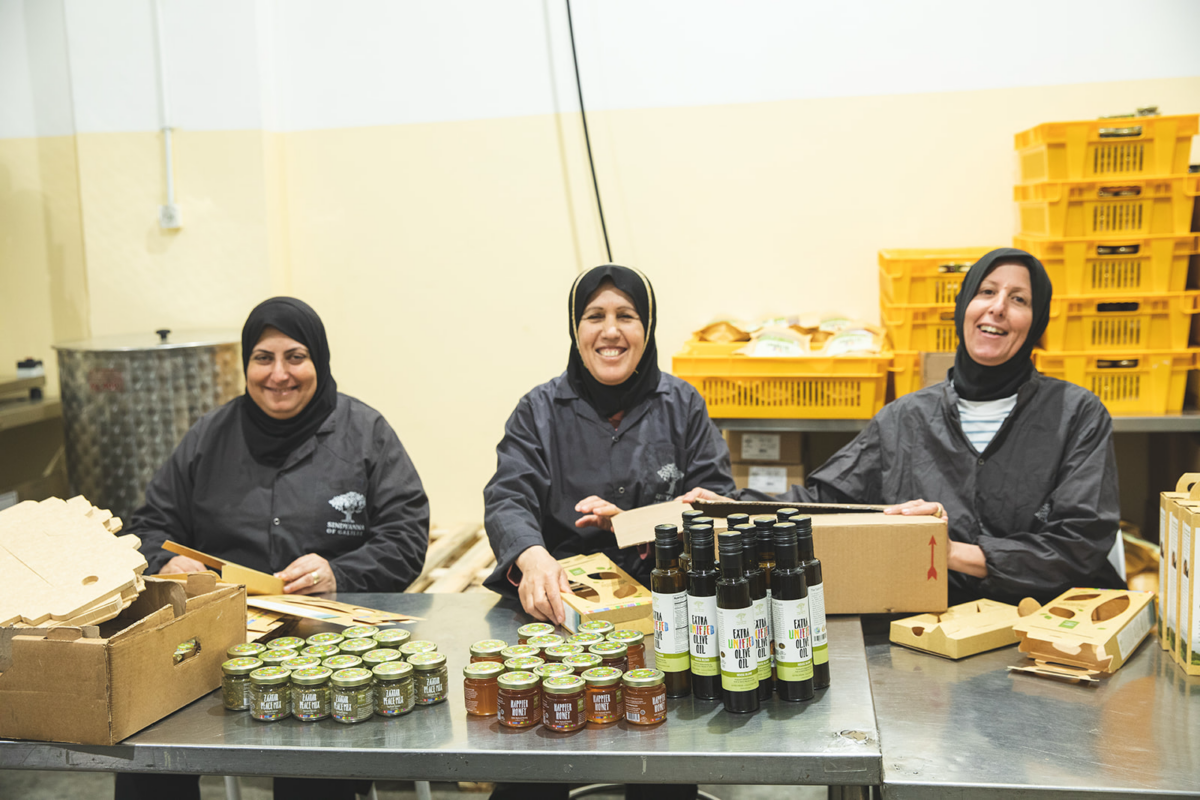
KAFR KANNA, Israel — For two decades, Sindyanna of Galilee built its model on a simple three-step premise: sell high-quality, fair-trade olive oil from Arab Israeli farmers to international markets; funnel profits back into an empowerment collective for Arab women; and prove that commerce could build bridges between Jews and Arabs in the Galilee.
By early October 2023, it was working. Seventy percent of its revenue came from exports — to the British company Zeytun, American buyers like Dr. Bronner’s and customers across Europe who valued the quality, the values and the cheerful, optimistic packaging. The cooking workshops at its visitors center in Kafr Kanna brought Jewish Israelis into Arab villages to learn traditional Galilean cuisine alongside Arab women, demonstrating that coexistence wasn’t just a talking point — it was delicious.
Then came Oct. 7.
After the Hamas terror attacks and the launch of Israel’s war against the terrorist organization in Gaza, longtime customers from abroad cut ties, not because of quality concerns, but because the products came from Israel, according to Hanan Manadreh Zoabi, co-manager of Sindyanna’s Visitors Center. The word “Israeli” on the label — even for an Arab-led, women-empowering, peace-building enterprise — became toxic. Zeytun stopped ordering. Seventy percent of its revenue evaporated.
At home, Jewish Israelis stopped coming to the cooking workshops. The fear of entering Arab villages, even for an explicitly coexistence-focused program, became insurmountable. The visitors’ center sat quiet.
“Jewish Israelis are afraid to come to Arab village courses now,” Zoabi told eJewishPhilanthropy last week. The international market rejected them for being Israeli. The Israeli market feared them for being Arab.
But Sindyanna — a self-sustaining organization that runs like a business but functions as an NGO, cycling all profits back into programming — isn’t folding. Instead, it’s doubling down on the most challenging path: winning over Jewish Israelis one bottle at a time.
Sindyanna’s team is betting that its optimistic branding will help. Instead of just “extra virgin,” its olive oil is labeled “Extra Positive,” “Extra Peaceful” and “Extra Hopeful.”
“The local market is now most important for us. More than overseas,” Zoabi said. “We want to spread our message of hopefulness. The Israeli population is who we want to share our message of equality and democracy with.”
It’s an ironic twist. For years, Sindyanna exported its coexistence story to sympathetic audiences abroad, people who already believed in the mission. Now, financial necessity is forcing them to do what they always truly wanted: reach the Israelis who live alongside them but remain strangers.
“When one person puts our oil on their counter,” Zoabi said, “that is a start.”
Sindyanna didn’t begin with grand ambitions. In 1993, a group of women in the Galilee town of Majd al-Krum noticed that Arab farmers in the region were sitting on exceptional olive oil but had no path to market. Sindyanna started packaging and selling it from a single room.
The name, Sindyanna, is symbolic, referring to the Palestine oak, also known as the kermes oak, which dots the Galilee landscape — a tree known for deep roots, longevity and endurance. By 2003, it had become Israel’s only World Fair Trade Organization-certified producer, a status it’s maintained through an intifada, countless military operations, the COVID-19 pandemic and the Oct. 7 attacks and ensuing two-plus years of war.
“It’s not easy to maintain a high level of fair trade,” Zoabi said. Every bottle requires documentation, quality control, fair pricing negotiations with farmers and adherence to international standards, which many producers find burdensome.
Once the organization sells the oil that it has purchased from some 200 small Arab farmers, the profits go into programs for Arab women. This includes hydroponics training, cooking workshops with celebrity Israeli chefs and a home-based tourism program designed to give women economic independence.
“The women didn’t know they had something here they could do something with,” Zoabi said of the early days. Those same women now teach biodynamic beekeeping and run culinary programs. “There’s no high-tech here,” she added. “There are olives.”
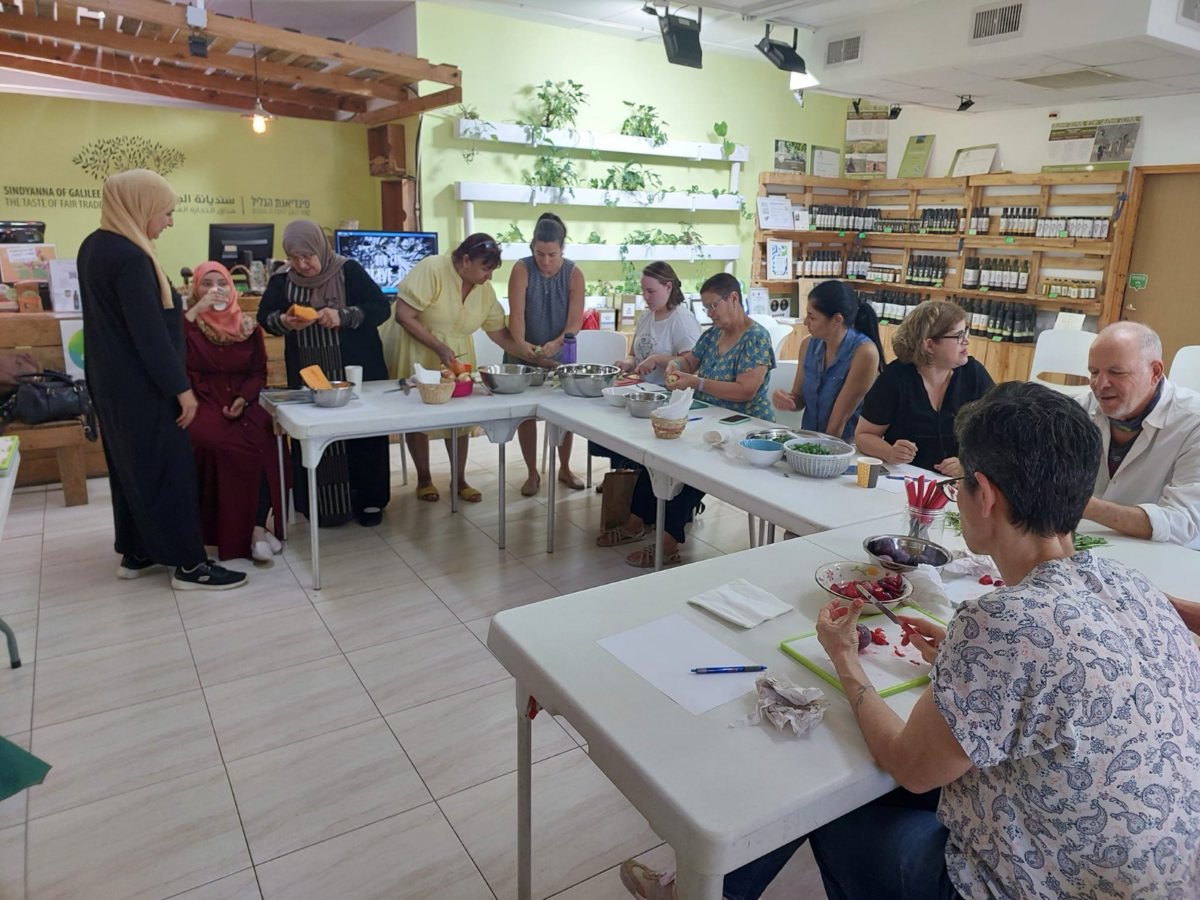 People take part in a cooking workshop at Sindyanna of Galilee in Kafr Kanna, northern Israel, in an undated photograph. (Courtesy)
But the road has been rocky. The Second Intifada in 2001 devastated local sales, prompting the strategic shift toward exports. Then, the pandemic forced it to shutter the cooking workshops. “We were crushed,” Zoabi recalled. But she and her team rebuilt, relaunching the programs just before the Hamas attacks. In 2023, the post-intifada export model was also thriving.
Now, with export revenue slashed and the visitors center sitting quiet, Sindyanna’s pivot to the domestic olive oil market isn’t just about survival, according to Zoabi, it’s about returning to its core mission of coexistence.
Zoabi pointed to the core of the problem geographically. “We live here in Kafr Kanna, and next door is Kibbutz Beit Rimon. Our kids never play together, and they never meet,” she said.
The communities are neighbors. They share roads, regional infrastructure, a view, but the children grow up as strangers. “If we don’t put our energy into trying to bridge our gaps, it won’t happen,” she said. “Food is the best way to do that.”
Sindyanna’s staff includes both Arab and Jewish women, who work side by side at the visitors center and warehouse. It’s also why the collapse of the cooking workshops stung particularly hard. Before the war, famous Israeli chefs donated their time to run sessions bringing Jewish and Arab women together over traditional Galilean recipes. The workshops weren’t just culinary — they were structured encounters designed to break down mistrust through shared experience.
Now that’s on hold. And while Sindyanna has built an online community of 5,000 supporters, digital connection can’t replace the intimacy of cooking side by side.
“When a person comes here for a workshop and meets me,” Zoabi said, “they see I’m a regular person.”
Dining and Cooking