

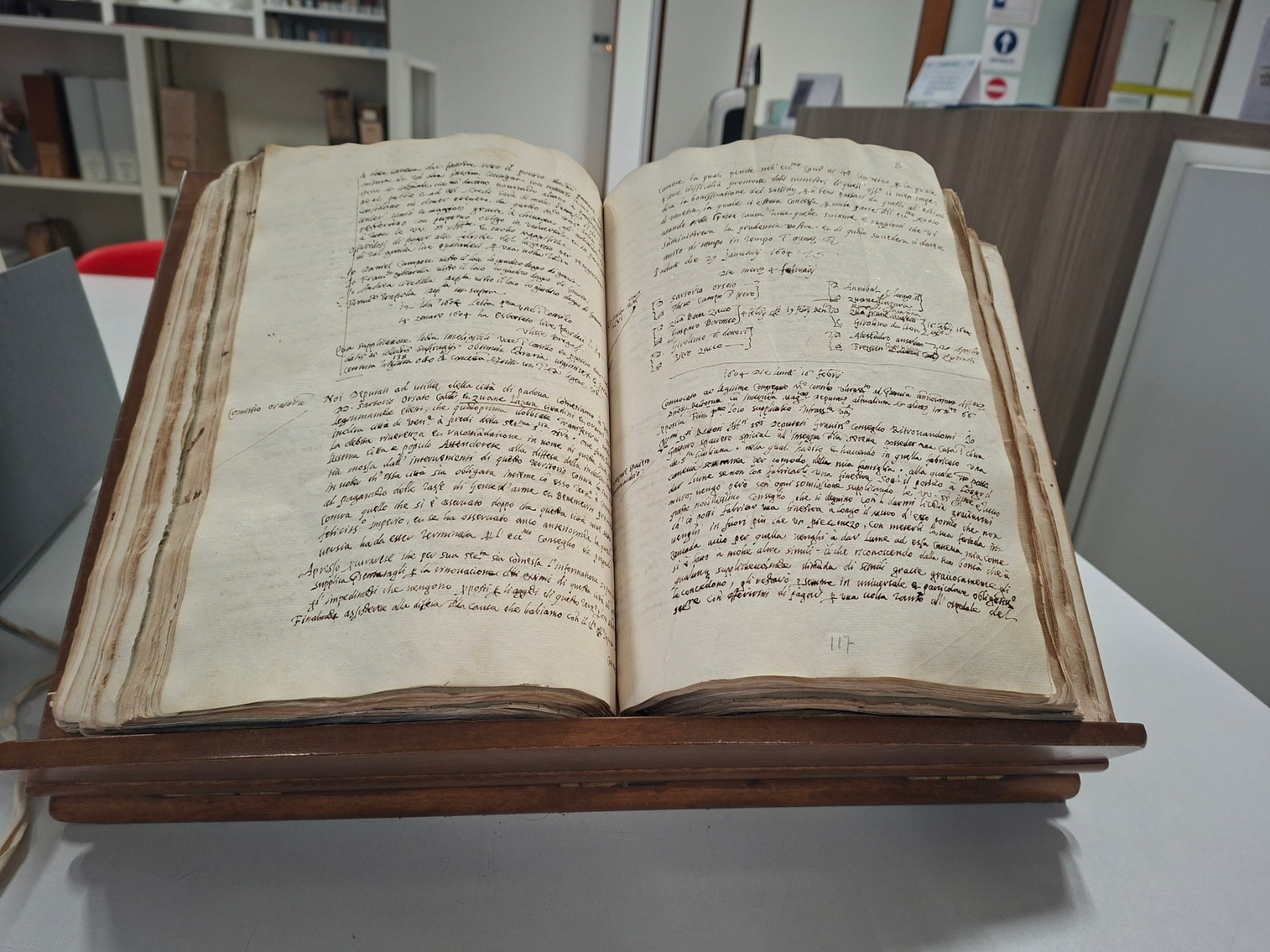
An original manuscript dated Monday 26 January 1604, preserved in the State Archives of Padua, documents the granting of a public privilege in favour of Bartolomio Veronese known as Abbondanza ‘for the production of pasta by means of his revolutionary mechanical invention’.
Yesterday, 26 January, in Padua, the presentation of the text that contains the rediscovery of the privilege (patent) and sanctions the epochal shift from manual to mechanical production. “A primary source of exceptional historical, cultural and scientific value, which makes it possible to place the production of bigoli and three other pasta formats within a structured institutional, technological and economic framework, already at the dawn of the seventeenth century,” said the institutional representatives present with the researcher author of the discovery, Paolo Caratossidis – president Cultura & Cucina / Eccellenze Venete.
The researcher
‘I was conducting research on an apparently marginal topic, almost hidden in the folds of history, a little-known subject but one that had long ignited a deep and abiding curiosity in me: the origin of Bigoli, the iconic pasta format that for centuries has been one of the most recognisable symbols of the gastronomic tradition of the Veneto region and, even more specifically, of the Padua area,’ the author of the discovery recounts. ‘What I initially imagined as a simple historical verification, a documentary confirmation of a consolidated tradition, gradually turned into something much more complex, profound and surprising. The story I found handwritten on these ancient pages is not just an answer to the questions I was asking, nor a confirmation of what I hoped to find: it is a layered, articulated narrative, rich in cultural, social, economic and symbolic implications. What emerges from this document does not in fact concern only a city, albeit a central and fundamental one such as Padua, but involves a much wider territory, destined to progressively expand beyond local borders, until it touches and goes beyond the geographical limits of the Veneto region, then the beating heart of the Republic of Venice and a strategic hub of knowledge, trade, culture and innovation’.
The fallout
The manuscript is an official public deed, drawn up by the city chancellery, recording a supplication followed by a resolution of the Council of Padua. The text explicitly mentions the formats: bigoli, menudelli, lasagne and macaroni.
The document does not merely describe a craft, but formally recognises a technical innovation, granting a five-year privilege that protects the invention and allows its development.
Dining and Cooking