
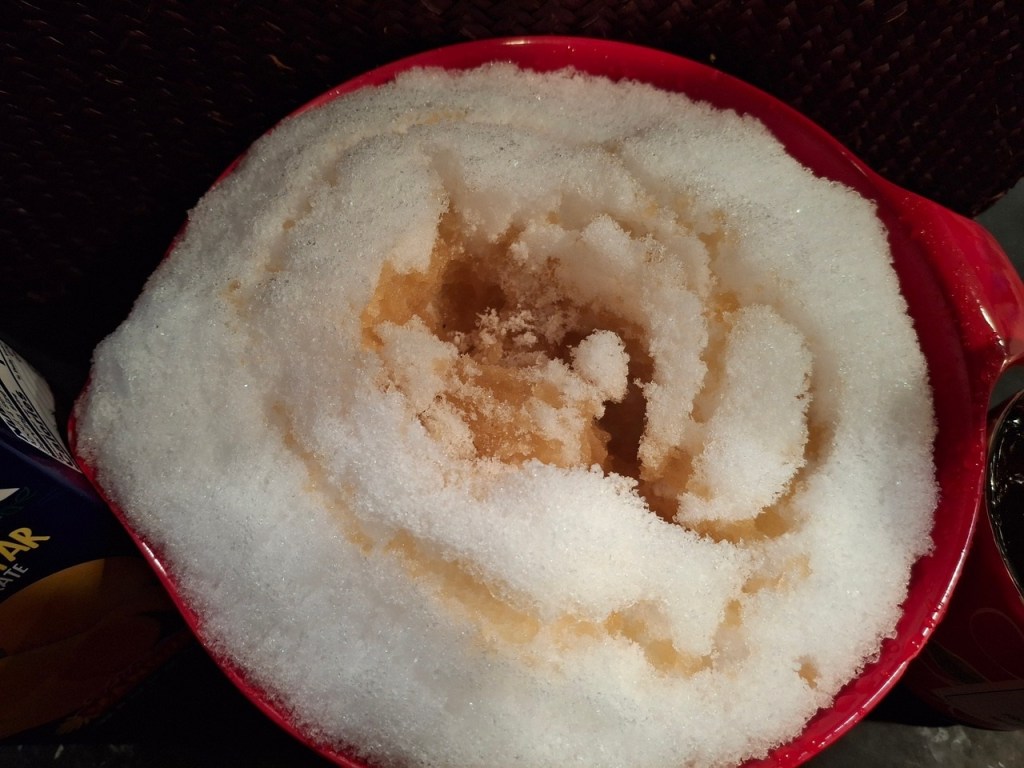
We knew it was coming — we knew it would fall — and fall it did. Hour after hour, inch after inch, white, fluffy, airy snowflakes by the bajillions. Those of us in north central Mass knew exactly what to do: check the generator, fuel the snow-blower, sharpen the snow shovels and then descend upon Market Basket, Hannaford’s, Price Chopper, Aldi’s with a sparkle in our eye and a touch of panic in our hearts.
I was coming back from Boston on Friday, and made a stop at Trader Joe’s in Acton, and you’d think the snow was already falling from the surging crowds loading up on pre-made meals. I picked up some fruit juice and the new “Sumo” orange — a wonderfully nubbly citrus fruit the size of a terrier’s noggin that’s aromatic and very zesty.
Still, two days to go before Snowmageddon 2026, and I figured that “Family Recipe Box” would move forward with part 2 of “First Time Cooking,” the sequel to last week’s column which asked the question: “What did you cook to feed yourself when you first fledged the family nest?”
However, once the snow began to fall, and the older child and I made a first pass on our long and hilly driveway, my mind wandered. That’s what happens after the first hour pushing, lifting, and shoving piles of fresh snow — so much snow. Makes you think of vanilla ice cream, sugar cookies, marshmallow fluff, blanched cauliflower. Wait – not blanched cauliflower!
Shoveling and snow rearrangement prompts this question: what else can you do with snow? I loved the Little House books and the marvelous “Sugar on Snow” that the Ingalls family made with warm maple syrup. And sno-cones — you can’t get through July and August without having at least a few of these!
We checked in with our friend Jay Johnson, Fitchburg realtor and owner of Jay’s Italian Ice. He was driving back from a property in Gardner and mused that “it’s too bad we can’t use this stuff — there’s too much stuff in the air.” I told him I’d been thinking of him and his business while experimenting with some juice and syrup recipes using the fresh snow. “Oh, I’d love that,” he said. “I’d have all the snow I need for Italian Ice – just store it in a freezer and use it all year.”
I urged him to check in if he had time to experiment with Italian Ice recipes using snow, and in the meantime, checked out recipes on-line. But first, exactly where does our region fit in the gauge of “Most Snowy Towns in Massachusetts”?
We are the champions
Fitchburg, Leominster and Gardner are considered the snowiest part of the state and our average annual snowfall is usually between 70 or 80 inches, but can go higher. The other high-snowfall region is west of us: North Adams and Pittsfield also get a lot of snow, but not like we do here.North Central Mass. Cities and towns are the champions of snow fall, snowdrift, snowpack, and snow storms.
I mean, we know we’re special in many ways, but in colossal snowfall, we are the tops. Why is this? Key factors include our higher elevations. This means temperatures remain below freezing more consistently than towns east of us, and those closer to the coasts. We are very hilly and far from the Atlantic, so we don’t get the warm coastal winds that usually transform snow into rainfall further east.
As the moisture moves from east (warmer) to west, it’s pushed higher into the atmosphere over the higher terrain and cools down, thus releasing more moisture. Welcome higher snow fall totals.
Recently, Fitchburg DPW Commissioner Nick Erickson released a detailed report on how the city prepares for heavy snowfall — including the complex recipe used by Public Works to create the “liquid treatment program.”
“We have two 10,000 gallon plastic tanks installed on a concrete pad,” he wrote on Friday. “The tanks have been plumbed up and each has been filled halfway. One tank is being used for a liquid brine consisting of de-sugared beet juice, salt, and water. This will be applied to roads for anti-icing (pretreatment) and de-icing (to help break up ice or hardpack snow).
“The other is being used for a liquid magnesium chloride brine with a corrosion inhibitor added. This will be used in trucks equipped with saddle tanks, which allow for the liquid to be sprayed onto traditional rock salt as it is being applied on roads. This reduces bounce and scatter, and helps improve the effectiveness of the salt at lower temperatures.
“We also plan to use the liquid magnesium chloride brine to pre-wet salt for trucks that are not equipped with saddle tanks. Last week we received our first 5,000 gallon delivery of the liquid beet juice brine. This week we received our first 5,000 gallon delivery of the magnesium chloride brine. More of both is on order and should be delivered next week.”
No, it’s not just salt anymore. The tools public works have for confronting massive snow dumps are sophisticated and gigantic in scale. So, as you are driving carefully over the roads, remember that every inch received requires a complex recipe to reduce the snow and ice. And all of these actions are further dependent on aging trucks remaining operational, supplies holding out, and the strength, determination and professional skills of our public works heroes.
Fruit Juice Slushy
INGREDIENTS:
½ cup juice (cherry, grape, cranberry, etc)
2-3 cups snow
DIRECTIONS:
Blend together in Nutribullet, or with a spoon. The cold juice will form slush, and this can be eaten with a spoon, or sipped. All snow recipes are most successful when you use fresh, fluffy snow, versus granular, packed snow.
Sugar on Snow
INGREDIENTS:
¼ cup maple syrup
2-3 cups snow
DIRECTIONS:
Gently heat syrup in the microwave for 20 seconds at a time until hot. Pour on snow, and mix together.
Snow Ice Cream
INGREDIENTS:
½ cup milk or light cream
¼ cup sugar or powdered sugar
1 teaspoon vanilla
pinch of salt
snow
DIRECTIONS:
Mix together in a bowl. Add snow a cup at a time, whisking as you go. Put in bowls and enjoy.
Sally Cragin would love to read your family recipes and stories. Write to: sallycragin@gmail.com
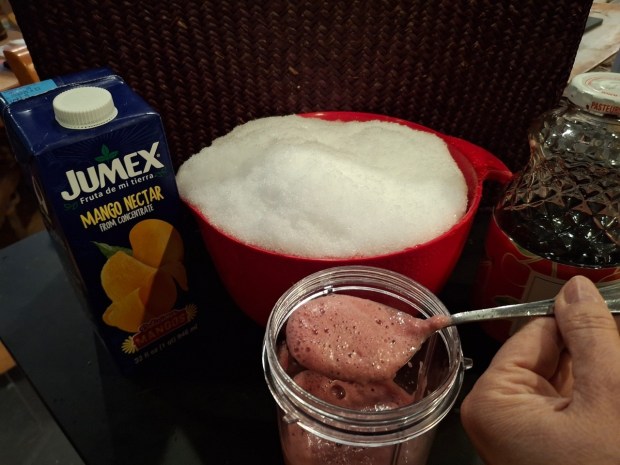 Mix together any fruit juice with snow and blitz. (SALLY CRAGIN)
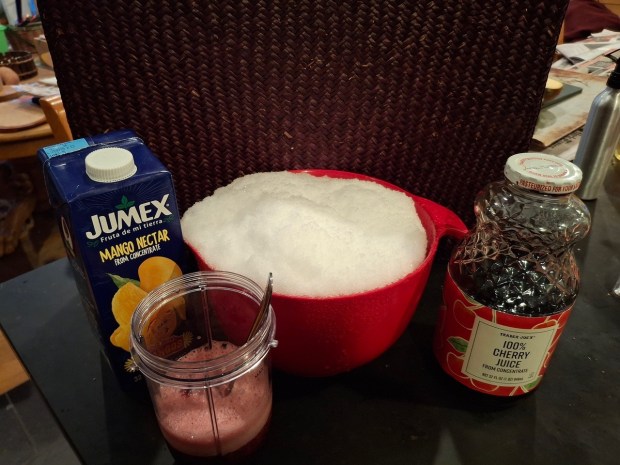 Snow and fruit juice makes for a slushy treat. (SALLY CRAGIN)
Dining and Cooking