
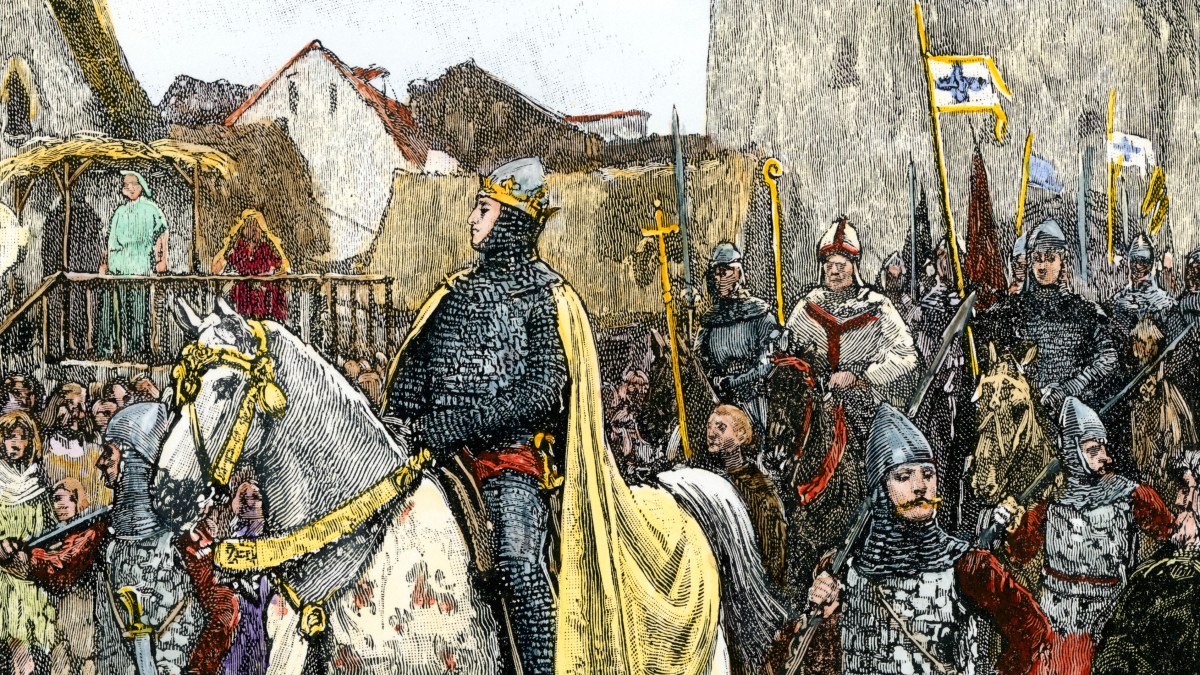
Letting the Normans take over the entire political, social and economic structure of our country was one thing. But the English drew the line at their fancy foreign cuisine.
The Norman Conquest is today considered the major historical faultline in English history. For the average Briton at the time it had less of an impact, a study suggests.
An analysis of medieval skeletons has found that in 1065 Oxford residents liked to eat soggy vegetables and boiled mutton and in 1067, having hit on this winning recipe, they saw no reason why invasion should change it. Neither, in the main, did they make many changes in the years that followed.
The research looked at isotopes locked in the bones of 36 skeletons, which give a signature of the food people were eating over the course of their lives. They also looked at residues on cooking equipment. They showed that only slowly, and very conservatively, could Norman trends be seen to be filtering into the lives of ordinary people — at least when considering the evidence of their diet.
Gradually, people did incorporate more chicken and pork into their diet but leafy vegetables, cereals, beef and mutton still predominated.
The study, published in the journal PLOS One, was an attempt to fill in some of the gaps in our understanding of the effects of 1066 and all that.
“The Norman Conquest is seen as an important threshold in English history,” said Elizabeth Craig-Atkins, from the University of Sheffield. “A lot of what we know comes from histories written by the elites. That’s not the whole story.
“One thing archaeology has the potential to do is write the lives of everyday people: people who were merchants, trading and going about their daily business while all these political events happened around them.” She said that looking at the bones of a section of society, rather than the writings of a small number, “brings a sense of humanity to the past”.
The skeletons in the study spanned the century before and after the conquest, with 13 estimated to be from the 11th century itself. The research is by necessity a small snapshot of the period but, the scientists said, the same is true of the scattered writings we have that inform much of our understanding. Dr Craig-Atkins said that it was possible in other towns, particularly in the north, there were more signs of post-invasion tumult.
Richard Madgwick, from the University of Cardiff, was a co-author on the paper. He was interested in the uniformity of the diet before and after, but surprised by how little it was interrupted. Using teeth analysis he and colleagues looked for signs people went short of food. There did appear to be more shortages around the time of the invasion, although nothing major. “It’s no surprise that when you are reorganising the economy and landscape there are going to be inconsistencies in food supply,” he said. “But we expected to see more impact on people’s health.”
Dr Craig-Atkins said that we have “preconceived ideas about the impact of the conquest” and while there was a shake-up of the elite, “ undercurrents of normality” continued.
Around them, the tectonic plates of geopolitics were shifting and Britain was set on a different trajectory — but for most people life went on.
“It was business as usual during huge events,” she said. “It’s all too pertinent to those of us trying to continue our jobs and lives during the pandemic.”
On the medieval menu
● Cabbage, boil until edible
● Mutton, boil until edible
● Onion, for taste
Dining and Cooking