
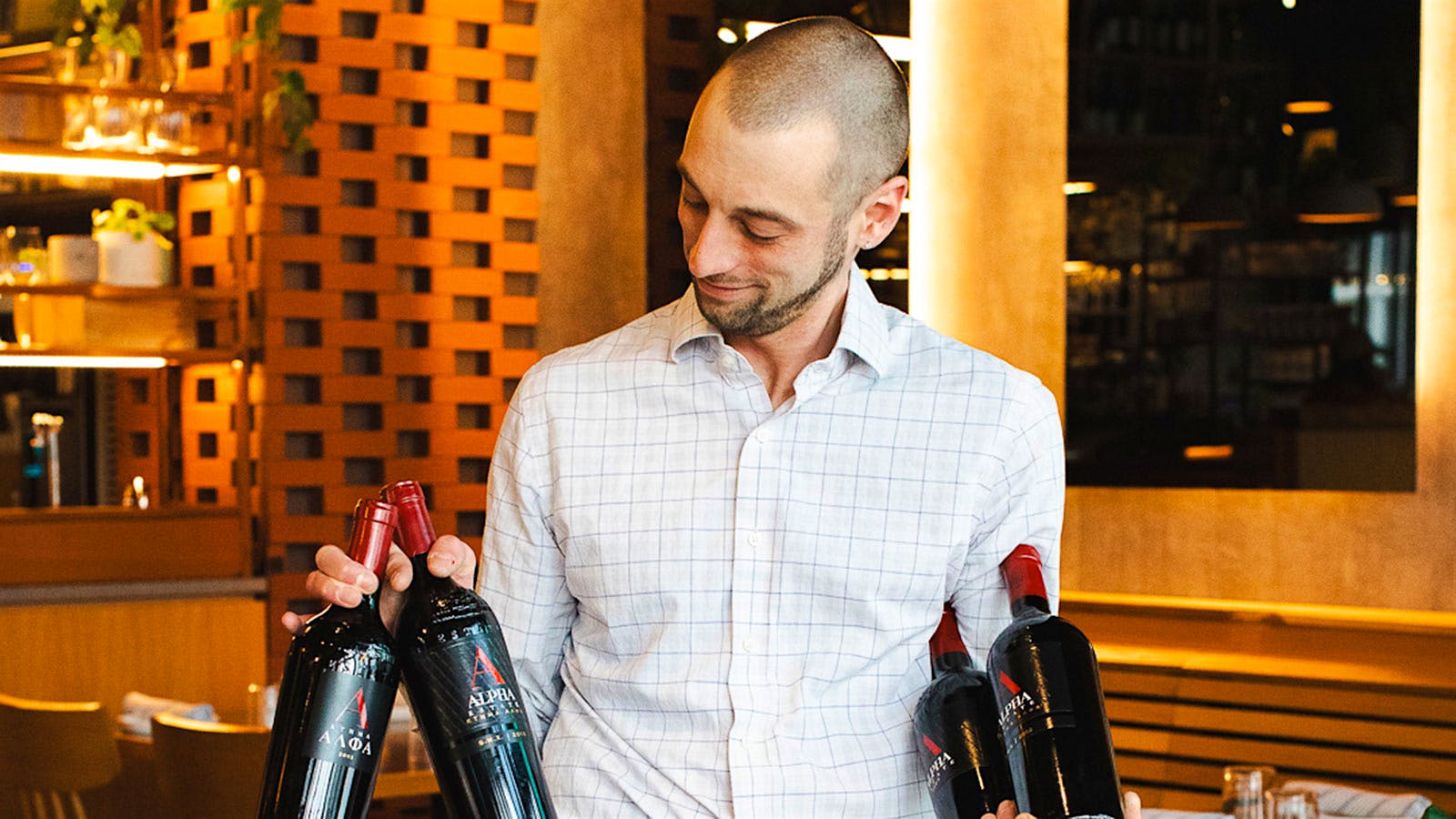
Thomas Kakalios is a true Midwesterner. Raised outside Minneapolis in a household where nearly every meal was cooked from scratch, Kakalios gained an appreciation for food made with love. At 18, he moved to Chicago to study philosophy at the University of Chicago, but after graduation, he took an unexpected path into hospitality, where he developed an appreciation for wine.
The first wine-centered position Kakalios landed was at Daisies, a popular Logan Square spot where he oversaw the wine list and staff education. From there, he joined Next, from the Alinea Group, and then Yugen, a now-shuttered Japanese restaurant, where he expanded his knowledge of sake.
Kakalios then took a sommelier position at the acclaimed restaurant Smyth, where he honed his palate and deepened his knowledge of food, wine and the guest experience. In 2023, shortly after the opening of Asador Bastian, a Basque-style steak house from chef Doug Psaltis, Kakalios signed on to grow the wine list into an Award of Excellence winner. Within a year, he lead beverage operations across all three of Psaltis’s Eat Well Hospitality’s restaurants: Asador Bastian, Mano a Mano and Greek restaurant Andros Taverna, also an Award of Excellence winner.
Kakalios sat down with Wine Spectator senior editor Aaron Romano to discuss the challenges and rewards of selling an all-Greek wine list at Andros Taverna, why people should be paying more attention to Greek wine and more.
From philosophy to wine—take me on that journey. How did wine win out over Socrates and Descartes?
Like most 18-year-olds, I thought I had it all figured out. I intended to go into law, and my counselor told me that the only things that matter for law school are your LSAT and GPA, so study something that you like. As somebody who comes from a strong literary background, philosophy was always something I was really passionate about.
I realized that while philosophy was something I was successful at, I didn’t want it to define my life. As I worked my way up the rungs in restaurants, I realized if you want to make a good living at it, getting a bottle of wine down on the table is a pretty strong strategy.
But philosophy winds up coming back in. Philosophy teaches you not just how to make an argument, but how to ask the right questions. For example, good food and good wine are two sides of the same coin—you can’t discuss one without introducing the other into the equation. Asking the right questions of a wine allows you to explore beyond the facts on the label and learn about the people, history, culture and traditions.
Was there an “aha” wine for you?
I was studying with a cohort for my certification exam and someone brought a Nicolas Joly Clos de la Coulée de Serrant 2006, an iconic French wine from the Loire Valley. There was so much going on, so many synapses firing, yet I’d never had a wine like that before.

Andros Taverna opened its doors in 2021. (Courtesy of Eat Well Hospitality)
Greece is not a wine region that is well-represented on wine lists. Why did you decide to devote the entire list at Andros Taverna to Greek wines?
When you’re there in Greece, the experience makes the case better than I ever can of just how superlatively the food and the wine go together. How do we not just offer Greek wine for the sake of having Greek wine, but compelling Greek wines that go toe-to-toe with not just wines from other Mediterranean countries, but Burgundy, Napa or Brunello? We have a lot of wine below the $100 mark, such as the Magoute Siasta Moschomavro or Argyros’ Atlantis Red Santorini.
There’s more to Greek wine than just one or two grapes. To showcase how far Greek wine has come, without sacrificing authenticity or its genuine identity, has been a cool story to share.
What are the challenges of creating and selling an entirely Greek wine list?
The amount of Greek wine entering the United States is fairly minimal. Even a large winery in Greece is not large by Napa standards; it takes money to export wine, and not all wineries have the infrastructure to do that. Let’s say I needed a Tempranillo replacement at Asador Bastian; there are literally hundreds of options available in Chicago. Whereas if I need an Assyrtiko replacement, there are far fewer options, so it requires much more creative problem-solving. We are still picky about who we bring in.
Greek wine is imposing and challenging even for sommeliers. It’s not something I’d expect our guests to know. With a few questions, we can highlight several wines on the menu to find the right bottle that will appeal to the guest that evening. It makes our jobs almost like that of a translator. Because the guests don’t have many preconceptions, whatever message you want to give, so long as you can relay it effectively, it resonates. Everything going on in Greek wine means that if you’re adventurous and you’re willing to have that conversation with the wine team, you’re able to find a wine that you can enjoy.
Why should people pay more attention to Greek wines?
They’re delicious wines that you could afford to drink every night. There’s much more demand for Burgundy, Napa and Champagne, with less demand chasing Assyrtiko. The ceiling is much lower than it might be for a white Burgundy, but these vines in Greece can be two hundred years old. Take the Haritatos family, who’ve had theirs for eight generations. You realize how much effort and labor go into the wine. The patrimony behind them reinforces that these wines are undervalued, if anything.
Another reason is that the wines have more savory tones and can match different ingredients, providing a great foil and surprise. As opposed to falling back on your classic Sancerre, Chardonnay or Zinfandel references, Greek wines can highlight new elements of your favorite foods, just as using a different lens on a camera can make the same image appear better, worse, or just more interesting.
What are one or two Greek wines that are your go-tos for pairing with a variety of dishes?
In a world flush with Cabernets and Chardonnays, Xinomavro and Assyrtiko have such strong character that they stand on their own identity. They serve as great ambassadors for Greek wine.
Xinomavro from Northern Greece is one of my favorites. I’ve recently come across more and better examples, such as Kir-Yianni Ramnista or Alpha Estate’s Ecosystem Reserve Vieilles Vignes, both from Macedonia. I wouldn’t use Xinomavro as a Swiss Army Knife, but it goes well with hearty foods. I grew up in the Midwest with those kinds of dishes, and that’s exactly the type of food you get in Northern Greece. Having a red like that, powerful yet elegant, can highlight many elements of what’s going on in my kitchen.
Assyrtiko has many compelling aspects. I often analogize it to a gem because it has many facets. If somebody likes the fruit qualities of wine, there are a lot of citrus zest and stone fruit elements. There’s also usually no shortage of minerality, be it oyster shell or sea spray tones. While traditionalists don’t use oak, Assyrtiko can be made with oak, adding another layer of versatility.
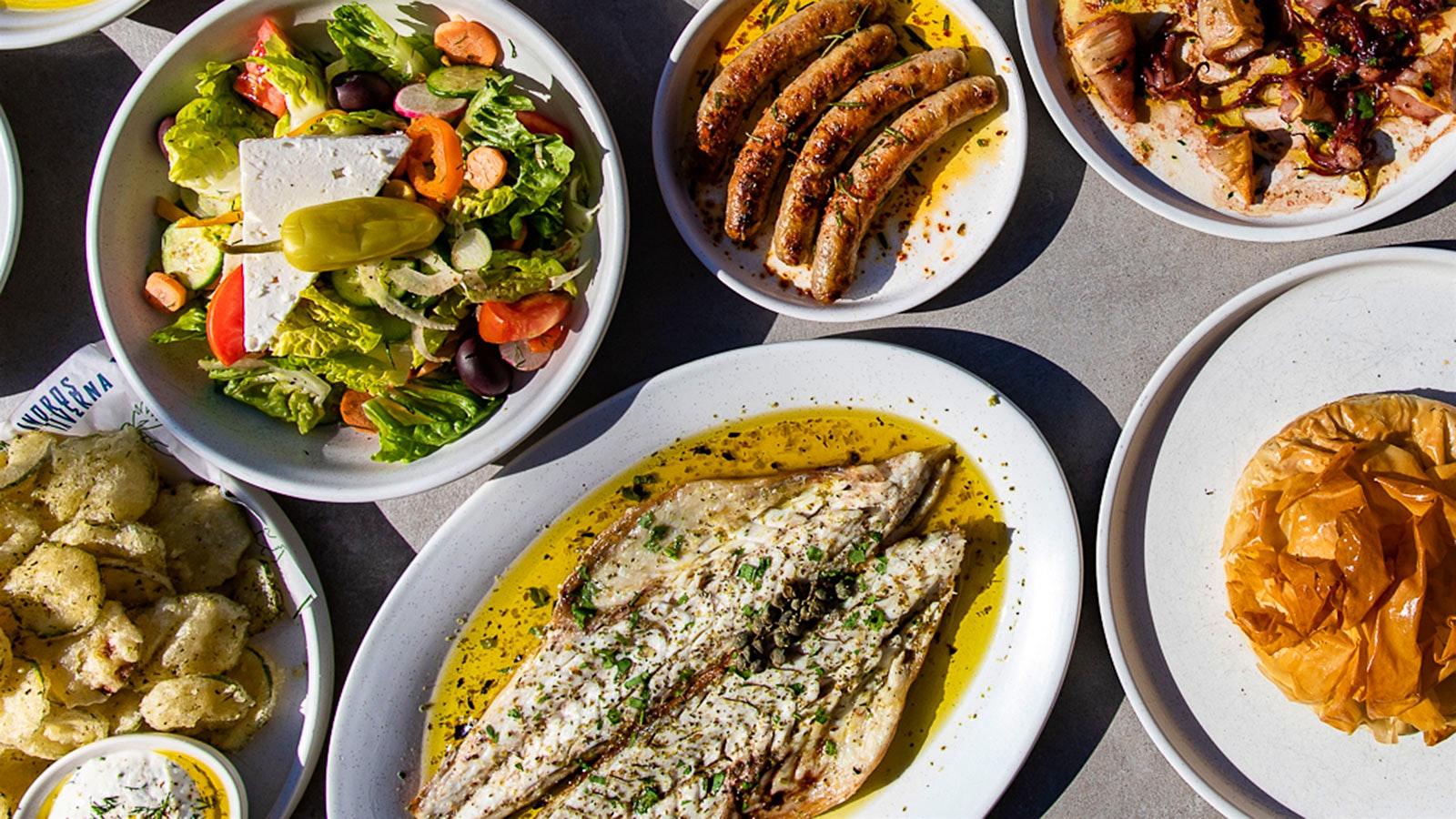
Greek wines are a “great foil and surprise” for many favorite dishes, says Kakalios. (Courtesy of Eat Well Hospitality)
Which Greek wines are good proxies for more familiar names like Cabernet or Chardonnay?
I’ll answer with the caveat that everything has an asterisk. Greece is still figuring out how it plays into the modern wine scene with its traditional varieties and approaches.
Xinomavro has the structure, elevated tannins, acid and earthy tones that speak to a Bordeaux drinker, or perhaps even a Nebbiolo drinker. For white wine, Malagouzia is known as a chameleon grape. When done in an unoaked style, it could appeal to someone who loves Sauvignon Blanc for its bright citrus tones, elevated acidity and crisp finish. But it can also be made authentically with oak, with that kind of roundness, generosity and toast, which would be in the wheelhouse of a Chardonnay drinker.
Is there a wine on the list that you didn’t expect guests to fall in love with?
The wines from Zafeirakis, in Thessaly, Central Greece. If you were to ask ten sommeliers or Greek winemakers what the top ten wine regions of Greece are, no one would say Thessaly. It’s an area known for quantity over quality—more for its crops than for viticulture, especially not for high-end viticulture.
Christos Zafeirakis—I term him the prophet in the wilderness, because you would never look for quality wines in this neck of the woods. But he has this laser-like attention to detail and unwavering commitment that aren’t always associated with Mediterranean cultures. He champions the grape Limniona, which is not to be confused with another grape, Limnio from Northern Greece. It very much drinks like a Pinot Noir, and it’s something I would happily pour for lovers of Burgundy—it has these dark berry fruit, earthy forest floor, rose petal, hibiscus, even kind of fresh mushroom and truffle notes.
Beyond Greece, what wine region most excites you?
One of my against-the-current or less popular takes is that Champagne is very much one of the most dynamic regions. Despite the fact that the wines aren’t cheap, I still think they’re terrific values. The more I’ve been able to learn and showcase a region that many folks think they’ve already kind of figured out, the more exciting it’s been. It’s the opposite conundrum when it comes to Greece, so it’s cool to explore that side, the ‘dark side of the moon’ from that area.
Keep up with the latest restaurant news from our award winners: Subscribe to our free Private Guide to Dining newsletter!
Dining and Cooking