
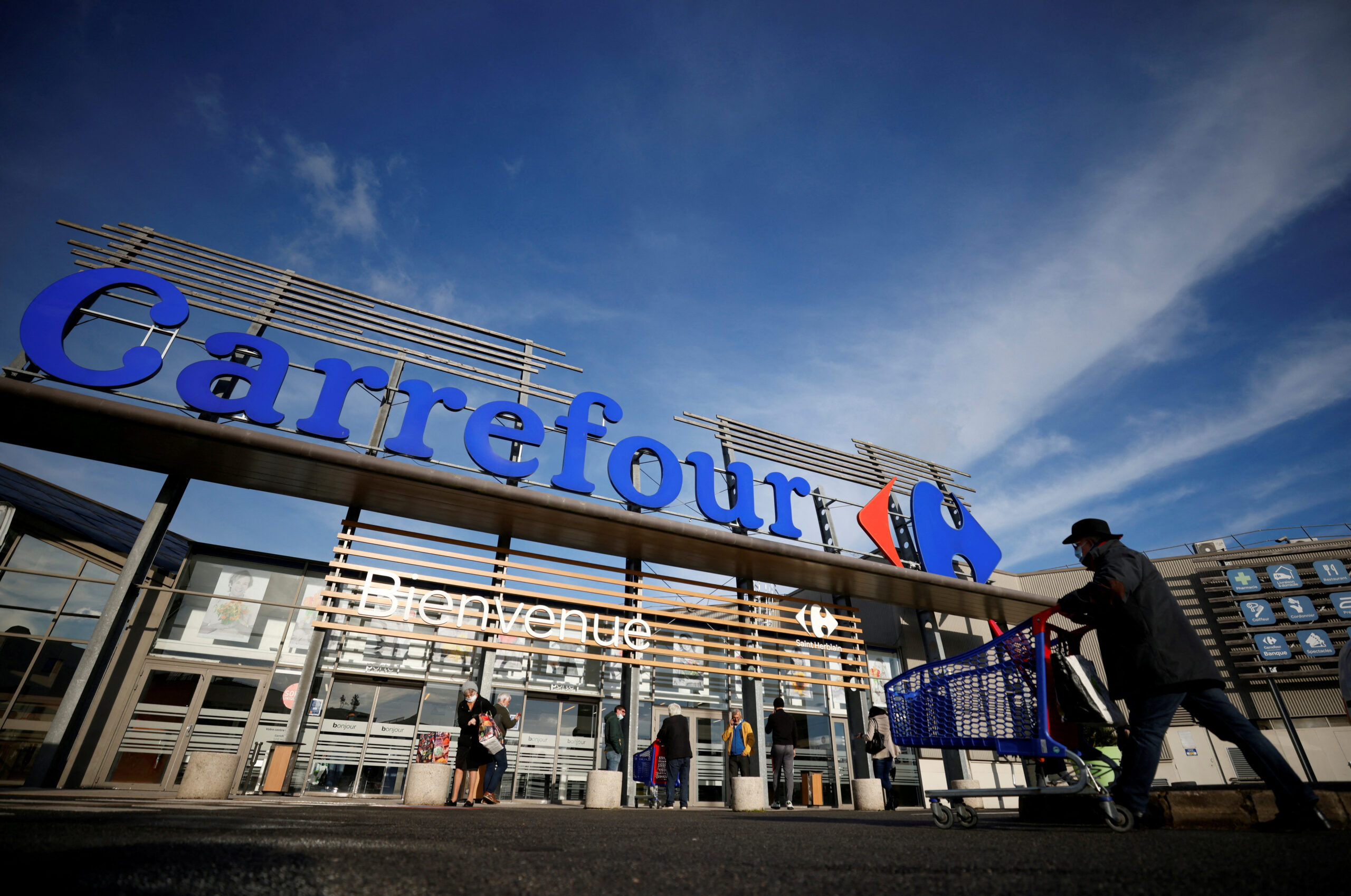
The planned entry of Carrefour into Ethiopia marks a defining moment in the country’s retail liberalisation drive, signalling a shift from decades of tightly controlled domestic trade toward a more open, competitive consumer market.
The French food retail giant’s move — its first supermarket footprint in Ethiopia — underscores growing investor confidence in Africa’s second-most populous nation and could accelerate competition, the formalisation of supply chains, and private investment across the country’s fast-expanding consumer economy.
For decades, the Eastern nation’s retail landscape has been dominated by informal markets, small family-owned stores, and state-influenced commercial channels. The arrival of the over 60 years old global, capital-intensive supermarket operator represents a structural break from that model and a test case for policymakers’ reform agenda.
Carrefour announced earlier in January that it will enter into a franchise and supply agreement with Queens Supermarket Plc, a subsidiary of Midroc Investment Group. Under the deal, 13 existing Queens supermarkets will convert to the Carrefour Market banner, while 17 additional stores are scheduled to open by 2028.
The first conversions are expected in the first half of 2026.
“This launch in Ethiopia marks another important step in the execution of our international franchise expansion strategy,” Patrick Lasfargues, Carrefour’s director of international partnerships, said in a statement, noting that the group surpassed 3,000 franchised stores globally last year.
Midroc said the partnership will combine the group’s operational expertise with local market knowledge to deliver wider product choice, improved standards, and competitive pricing for Ethiopian consumers.
Reform signal, not just store expansion
Carrefour is best understood as a signal of reform. Large-format food retail depends on stable regulation, predictable import rules, functioning supply chains, and sufficient consumer purchasing power. Entry by a global chain suggests policymakers are increasingly confident that Ethiopia can support more formal, organised retail structures.
The country historically restricted foreign participation in retail, wholesale, and import trade, viewing the sector as strategically linked to jobs, food security, and local enterprise. That stance began to shift recently.
In 2024, authorities opened dozens of previously closed sectors — including retail and wholesale trade — to foreign investors under defined capital and compliance thresholds, with further clarification issued in 2025 directives.
According to Euromonitor International, the regulatory shift removed a major barrier to entry for global retailers.
“Historically, foreign retailers faced restrictions due to government policies, which limited market entry,” the London-based market research firm noted. “However, this changed in 2024 when Ethiopia liberalised its investment regime by opening retail and wholesale trade to foreign participation.”
Christele Chokossa, a research consultant at Euromonitor, said the country’s scale and structure make it particularly attractive. “As the second most populous country in Africa, with over 135 million people, it offers strong growth potential in overall grocery retail,” she told BusinessDay in an email. Chokossa cited urbanisation, infrastructure improvements, and the dominance of informal trade as key drivers of modern retail expansion potential.
Demand fundamentals are strengthening
The timing of Carrefour’s entry also aligns with improving consumer fundamentals.
Data from Ethiopia’s statistical authorities show inflation has eased sharply, falling to single digits in December at 9.7 percent — the lowest level since November 2018 — and averaging about 13.3 percent in 2025, down from above 20 percent the previous year.
Disinflation improves real purchasing power and planning visibility for both retailers and suppliers.
Euromonitor projects that the country’s consumer spending will reach $134.3 billion in 2025 and $160.5 billion in 2026, up from about $110.2 billion previously and roughly $23.3 billion in 2019, reflecting urbanisation, income growth, and changing consumption patterns.
Yet modern retail penetration remains low compared with peers such as Kenya, Egypt, and Morocco — a gap that organised chains are targeting.
Africa expansion strategy at work
The Ethiopia deal fits into Carrefour’s broader Africa and franchise-led expansion model. The retailer operates hundreds of stores across sub-Saharan Africa and North Africa through partnerships, focusing on markets with rising urban populations and expanding middle-income segments. Franchise structures reduce capital exposure while leveraging local market knowledge.
For the nation, the Midroc partnership provides political and operational anchoring, helping navigate regulatory processes, supplier networks, and real estate constraints — factors that often slow foreign retail entries.
Risks remain material
Despite the opportunity, execution risks remain significant. Modern food retail depends on reliable electricity, cold-chain logistics, access to foreign exchange, and efficient transport networks. Ethiopia still faces periodic power shortages, forex constraints and administrative bottlenecks.
Although progress has been made, the country continues to have one of the largest energy access gaps on the continent, with about 60 million people — roughly half the population — lacking electricity access, according to 2025 reports.
Uchenna Uzo, a pan-African consumer market specialist, says cost structure will be decisive. “Modern retail is energy-intensive. Carrefour would have run detailed cost comparisons before entry,” he said. “If operating conditions prove manageable in Ethiopia, that will send a strong signal to other international retailers. If not, it could slow follow-on investment.”
The deputy vice chancellor at Lagos Business School added that the multinational is effectively an early mover there, unlike in more crowded markets. “The first 24 to 36 months will be critical. Success could accelerate further liberalisation and investor inflows; failure could reinforce caution.”
For now, Carrefour’s arrival stands as one of the clearest signals yet that Ethiopia is prepared to open its consumer economy to global competition — and test whether reform can translate into modern retail scale.
Bunmi Bailey
Bunmi holds a degree in Economics from the University of Lagos and has over eight years of experience in content writing and journalism.
Her career spans roles as a financial and business journalist at BusinessDay Media and TechCabal, and as Head of Research at SBM Intelligence, an Africa-focused market intelligence and strategic consulting firm.
She also served as Editor at Finance in Africa, a subsidiary of Businessfront and is currently Assistant Editor, Finance (Africa), at BusinessDay.

Dining and Cooking