
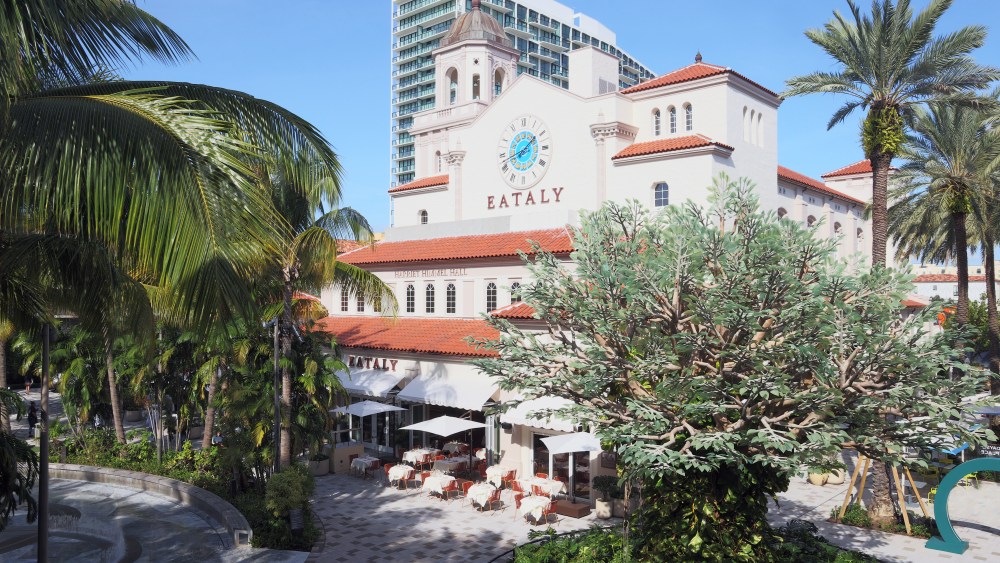
At CityPlace, the emerging hub of West Palm Beach, Fla., the new Eataly is unlike any other.
Besides being a place to dine and shop, it functions as a center for cultural activities. There’s a stage for music, theater, poetry readings, talks and book signings; an educational program to learn about Italian wine, cooking and lifestyle, and a staff steeped in knowledge about food and wine and ready to share what they know. Tell them what you’re cooking for dinner, they’ll recommend a Chianti or a pinot grigio, and provide a briefing on the grapes.
“The Italian art of living is our mission. It’s our brand statement. We want to deliver a truly authentic Italian art of living experience where the food is the connector — really a cultural experience,” Tommaso Brusò, chief executive officer of Eataly North America, said in an interview with WWD.

Tommaso Brusò
Most unique is the setting. Eataly at CityPlace is housed in a 30,000-square-foot former Mediterranean Revival-style church, constructed over 100 years ago with stucco walls and terracotta roofs. Inside, there’s a huge commissioned mural by artist Tristan Eaton titled, “The Italian Art of Living.” Eataly in CityPlace employs about 250 people, including the chef, cooks, retail associates, merchandisers and servers.
“With this church and this location, we are really able to deliver our entire lifestyle,” said Brusò. “It’s a place people enjoy, not only for the food but for the amazing experience, truly like in Italy. It’s the interior design, the music, the table settings, and the staff. We train our staff to engage with the customer, not just to talk about the product, but also about what’s behind the product, how it’s made, where it comes from…
“Say you want to buy a bottle from Italy. When you describe what you need for a dinner, perhaps with some friends or family, we ask, ‘what are you cooking?’ Then we show you the best wine and we [mention] the producer, where the wine comes from, why this wine is very famous in Italy, and why it’s better than some other wine. So you are not just serving some Italian wine. There’s a cultural element that you can bring to this dinner with your friends.
“Our people are able to deliver something more to the retail experience. The best compliment we receive is when people come into our Eataly store, talk to the chef, or to the gelato person. It’s not just how the food tastes. It’s the five senses. The music, the smell, the empathy from the people. I like to call what we do ‘a commercial consulate.’
“So when you think about how we occupy this former church, this infrastructure, it matches up perfectly with the Eataly philosophy. West Palm Beach is a project that consolidates our vision to create a lifestyle experience. There’s this big ‘wow’ effect that helps in terms of positioning. It’s a very high-end location.”
The huge mural inside Eataly at CityPlace in West Palm Beach, Fla.
It’s also a reflection of Eataly’s widening range of product and experiences in the U.S. Eataly, based in Monticello d’Alba, in the province of Cuneo, Piedmont, Italy, first arrived in the U.S. 15 years ago, in the Flatiron neighborhood of Manhattan, which integrates restaurant and café concepts, with food counters, specialty food stalls, groceries, a wine shop, as well as classes and demo spaces in a single, large, energetic setting. In its fullest expression, Eataly is referred to as a food hall or marketplace.
But in the past year, a more compact format was introduced in the U.S. — the Eataly Caffé. It’s currently in three New York City locations — Hudson Yards, Rockefeller Center, and on Lexington Avenue and 78th Street. Compared to a full-scale Eataly, which can be as large as 40,000 to 50,000 square feet in New York City or even 170,000 square feet in Rome, the Eataly Caffé occupies about 4,000 to 5,000 square feet.
“Inside you have the classic coffee bar, a pizza parlor, you can have a gelato, and there is a bit of retail selling. It’s not a full restaurant. You can eat in, but it’s quick service,” the CEO said.
All the products are under the Eataly label, while at the big Eataly food halls, there are multiple vendors on display. “The idea of Eataly Caffé is to offer the best of the Eataly experience in a quick service concept. It’s less of a destination and more a place where people stop by and have a cappuccino or a slice of pizza. We also have grab and go, like a lasagna already made.”
Brusò said Eataly Caffé could be rolled out to additional locations in North America, especially in the large cities where an Eataly marketplace operates, such as in Los Angeles, San Francisco or Dallas. But no locations outside New York City have been revealed yet.
In yet another initiative, last month Eataly launched a bar/restaurant format at Terminal 8 at John F. Kennedy International Airport with both sit-down and grab-and-go settings, as well as a wine bar and a retail market selling Italian products.
“This is also something we can roll out,” said Brusò. “We will also open inside Terminal 4 and Terminal 5 at JFK this year.”
Among the offerings are traditional pizza, artisanal pasta and regional specialties. The restaurant seats over 130 guests and the wine bar seats 45. Also served: coffee, soft drinks and other to-go type items, for those rushing to catch a flight. Eataly’s airport format expansion is part of the $19 billion, multiyear modernization of JFK.
Also last year, the company launched its Eataly private label in the U.S., Italy and other countries, with more than 100 stock-keeping units, including pasta, olive oil, balsamic vinegar and chocolate as well as fresh foods such as parmigiana and mozzarella cheese.
“This was the first time in the history of the company that we created our own line of products,” said Brusò. “It’s a signature line with a premium positioning.”
Eataly sets the ingredients and the packaging, though it doesn’t produce anything. “We don’t work with major vendors. We work with very small, high-quality vendors that come to us,” Brusò said. “On our side, we guarantee something exclusive, something with the highest quality you can’t find anywhere else.
“We are not competing with Whole Foods. We are not competing with restaurants. We are competing with entertainment,” the CEO added. “Food, of course, is our DNA. We import the best vendors from Italy, the best products, the best wine. This is a given. On top of that, we want to import Italian culture — authentic Italian culture — not Italian-sounding. We want to be sure that when people come to us, they find an authentic, full Italian experience.”
With each location, be it a café, a food hall or an airport restaurant, “We think about how we can be an authentic brand, show how Italian people live today, and create a place where you can feel Italy.”
Dining and Cooking