
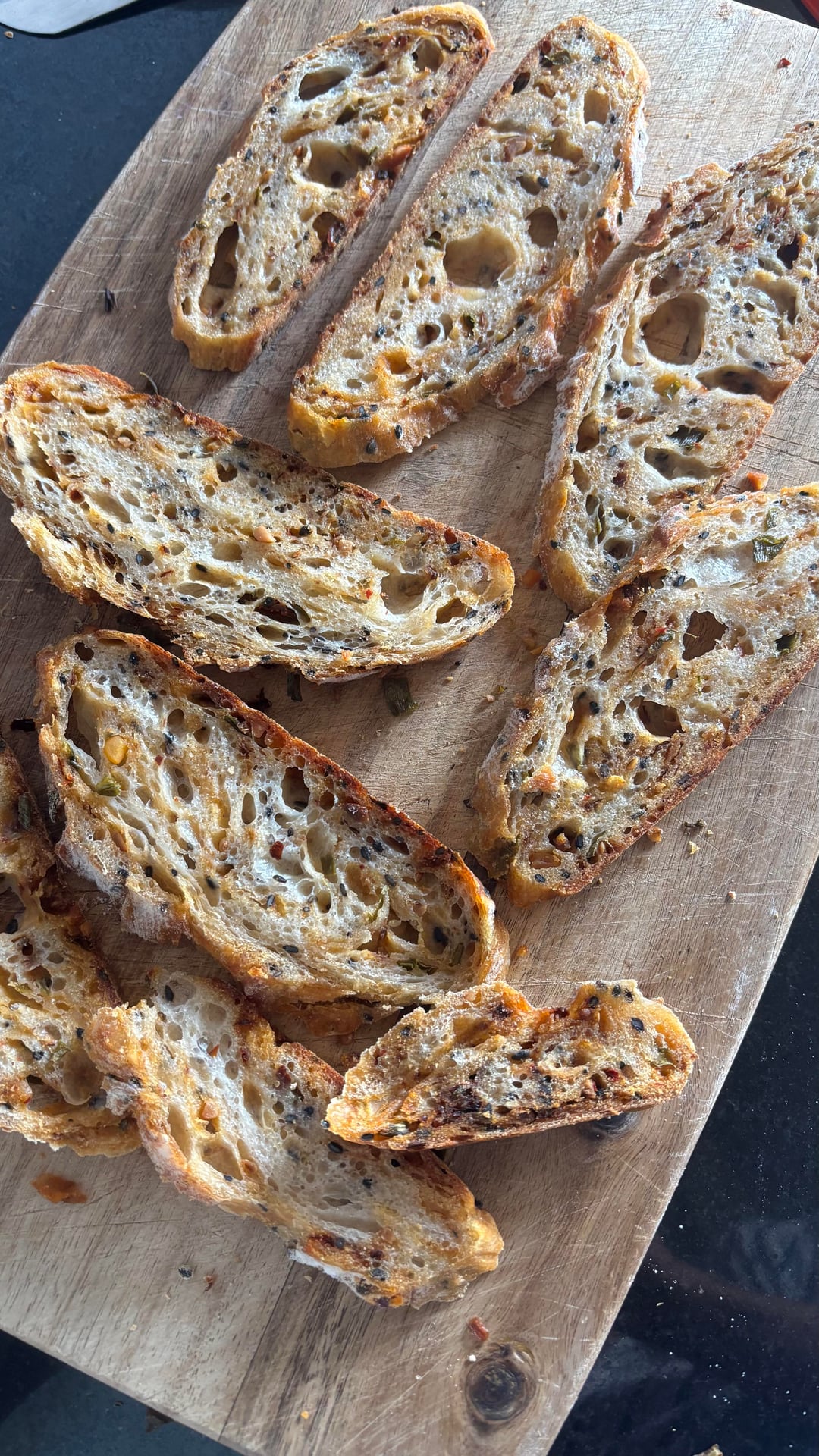
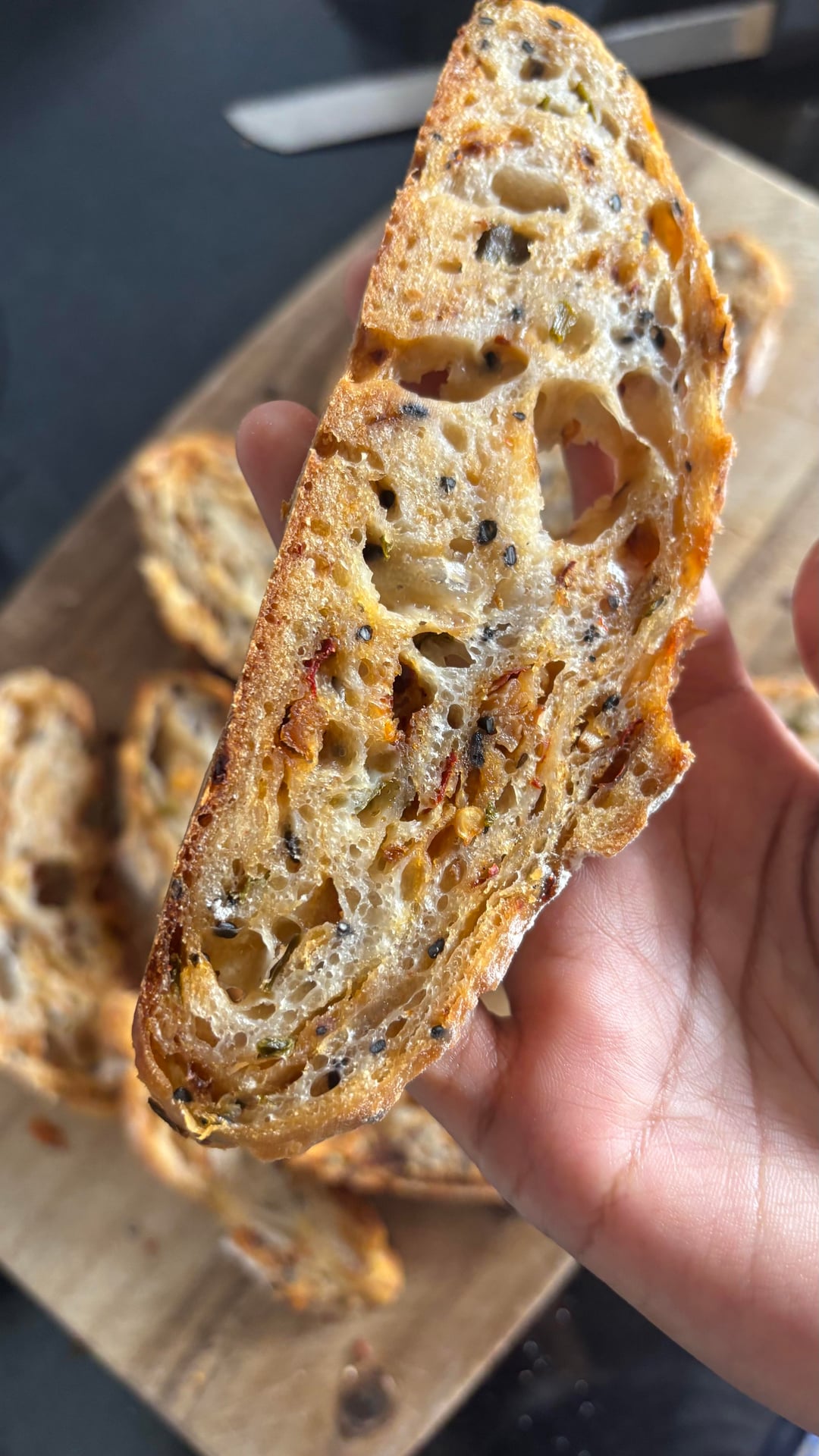
Hello! I made a Chilli oil + scallion sourdough but the crumb (even though it has airy pockets) is still gummy at parts and didn’t rise that much. For context, I live in hot tropical weather, so that always affects the bread and bulk fermentation. I did mess up the shaping because the dough was a little sticky and hard to handle, but please help me figure out what went wrong?
Recipe:
300g flour, 230g water, 60g starter
Process:
Mixed the flour, starter and water and rested for 45 minutes
Did a first set of stretch and folds after adding salt.
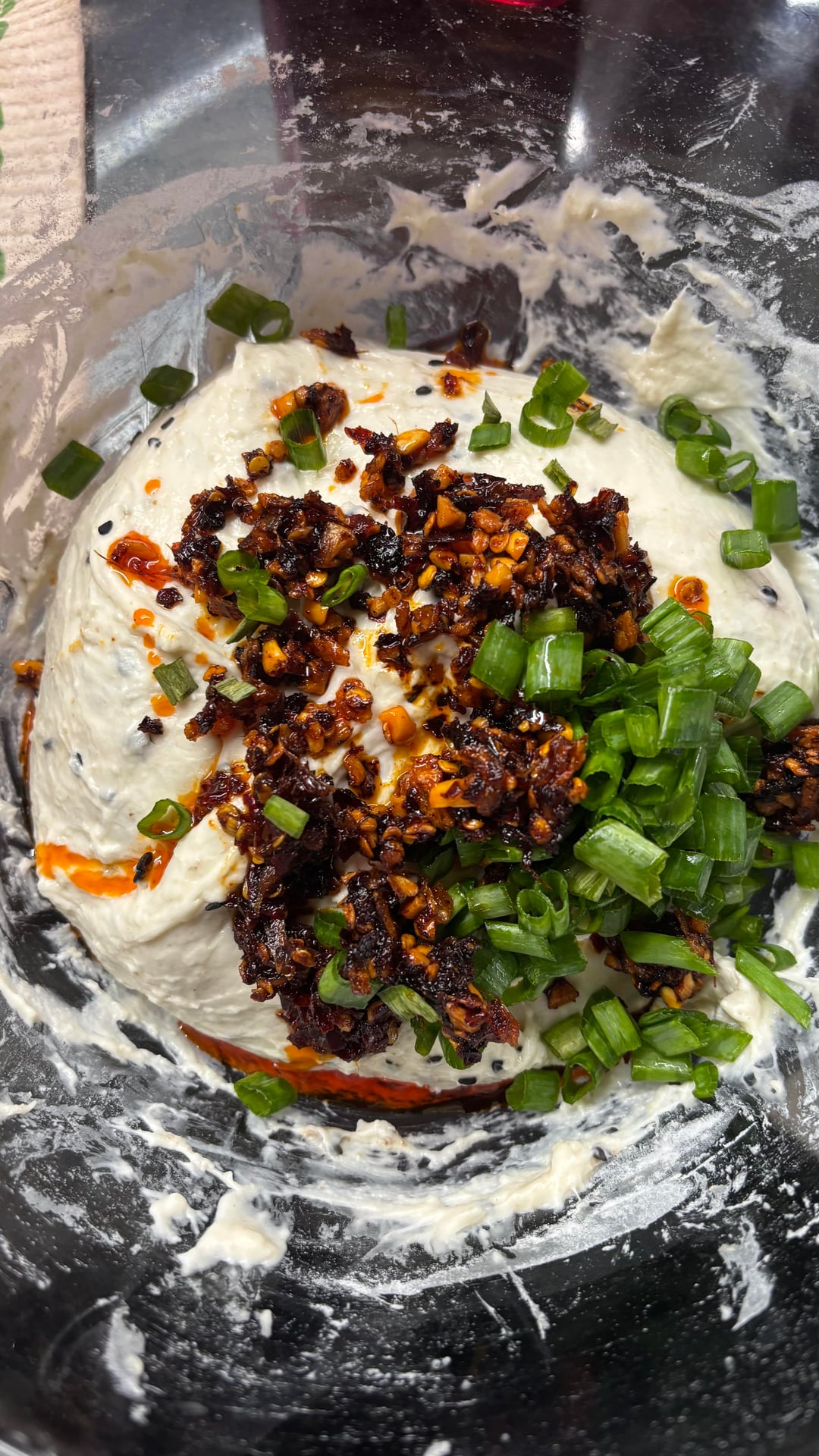
Did 2 sets of stretch and folds at half an hour intervals. After the second set, added spring onions, sesame and chilli oil and did a set of stretch and folds until it felt mixed
Bulk fermented for about 5 hours since the time it was mixed, since it’s hot weather I was worried it was going to overferment and skipped the cold ferment in the fridge
Tried my very best to shape it, ended up forming some kind of a ball shape and chucking it in the oven at 220 Celsius, covered. Baked for 45 minutes covered, then 10 mins uncovered
by Particular_Algae6456
14 Comments
Even though it looks delicious! I would suspect that your hydration was really high! You started with a 76% hydration and then added oil – that increases your hydration. Next time I would lower your hydration to about 65% – 67% which would be 195 – 200g water. Also 5 hours bulk fermentation would mean your kitchen is sitting at about 83F / 28C, in which I am jealous since it’s 32F / 0C here in a freak winter storm that’s hitting north Florida! LOL
Omg it looks delicious!!
Was it a chili oil that had garlic in it? I find garlic does funky things to my fermentation.
I made a sourdough with mozzarella balls that were marinated in oil and it didn’t rise well. I kinda assumed the oil may have weighed it down.
No advice to offer besides what’s already been said about the hydration but this looks so bomb!!! I will be stealing this idea to use up the scallion that’s been wilting in our fridge haha
Oil is difficult to mix into dough via hand kneading, you literally need to do a ton of slap and fold to incorporate oil properly.
Any sauce that has sugar and or fat will be difficult to incorporate as a inclusion, you first need to knead them into the dough first.
TBH it’s probably better to dip your toast into the hot chilli oil then to put them into your dough.
I recently had a similar experience with a croissant loaf, so I dug around a little. It seems like oil in general interferes with the ability of the dough to form a strong gluten network. This means that the dough will be more brittle and it decreases its ability to hold air. So, a lower rise is expected or at least those big baloon rises are harder to pull off. Apparently it helps to incorporate the oil later. This is probably even worse for chili oil, as it’s liquid from the start, much more so than butter. See: [https://www.theperfectloaf.com/what-does-butter-do-to-bread-dough/](https://www.theperfectloaf.com/what-does-butter-do-to-bread-dough/)
Although: your loaf does look delicious and my croissant loaf tasted amazing so I think it’s fine 🙂
I was just thinking this looked like lovely biscotti until I saw the title 🤣 Looks delicious either way. From my understanding oil slows down fermentation by a lot. (Found this out after my attempt with sourdough sandwich bread that used olive oil, still decent but a little under proofed) It would probably work better to delay adding the inclusions until later in BF that way the gluten development gets a head start. This makes me want to try it!
Your loaf still looks good but having just done a few chili oil infused loaves myself I can echo what others have said and confirm that oil (or other fats) basically keeps a slippery surface between the layers of dough as it expands so the dough around the layer of oil has nowhere to build gluten strands to to form around it. Also if your chili oil has garlic in it that can also put off gases that interrupt the fermentation process.
I’ve found that if you’re going to add in inclusions that can hurt the rise like oil, garlic, cinnamon etc, you should do it after bulk fermenting right before shaping so that your dough has as much time as possible to build it’s strength up before you introduce something that weakens it. For me that means when I get it out of the BF container I basically stretch the dough as wide as I can into like a 12×15 rectangle and then spread out the inclusions evenly and then fold and roll the whole thing back up into a loaf before dropping it into a banneton for it’s second rise. I do all of mine as a cold proof and it seems to come out fairly well.
This was the last chili oil loaf I did at roughly 70-ish percent hydration give or take the 30 or so grams of chili oil I swirled in. Only had one small pocket where the oil was too concentrated in one area but otherwise it came out flavored well without disruptioning the crumb.
https://preview.redd.it/l5tle3mv18hg1.jpeg?width=2268&format=pjpg&auto=webp&s=70c678cebe90cd901e7ce650c8083a786815e8fc
Are you a seasoned baker and have experience with high hydration dough? If not, I would suggest lowering the hydration level or changing the methods you use to build gluten. Here are some other suggestions:
– Too much oil and very high hydration makes gluten development difficult.
– You might want to chill the dough in the fridge between stretch and folds.
– Colder dough will also be easier to handle when so wet for shaping as well.
– Try some more flour while shaping if it’s very wet.
– Try lamination and/or coil folds.
– Lower amount of inclusions until you are comfortable.
– Turn it into a focaccia instead of a boule.
I’m sure roasting these can transform them into tasty sourdough chili oil crisps or crackers.
I think the hydration level was a bit too high for your skills, which might have affected the shaping. It’s quite challenging to shape such a sticky dough, so there wasn’t much oven spring, possibly due to the lack of tension and a bit of underfermentation, as indicated by the large air pocket.
Next time, try adding the oil while shaping, it’s a great way to create a swirl design.
Additionally, I’m not entirely sure about the baking time and temperature. Oven spring typically occurs in the first 15-25 minutes, so there’s no need to bake it for 45 minutes covered. You might want to try 25 minutes at 230°C covered, followed by 20 minutes at 210°C uncovered, to achieve a nice browning and ensure it’s cooked through properly.
I don’t have anything helpful but I need to know…. Did that taste gorgeous? Cos my goodness…. Looks awesome
I don’t know but it looks delicious AF